Azerbaijan - Where East & West meet.
Tours in Azerbaijan are your meeting with one of the beautiful, amazing, and colourful places in the Caucasus. This is a mild climate, sea and sun, thousands of coastal lights reflected in the black mirror of the Caspian, the old city of the medieval era, incredible views of picturesque nature, and, of course, the joyful openness of the Azerbaijani people who are ready to share all the advantages of the national culture, including excellent cuisine.
Visa upon arrival at international airports of Azerbaijan can be obtained only by citizens of Turkey, Israel, Qatar, Oman, Saudi Arabia, Bahrain, Kuwait, Japan, China, South Korea, Malaysia, and Singapore. For citizens of Russia and the CIS (except for Turkmenistan), a visa is not required for Azerbaijan. Citizens of other countries must obtain a visa prior to arrival through the consulates of Azerbaijan in their country or issue an electronic visa through travel agencies. To apply for a visa, contact the managers at least 4 weeks before arriving in Azerbaijan.
Local currency: Manat.
The recommended currencies for exchange are USD or EUR.
Where to exchange currency: upon arrival at the airport, the guide will provide accurate information on where and how to exchange cash for local currency.
Availability of ATMs: only in large cities.
Credit cards are accepted only in large cities.
The firm reserves the right to change the order of visiting excursion objects while keeping the program as a whole. The company also reserves the right to change the cost of the tour, provided that notice is given in time.
Dear guests, please send inquiries for individual tourists and tourist groups.
Bibi-Heybat Mosque (Azerbaijan's Bibiheybət məscidi) is a mosque located on the shore of Baku Bay in Azerbaijan. The existing structure, built in the 1990s, is a reconstruction of the mosque of the same name, originally built in the 13th century by Shirvanshah Abu-l-Fath Farrukhzad and destroyed by the Bolsheviks in 1936 during the fierce anti-religious campaign across the USSR. In addition to the mosque, the Bibi-Eybat complex includes tombs of revered people, including the grave of Ukeima Khanum, a descendant of the Prophet Muhammad. Before its destruction and again today, it has been a spiritual center for Muslims of the East and one of the significant monuments of Islamic architecture in Azerbaijan. The mosque was once visited by Abaskuli-aga Bakikhanov, Alexander Dumas, and Khurshudbanu Natavan. In the past, the local population called it "the mosque of Fatima", the same name used by Alexander Dumas when he described the mosque after visiting it in the 1840s.
Very often, Icheri Sheher is called a fortress because it is surrounded by a well-preserved fortress wall. People lived in the territory of Icheri Sheher in the Bronze Age, and by the 8th-11th centuries it was completely populated. Behind the walls are many unique monuments: the palace complex of the Shirvanshahs with a burial vault, a sofa, and a mosque; Gyz Galasy (the Maiden's Tower); mosques and minarets; and the remains of caravanserais and baths. The buildings of the old fortress have a special character. Because of the lack of space, structures were erected wall to wall from ancient times. There are no gardens, the yards are extremely small, and they are separated by threads of narrow streets, lanes, and dead ends. When the Shirvanshahs moved their capital from Shemakha to Baku in the 15th century, massive construction began in Icheri Sheher. During this period, the pearl of the fortress, the Palace of the Shirvanshahs, was built. It should be noted that Baku in the 17th-19th centuries did not extend beyond the boundaries of Icheri Sheher. The palaces of the rulers and residential quarters were located here. From 1747 to 1806, it was the capital of the Baku Khanate. Only after the beginning of the oil boom did the city begin to expand beyond the boundaries of Icheri Sheher. The fortress wall itself is also of interest. Once Baku had two walls separated by moats, but at the beginning of the 19th century the city grew so quickly that the outer wall had to be demolished. Only the inner wall remained. It has 25 towers and 5 gates. It is said that in the 1930s there were more than 900 buildings in the fortress, and by the beginning of the 21st century only half remained.
The Temple of Eternal Fire - Ateshgyah - is well known practically all over the world. It is located 30 km from the center of Baku in the suburb of Surakhany. This territory is known for such a unique natural phenomenon as burning natural gas outlets, where underground gas coming to the surface contacts oxygen and ignites. The temple in its present state was constructed in the 17th-18th centuries by the Baku-based Hindu community related to Sikhs. However, the history of the temple is even longer. From time immemorial, this was a holy place of Zoroastrians - fire worshippers - who attributed mystical significance to the inextinguishable fire and came there to worship the relic. After the introduction of Islam, the Zoroastrian temple was destroyed. Many Zoroastrians left for India and continued their worship there. But in the 15th-17th centuries, Hindu fire worshippers who came to Absheron with trading caravans began making pilgrimages to Surakhany. Indian merchants started the erection of the temple. The earliest temple part is dated 1713, while the latest, the central temple-altar, was built with the support of merchant Kanchangar in 1810. During the 18th century, chapels, cells, and a caravanserai were added to the central part. Carved inscriptions in Indian lettering can still be found there. In the early 19th century, the temple acquired its present-day appearance. Ateshgah is a pentagonal structure with a castellation and entrance portal. In the center of the yard stands the altar-sanctuary, executed in the form of a stone bower, with several small towers at the corners. In the center of the altar is a well from which "eternally" burning gas once rose.
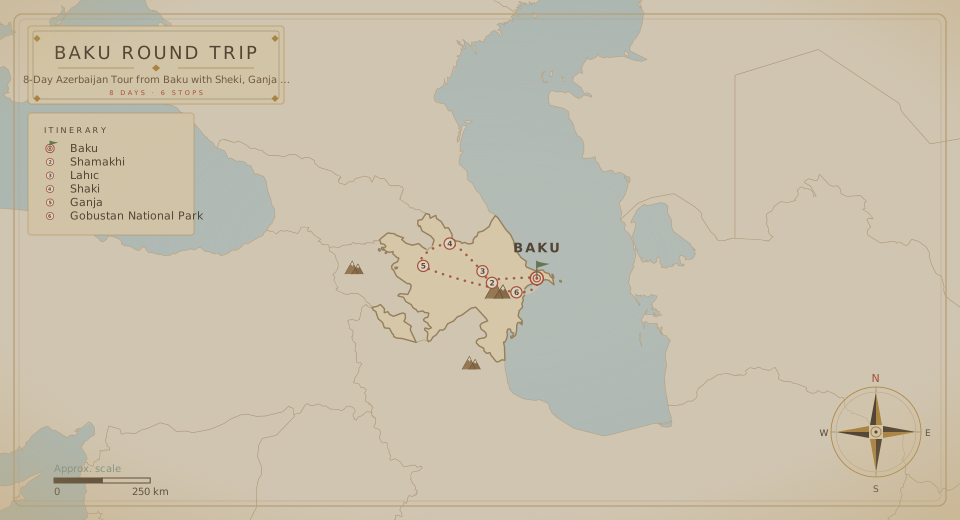
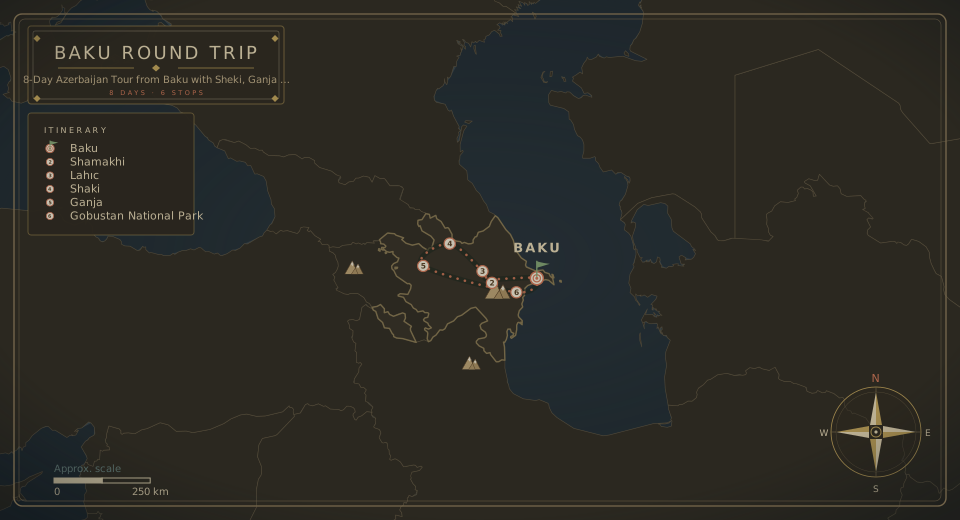
Shamakhi is an ancient Azerbaijani city that originated in the 5th century BC. In the 9th-16th centuries, it was the capital of the Shirvan kingdom and the residence of the Shirvanshahs, making it one of the most beautiful cities of the East. From the middle of the 18th century, it became the center of the Shemakhan khanate. For a long time, Shemakha was one of the most important points along the Great Silk Road. This was due to the fact that the city was one of the centres of the Shirvan-Absheron architectural school and the school of decorative and applied arts, including carpet making and miniatures. Located at the intersection of caravan routes, Shemakha was one of the major trade and craft centres in the Middle East and occupied an important place in the silk trade. As early as the 16th century, trade ties between Shemakha and Venetian merchants were mentioned. Azerbaijani, Iranian, Arab, Central Asian, Russian, Indian, and West European merchants traded in Shemakha, where they owned factories and had numerous silk-weaving, paper-spinning, and carpet workshops. The city became famous as the home of many prominent Azerbaijani philosophers, architects, scientists, and poets such as Khagani, Nasimi, and Sabir.
Diri Baba is a unique monument, a two-story mosque-mausoleum of the 15th century, located on the road from Baku to Shemakha in the village of Maraza opposite the old cemetery. For a long time, local residents believed that an imperishable saint named Diri-Baba was buried here. This monument is associated with many legends and mystical details, and since the 17th century it has attracted many pilgrims and ordinary travellers. The peculiarity of the structure is that the architect seems to have "built" the tomb into the rock, making it appear as if it is suspended above the ground. The tomb impresses with the strictness of its architecture and the purity of its lines, while against the irregular dark rock, the light and smooth surface of its walls stands out solemnly.
Mausoleum of Nizami Ganjavi: Nizami Ganjavi, born in 1141, was one of the most educated people of his time. He gained world renown as the author of "Hamsa" (Pyateritsy), in which five poems were combined, reflecting not only the high skill of the poet's pen but also his ethical and philosophical views. Most of Nizami's lyrics are devoted to love. Other world-famous works by Nizami are the poems "Khosrov and Shirin", "Leyli and Majnun", and "Iskender-nime". To this day, the mausoleum remains a place of pilgrimage and reverence for poets. It is located at the entrance to the city from the south-west side. The tomb is a modern monumental cylindrical structure made of red granite and carved in the manner of semicircular facets. Just below is the entrance, which seems tiny against the grandeur of the whole building. The name Nizami is carved in gold right above the entrance.
Juma Mosque: this Azerbaijani mosque is the oldest and largest in the Caucasus. According to legend, it was founded in the 8th century, when Shemakha was chosen as a residence by the Arab caliph. The exact date of its construction is 744, established as a result of research conducted by the geological commission that arrived from Tiflis, headed by Prince Shakuli Kajar. This date was determined by the Arabic inscription on the facade of the Juma Mosque, which indicates the 126th year of the Muslim calendar as the date of foundation. It was at this time that the construction of new religious buildings began in the territory of modern Azerbaijan. The Juma Mosque in Shemakha is the earliest mosque in the Caucasus after the Derbent Cathedral Friday Mosque, built in 734.
The Albanian church is located in the village of Kish. According to legend, this church is the first Christian church built not only in the territory of Caucasian Albania but in the whole of Transcaucasia. This place is also remarkable because burial places of people were found on the territory of the temple whose physical structure differs greatly from that of the current inhabitants of the region. In 2003, the church was restored with funding from the Norwegian government thanks to the personal efforts of Tour Heyerdahl. Next to the church, you can find a memorial bust in honour of the famous researcher, set there as a token of gratitude from local residents and the state.
Ganja is a city of Khans and Poets. According to legend, this fabulously beautiful city was founded where the traveler Maazid found a huge treasure - pots filled with precious stones and gold. The city was named after this incredible find and several centuries later became the second most important city in Azerbaijan. The famous Great Silk Road passed through Ganja, and today the city participates in a project to restore this ancient trade route. Many sights of Ganja are included in the UNESCO World Heritage List.
The Juma Mosque was built during the reign of Shah Abbas, which is why it is sometimes called by that name. It is the undoubted pride of Ganja. The building was constructed according to the project of the architect, astronomer, and vizier of Shah Abbas - Sheikh Bahauddin, a direct descendant of Nizami. The red-brick mosque is a squat, broad building consisting of a prayer hall divided into two halves for men and women, with a large screen and small adjoining rooms. The windows are decorated with patterned lattices called shebeke. Before the massive gates of the mosque once spread the market square, surrounded by benches and century-old plane trees. The roof is a huge metal dome with a diameter of 17 meters. The mosque has two high minarets crowned with towers for observing the surroundings. The minarets were restored and slightly modified in the 19th century. In the courtyard there was also a madrassa built at the same time, which was unfortunately destroyed during the Soviet era, though both facilities have now been restored and function perfectly. The Juma Mosque has one interesting feature: since Sheikh Bahauddin was an excellent astronomer, he applied his knowledge in construction. At precisely noon, the shadow falling on the western wall of the building disappears, indicating to the faithful that it is time for midday salah. To this day, the people of Gyandzha check the disappearing shadow, and its accuracy is absolute.
Chokyak-Hamam is a bathhouse consisting of two communicating rooms. In the centre of the large hall are a swimming pool and a fountain intended for relaxation, while the smaller room is designed for bathing. Built from red brick, the bathhouse has two large and five small domes. At the top of the large domes are half-domes that played the role of ventilation, with pipes dispersed through the space inside the walls, making it hot in winter and cool in summer. The sauna was heated with firewood. In the basement there were two steam boilers. Steam was fed into the halls through ceramic pipes that also passed through the walls and floor, circulating evenly and heating the entire room. This unique system of the 400-year-old bathhouse worked perfectly until 1963, and throughout those centuries the bathhouse remained very popular among the townspeople.
Dzhavadhan Mausoleum: not long ago, on the territory of the historical ensemble in the courtyard of the mosque, a tomb was built on the site of the grave of the fearless ruler of Ganja, Javadkhan, who died on January 3, 1804, while protecting Ganja from foreign invaders. In the 1990s, the remains of Javadkhan were moved here from the ancient city cemetery. Construction began in 2004 and lasted several months. During its erection, the builders adhered to the requirements of the medieval architecture school. The monument was opened in 2005 and took its worthy place among other monuments of the 17th century.
Goygol Lake: the road south from Xanlar winds up through the woodland picnic spots of Hacikand and onto a ridge with magnificent views of the dramatic Lesser Caucasus range, crowned by the distinctive cleft peak of Mt Kapaz. For now, the valley beyond is out of bounds. However, it contains one of Azerbaijan's most celebrated beauty spots, the gorgeous, forest-ringed Goy Gol (Blue Lake), which is slated to reopen to tourism as a new national park within the next few years. The distinctive rocky beak of Mt Kyapaz broke open in the 1139 earthquake and disgorged such a mass of rock that it dammed the mountain streams in several places. The result was a string of seven idyllic mountain lakes known as the "tears of Kyapaz". The most famous are Goy Gol (Blue Lake), formerly a popular sanatorium and camping retreat, and the more secluded Maral Gol (Deer Lake). Lesser-known Zali Gol (Leech Lake) and Sara Gol (Yellow Lake) are less appealing in name. The area is especially magnificent in autumn, when green forests are burnished yellow, auburn, and red like a pointillist painting rising from Goy Gol's still blue waters to Kyapaz's dramatic crown. The best views are part way to Maral Gol.
Mausoleum of the Imamzadeh: the mausoleum of Sheikh Ibrahim, erected on the burial ground of the son of Imam Mohammed Bagir, who died in the 6th century, is one of the main sights of the city. The mausoleum is also known as "Gay-Imam", a name derived from the blue colour of its dome, and "Imam-Paste", the traditional name for mausoleums where descendants of the Prophet Ali are buried. The mausoleum of the Imam-pahe is a Muslim shrine where hundreds of believers make pilgrimages every year. The complex includes a cemetery, small mosques, a caravanserai, and other structures, all later surrounded by a brick wall. The most beautiful feature of the ensemble is the dome of the mausoleum, lined with bright blue tiles. Against this blue lining stands out a dark blue stamped pattern. The dome is 2.7 meters high and 4.4 meters in diameter, while the mausoleum itself is 12 meters high. Although it was restored in the 19th century, it still looks rather old. The mosque at the mausoleum is still functioning.
The reserve is located 60 km from Baku, between the slope of the Great Caucasus Ridge and the Caspian Sea. Gobustan is an open-air reserve reflecting the life and everyday world of primitive people who lived here from the Mesolithic period until the Middle Ages. A special place is occupied by ancient rock carvings, pictograms, and petroglyphs. These ancient monuments of art reflect the worldview, economy, customs, and traditions of ancient Azerbaijanis. Gobustan is characterized by both male and female images. Men in the drawings are depicted as hunters with bows and arrows - tall, slender, belted, and muscular. The reserve also contains images of animals that lived here during the last 10 thousand years, including gazelles, wild goats, deer, wild pigs, horses, and lions. On the rocks there are also images of birds, fish, snakes, lizards, and various insects. The ancient rock carvings, with their wide variety of subjects, abound in compositional scenes reflecting many spheres of human activity, including the Azerbaijani dance of Yally, collective labour, hunting with various weapons, swimming on a Tigris-type boat, reaping animals, and attacks of predators on herbivores. Perhaps Yally was performed to the sound produced by the oldest musical instrument, Gavaldash, a stone with a deep resonating sound.