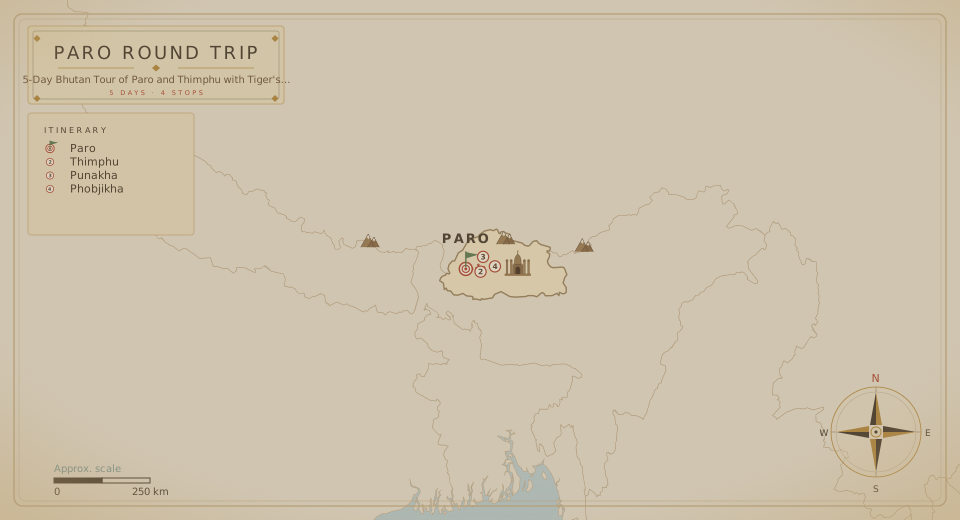
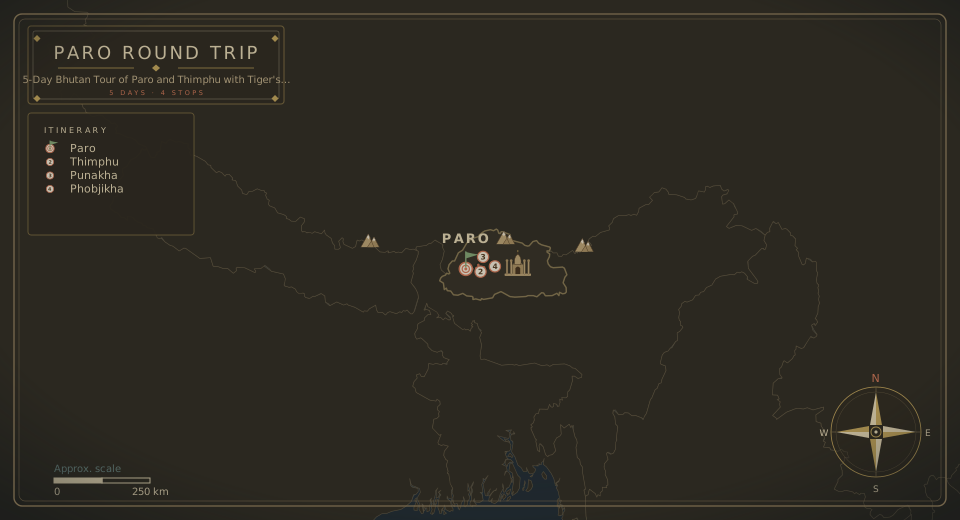
Druk Air or Bhutan Airline flights into Bhutan are spectacular. Whether flying along the Himalayan range from Kathmandu, over the foothills from Kolkatta, or following the coastline of the Indian Ocean en route from Bangkok, every Druk Air flight is memorable and offers incredible scenery. Get your camera ready! After arrival at Paro Airport and clearing immigration and customs formalities, you will be greeted by your guide and driver and warmly welcomed to the enchanting Land of the Thunder Dragon. You will then drive for about an hour alongside mountains, rivers, and fields of red rice to Thimphu, the capital city.
The magnificent 169-foot-tall bronze statue of Lord Buddha is located on a hilltop at Kuensel Phodrang, overlooking the Thimphu Valley. From here, you can enjoy a beautiful view of Thimphu city. It was built to celebrate the 60th birth anniversary of the Fourth King, His Majesty Jigme Singye Wangchuck, and to bring peace to the world. The giant Buddha statue houses more than 100,000 8-inch-tall Buddha statues of the same type. Construction began in 2006 and was completed in 2015 after almost ten years. The total cost of the entire project is well over US$100 million.
Dochu La Pass - 3,150 m/10,335 ft above sea level: About a 45-minute drive from Thimphu towards Punakha is a mountain pass at an altitude of 3,150 meters above sea level, from where you can see, on a clear day, some of the highest peaks of Bhutan. Before the construction of the beautiful 108 Druk Wangyal Choetens (stupas) in 2004, this mountain pass remained a sacred place blessed by the famous Buddhist saint Lam Drukpa Kuenley in the late 15th century.
Chhime Lhakhang is located on a gentle hilltop near the village of Sopsokha. You have to walk 20-30 minutes through beautiful terraced paddy fields and traditional farmhouses to reach the temple. The history of Chime Lhakhang is associated with the 16th-century Lama Drukpa Kuenley, who was affectionately known as the "Divine Madman" for his improper behaviour and outrageous ways of cleansing people from religious dogmatism and egoistic self-possession by exhibiting his intense desire for sex. He would often use the phallus as a tool to subdue evil spirits. Using the phallus was also intended to free up the social inhibitions enforced by socially established values. Today, one of the relics of Chime Lhakhang is a phallus. The blessing of the phallus is considered sacred, particularly for women who cannot conceive a child, as it is believed to bring fertility and the ability to bear offspring. Because of this belief, people like to call Chhime Lhakhang the "Temple of Fertility". Lama Drukpa Kuenley built a small black stupa on this hilltop to mark the burial site of demons he managed to subdue after chasing them from Dochula Pass, where the monsters were terrorizing travellers. Even today, this black stupa can be seen just outside the main temple. Lama Ngawang Chogyel, the younger brother of Lama Drukpa Kuenley, built the present temple in 1499 AD.
The historic Punakha Dzong was initially known as Pungthang Dewa Chenpoi Phodrang, meaning the "Palace of Great Bliss". It was built in 1637 AD by Zhabdrung Ngawang Namgyel, a Tibetan Buddhist master who came to Bhutan in 1616 and founded the nation-state of Bhutan, on a slight stretch of land where the rivers Phochu and Mochu converge. Punakha Dzong is the second-oldest and second-largest Dzong in Bhutan. The sacred wall paintings and major artifacts inside the Dzong, along with the intricate woodwork and architectural structure, display a fine example of Bhutanese arts and craftsmanship, which continues to influence Bhutanese architecture even today.
The National Museum of Bhutan is located in Paro, just above the Rinpung Dzong, the administrative headquarters of the Paro district. It is housed in an ancient watchtower called Paro Ta Dzong (Ta Dzong means "watchtower fortress"), built in 1649. It displays hundreds of ancient Bhutanese artifacts and artworks, including traditional costumes, armour, weaponry, and handcrafted implements for daily life. The collection at the National Museum preserves a snapshot of the country's rich cultural traditions.
Paro Rinpung Dzong (Rinpung Dzong means "fortress of the heap of jewels") was built by Zhabdrung Ngawang Namgyel in 1646 and established as the administrative and monastic centre of the western region. Today, the Dzong serves as the governor's office of the Paro district and the head of the district monk body in Paro. A great annual festival known as Paro Tsechu is held in Rinpung Dzong from the eleventh to the fifteenth day of the second month of the traditional Bhutanese lunar calendar, usually in March or April of the Gregorian calendar. On this occasion, holy images are taken in procession, followed by a series of traditional mask dances conveying religious stories, which monks perform for five days. After visiting the Dzong, take a short walk to the traditional wooden cantilever bridge called Nemeyzampa, where your driver will be waiting. This roofed wooden cantilever bridge is built in a classic style, and this type of bridge is called Bazam.
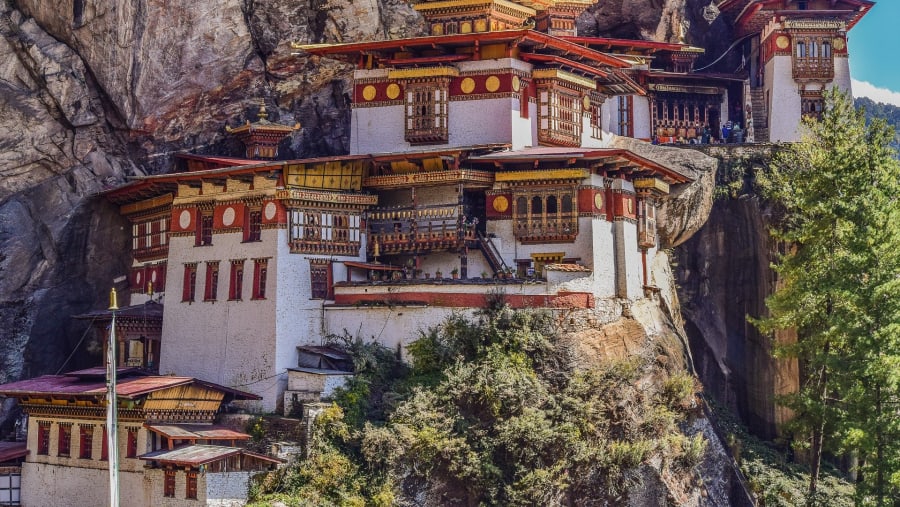
The history of Taktsang is associated with the visit of Guru Padmasambhava, known as Guru Rinpoche, the Indian saint who came to Bhutan and introduced Tantric Buddhism in the 8th century AD. It is believed that Guru Padmasambhava flew into the cave from Kurtoe Khenpajong in eastern Bhutan, riding on a tigress. It is not only considered one of the most sacred pilgrimage sites in Bhutan but also a must-visit place for tourists.