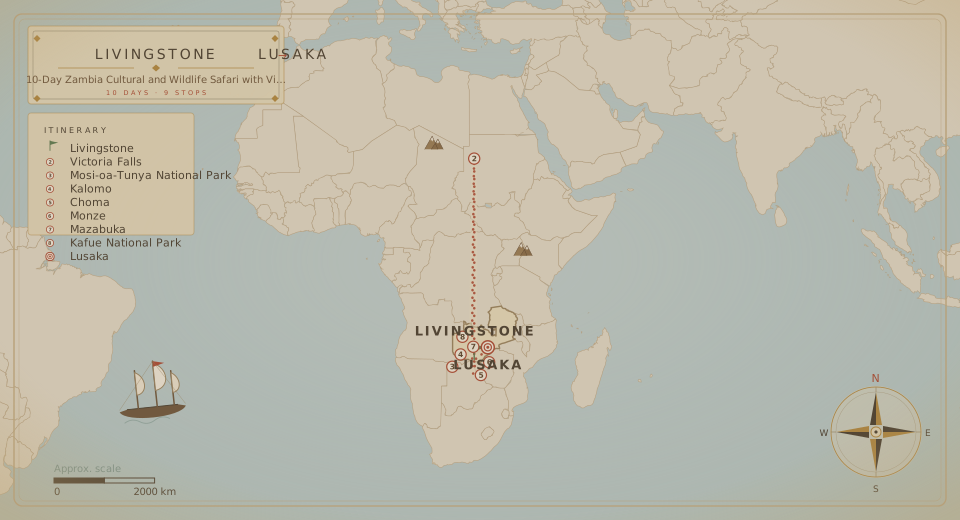
- You will do an early morning game drive in the Mosi-oa-Tunya National Park in Livingstone.
- 05:30 am: Wake up call and take a bath.
- 06:10 am: You will be picked up from your lodge and proceed to Mosi-oa-Tunya National Park's main entrance. You will be required to pay the necessary park entry fees to enable you to enter the Mosi-oa-Tunya National Park.
- 06:45 am: Commence game viewing within the Mosi-oa-Tunya National Park. You will take a mini break by the shores of the Zambezi River.
- Thereafter, you will proceed to the other side of the Mosi-oa-Tunya National Park for a walking safari to view the White Rhinos. You are encouraged to donate anything, either materially or financially, to the Wildlife Protection Officers who watch over these few remaining white Rhinos 24/7.
- A videographer will capture the entire game drive experience for you. A saved soft copy on a flash will be given to you at the end of the game drive. This way, you will always be able to relive this life-time experience all your life!
- 09: 30 a.m. - Exit the Mosi-oa-Tunya National Park and return back to your lodge for breakfast.
- 09:35 am - Take your sumptuous breakfast.
- 10:30 am: Leave for Kalomo travelling by road up north on T-1, the main tourist road of Zambia (Livingstone – Lusaka T-1 road). It is a good tarmac road, and you will cover a distance of about 128 km. You will pass the small roadside town of Zimba on your way up north before reaching Kalomo.
- 13:00 pm: Arrive in Kalomo town, the first colonial capital city of the then Northern Rhodesia, current Zambia.
- You will visit and tour the first "state house" of the colonial administrator of Northern-Western Rhodesia (now Zambia).
- More details: The Administrator's House national monument-located in Kalomo, Zambia, is a 116-year-old house. It was the first home of the British South African Company (BSAco)'s administrator in charge of a territory back then called North-Western Rhodesia. It is believed the house served as present-day Zambia's first state house.
- Thereafter, you will depart for Choma and, along the way, see the Kalundu Mound: About 3km north of Kalomo, on the main road, is a slightly raised mound (a matter of just a few metres) of earth through which the road passes. This marks the site of an Iron-Age village, and the mound is the accumulated debris of many centuries of occupation.
- 14:30 pm: Enjoy lunch break in Kalomo.
- 14:45 pm: Depart for Choma, a distance of about 100 km.
- 17:30 pm: Arrive in Choma town.
- Narration: Choma is a market town and is the provincial headquarters of the Southern Province of Zambia. It lies on Zambia’s main T-1 tourist road and railway line, about 285km from Lusaka and 188km from Livingstone. It is home to the Choma Museum and Craft Centre, exclusively dedicated to the cultural heritage of the Tonga people of the southern province of Zambia.
- 17:00 pm: Check in at Twin Cave, Leons Lodge, or Meridian Lodge in Choma or at any other good accommodation facility.
- 19:00 pm – 21:30 pm: Enjoy your nice dinner.
- 21:40 pm: After an exciting day of activities, you will retire to bed to sleep.
Please note: The times indicated above against each activity may vary during the actual tour due to changed situations or circumstances.
Mosi-oa-Tunya National Park is a UNESCO World Heritage site that is home to the Mosi-oa-Tunya Falls, which means — "The Smoke that Thunders", known worldwide as Victoria Falls — on the Zambezi River. What makes this park unique in Zambia is that it’s the only wildlife area with white rhinos. These are closely protected from poachers by the scouts from the DNPW (Department of National Parks and Wildlife). The Mosi-oa-Tunya National Park is Zambia's smallest National Park, free from predators. This, in combination with it being an area with man-made boundaries, guarantees an abundance of wildlife throughout the year. In addition to the migratory elephants, wildlife, including white rhinos, giraffes, buffalo, waterbuck, impala, wildebeest, zebra, bushbuck, warthogs, monkeys, baboons, hippos and crocodiles, are residents in the park year-round. They inhabit a mix of riverine forest, mopane woodland, and grassland, which also provides a variety of habitats for numerous bird species. Within this park is the Old Drift Crossing Point as well as the Cemetery, where the first European settlers were buried. Historically, the Old Drift was where ox-wagons were floated across the Zambezi before there was a bridge.
In 1907, it became the capital of what was known as Northern-Western Rhodesia. In 1911, it became the capital of Northern Rhodesia, what is today called Zambia.