



Day 01
Airport Arrival and Hotel Transfer
Settle in at the hotel, transfer for supper, and return to the hotel.


Explore the world with tourHQ
South Africa · Wildlife
The journey
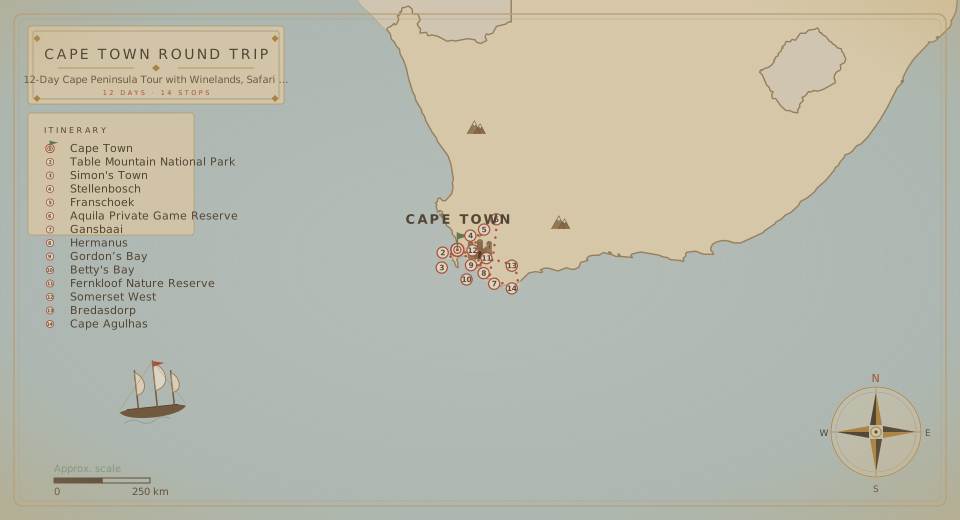
Explore the natural beauty, wildlife, heritage, and wine regions of the Cape Peninsula on this 12-day journey through Cape Town and beyond. Take in sweeping views from Table Mountain, visit historic landmarks such as the Castle of Good Hope and Robben Island, and travel along the scenic Cape Peninsula to Cape Point and Boulders Beach. Enjoy wine tasting in Stellenbosch and Franschhoek, experience a Big 5 safari at Aquila Private Game Reserve, photograph great white sharks in Gansbaai, and discover coastal towns including Hermanus and Cape Agulhas.
The five-minute ascent to the top of Table Mountain offers a 360-degree view of Cape Town, the ocean, and the neighbouring peaks.
From the itinerary
At a glance
Day by day
Settle in at the hotel, transfer for supper, and return to the hotel.
After departing the hotel, head for Table Mountain, which is part of the Cape Peninsula National Park. This area is also a World Heritage Site. The five-minute ascent to the top of Table Mountain offers a 360-degree view of Cape Town, the ocean, and the neighbouring peaks. At the top, enjoy spectacular views and the peaceful feeling of being more than one thousand metres above the city. The area at the top of the mountain is surprisingly large, so leave enough time to stroll around, enjoy the viewing platforms, and soak up the vistas. Enjoy the crisp air and clear visibility as you reach the summit, weather permitting. The guide will point out the highlights of one of the world's most famous views.
After the descent, stretch your legs with a walk through the Company Gardens.
Visit the Castle of Good Hope, the oldest building in South Africa built by European settlers, which once stood at the edge of the sea. Today, it is the headquarters of the Western Province Command. The staterooms contain the William Fehr collection of furniture, paintings, china, and glassware. The military and maritime museums are also of great interest.
Continue the tour with a drive past the Houses of Parliament, the City Hall, and the Slave Lodge before entering the Bo Kaap, also known as the Malay Quarter. The architecture in this area is typical of what Cape Town was like 200 years ago.
Embark on a journey to Cape Point along the scenic Atlantic seaboard coastal road. Pass the pristine beaches of Clifton and Camps Bay with their soft white sand and azure blue water.
Arrive at the quaint fishing village of Hout Bay with its imposing Sentinel.
Visit Seal Island and see the hundreds of Cape Fur Seals that make the island their home.
Continue to Chapman's Peak, which offers amazing photo opportunities.
Descend into the flat, low, marshy plain of Noordhoek. The beach there is broad, long, windy, and excellent for surfing, but not recommended for casual swimming. The final port of call on the west coast route is Scarborough, a tiny cluster of cottages set in the heath-type countryside.
Turn inland to reach the entrance to the Cape of Good Hope Nature Reserve.
Take the funicular or walk to the lighthouse to see the meeting of the Atlantic and Indian Oceans at Cape Point.
En route to Boulders Beach via the eastern shoreline, see the jackass penguins before arriving at the naval base of Simon's Town. The Boulders, a rocky stretch of coastline south of Simon's Town, has numerous inlets, pools, secluded little beaches, and a protected colony of jackass penguins. Boulders Penguin Colony in Simon's Town is home to a unique and endangered land-based colony of African Penguins. This colony is one of only a few in the world, and the site has become a famous and popular international tourist destination.
On the way back, go through Peninsula Inland - the central portion of the Cape Peninsula.
Pass the University of Cape Town and its teaching hospital, Groote Schuur, where the first heart transplant operation in the world was performed by Professor Chris Barnard and his excellent cardiac team in 1967. With the sun setting over the tall peaks of Table Mountain, the last rays sparkle on the trees and flowers and offer a fitting end to a day filled with all the Cape has to offer.
Head north to Stellenbosch. This delightful drive winds its way to the heart of the Cape Winelands. Splendid mountain ranges, green and fertile valleys, historic towns and villages, gracious homesteads, orchards, and vineyards heavy with fruit - these, in brief, are the physical elements that distinguish the Western Cape's Winelands. Spend some time at leisure in the heart of Stellenbosch.
Next stop this morning is Waterford Estate for chocolate and wine tasting. Enjoy lovely wine and chocolate tasting at Waterford Estate.
After the wine and chocolate tasting, depart Stellenbosch and travel over the Helshoogte Pass.
Stop off at Boschendal to enjoy a picnic lunch before continuing on to your next wine tasting.
Make your way to Franschhoek with a photo stop at Groot Drakenstein.
Enjoy wine tasting at Vrede en Lust Wine Estate.
Time permitting, a third wine tasting will be included.
Return to Cape Town with amazing photos and fond memories.
Private transfers to Aquila Private Game Reserve.
Depart Cape Town early in the morning. The transfer takes approximately 2 hours. Enjoy a welcome drink such as coffee, rusks, and croissants on arrival.
Go on a 2-3 hour Big 5 game drive in 4x4 safari vehicles with an experienced ranger guide, where visitors can enjoy a game drive experience among lions and other members of the Big 5. Enjoy an enormous variety of safari wildlife such as giraffe, lion, leopard, zebra, rhino, and wildebeest.
Visit the Animal Rescue and Conservation Centre and view a cheetah and lion sanctuary. The reserve is set in the malaria-free famous Fynbos, Succulent Karoo, and scarce Renosterveld vegetation that were once the favourite hunting grounds of the ancient Khoi/San hunter-gatherers. Eat lunch in an African Boma restaurant.
Browse the African curio shop, relax at one of the spectacular swimming pools, or enjoy a roaring fire and cigar in the thatched colonial lounge.
Return to Cape Town.
Travel to Gansbaai - Gansbaai (Afrikaans: "bay of geese," sometimes referred to as Gans Bay) is a fishing town and popular tourist destination in the Western Cape, South Africa.
After arrival, start with a continental breakfast. Then, a safety briefing will be held.
Board your shark-chaser for the 5-mile voyage to Dyer Island or the anchor spot.
After dropping anchor, begin attracting great whites with a specially formulated "chum" mixture, made from completely legal ingredients, which has taken years to perfect and is a highly guarded trade secret. Sharks are seen on 99.9% of the trips. Once the great whites arrive, you will have the opportunity to photograph these awe-inspiring animals feeding at the surface, right alongside the boat. This is when you enter the cage. Passengers are exposed to the open sea while travelling to and from the islands.
At the islands, the boat is anchored off the lee sides and protected bays. Vinyl side curtains give additional protection from the wind and water spray.
Begin by meeting your local tour guide for pickup from your hotel in Cape Town at 8 am and drive to Hermanus, in the heart of the Cape Whale Route.
Upon arrival, explore the surrounding areas in this quaint fishing village. If you are lucky, you might get to see whales during the land-based whale-watching tour.
Visit famous tourist destinations, including Gordon's Bay, Pringle Bay, Betty's Bay, and Harold Porter Botanical Gardens.
Later, drive through the Hamilton Russell Wine Estate, except on Sundays, and visit the Fernkloof Nature Reserve.
Begin by meeting your local tour guide in Cape Town at 8 am and transfer to the waterfront to catch a ferry to Robben Island.
Upon arrival, go on a bus tour and visit the Robben Island prison and President Mandela's cell.
Proceed to the historic District Six Museum and explore the pieces on display.
Later, visit Langa, the oldest township in Cape Town.
Continue walking and arrive at Gugulethu to visit a traditional healer.
Finally, visit the Xhosa community centre and enjoy the excellent African crafts before the tour ends.
Pickup by your local tour guide from the hotel at 09:00 am.
Drive to Franschhoek.
Upon arrival, visit the largest crocodile breeding farm and observe these amazing reptiles. Stop for lunch and enjoy a bottle of wine inside Crocodile Park.
In the afternoon, visit the Tropical Butterfly Park, where live butterflies fly freely in a beautifully covered garden. Many South African insects are also displayed, including tarantulas and bugs from Madagascar.
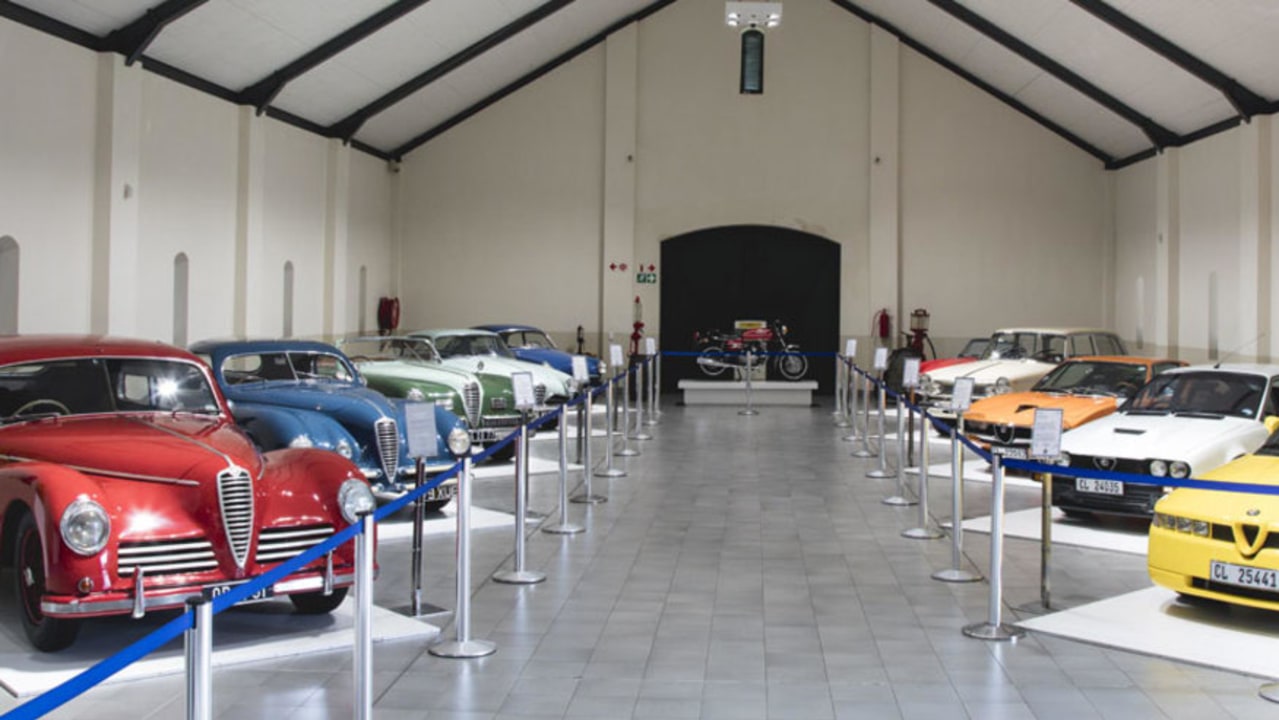
Later, visit the motor museum.
Drop off at the hotel in Cape Town.
Begin by meeting your local tour guide at 7:00 am at your hotel in Cape Town and drive to Cape Agulhas via Sir Lowry's Pass.
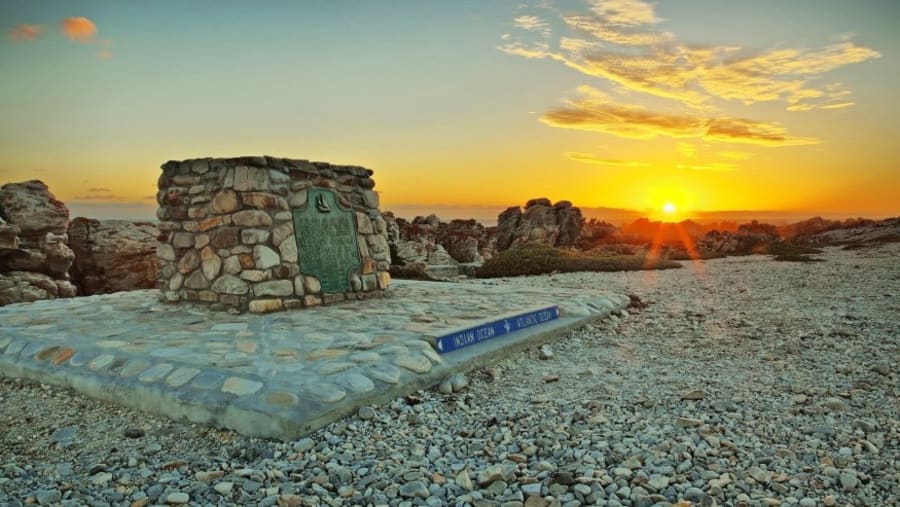
Visit the southernmost tip of the African continent and the official meeting point of the Atlantic and Indian Ocean. Drive past rugged mountain ranges, picturesque vistas, and rolling wheat and canola fields on your way to Cape Agulhas. Take numerous pictures near the lighthouse before taking a stroll near Struisbaai Beach.
Explore the rugged mountain ranges, picturesque vistas, and rolling wheat fields near Sir Lowry's Pass as you stop for photos.
Stop by the Orchard farm stall for refreshments at your own expense.
Head through the small town of Caledon, a town established in the 18th century to provide relief to weary travellers at the nearby hot springs.
Proceed to Bredasdorp and visit the Shipwreck Museum. See visual displays and a fascinating collection of shipwreck artefacts.
Next, visit the lighthouse at Cape Agulhas and Struisbaai Beach before the tour ends.
In the end, enjoy a scenic drive back to Cape Town.
07:00: Travel from Somerset West east up to Sir Lowry's Pass and over the mountain to the starting point.
By 07:30, set out on your walk. The trail is a 5 km return walk and takes about 4 to 5 hours to complete, including stops for photographs, discussions, general exploring of the area, and a lunch or refreshment break, depending on the stops and weather. The first 2.5 km is an uphill trail to the mountaintop and is not that difficult. At the neck, atop the mountain ridge, the old pass is an easy walk, and it takes about an hour to explore the area and traverse a short way down the opposite mountainside to view the spectacular ruts still visible in the rocks.
Once at the top of the kloof, the track starts to dip steeply down, and it is here that the ruts carved into the rocks by wagon wheels become visible. The Dutch and British settlers at the Cape built this rough pass, called the Hottentots Holland Kloof Pass, following the Gantouw route. Also, while taking a bird's-eye view from the top of the pass, you can see the two historic cannons used to communicate over the mountains.
Midway through the adventure, stop for a break for either some refreshments or lunch.
Pickup for airport drop-off.
Where this trip takes you
Table Mountain, Cape Point, Gansbaai Great White Shark Experience
The route
The fine print
All entry fees
Luxury air-conditioned vehicles
Lunch
Drinks
Beverages
Supper
Comfortable clothing
Franschtours CC provides an elegant, safe, and comfortable experience.
Dress comfortably.
The formidable 12 Apostles Peaks rise above the road on one side, while sheer cliffs and incredible rock formations drop into the icy Atlantic Ocean on the other side. There is no doubt the coast of the Cape Peninsula offers magnificent scenery with its great biodiversity.
Company Garden: The humble vegetable patch that the first white colonists planted in the autumn and winter of 1652 still flourishes. Over the centuries, it has changed beyond recognition, both in appearance and function. It is now one of the world's more attractive and botanically most interesting city parks.
An enchanting town and fishing harbour nestling in a wide, green, hill-flanked valley. In translation, the name means "Wood Bay," derived from its value as a source of timber in the earliest colonial period, and fisheries are now its main industries. It is the headquarters of the Peninsula's crayfishing fleet.
Here the road cuts through different strata of granite, sandstone, and rock faces that are attractively multicoloured. At its highest point, the drive skirts cliffs that plunge almost sheer to the sea some 600 m below, and there are magnificent views from the picnic sites and lookout points of Chapman's Bay, its wide expanse of beach, and Hout Bay.
Within the Cape of Good Hope Nature Reserve, which is open throughout the year, there is an extensive network of roads, picnic spots, view sites, pleasant walks and trails, as well as a restaurant and a gift shop. This area is home to magnificent fynbos, many different species of buck and birds, the Cape Mountain Zebra, and mischievous baboons. These creatures entertain guests by enjoying lunch at the restaurant, which has splendid views of False Bay. The Point part of the reserve is the finest of view sites.
Cape Point has been the treacherous site of many shipwrecks and offers some of the most spectacular views of False Bay and the Cape of Good Hope, situated at the junction of two of Earth's most contrasting water masses - the cold Benguela Current on the West Coast and the warm Agulhas Current on the East Coast.
The eastern shoreline is lapped by the warm, blue, and often wind-blown waters of False Bay, which stretches in a wide arc from Cape Point northward and then eastward to the Hottentots Holland Mountains. The bay is so named because early navigators, bound for Table Bay, mistook the Point for Hangklip - a costly error. The wind and current are perverse, and over the centuries there have been a great many shipwrecks. The bay is one of the country's main angling, surfing, and boating areas and, incidentally, a treasure house for marine biologists.
Stellenbosch is a town in the Western Cape province of South Africa, situated about 50 km east of Cape Town, along the banks of the Eerste River. It is the second-oldest European settlement in the province after Cape Town. The town became known as the City of Oaks due to the large number of oak trees planted by its founder, Simon van der Stel, to grace the streets and homesteads.
Franschhoek is a small town in the Western Cape province and one of the oldest towns in the Republic of South Africa. It can easily be mistaken for being in Switzerland. It is about 75 km from Cape Town. In 1688, 176 French Huguenot refugees, many of whom were given land by the Dutch government, originally settled in the valley. The Cape Dutch architecture in much of the village is unspoilt, as restrictions have been placed on the extent of renovations and new constructions in order to preserve the spirit of the original settlers in the area.
The main tourist attraction in Gansbaai since approximately 1995 has been cage diving with great white sharks. It is said that, after Kruger National Park, the great white sharks attract some of the highest numbers of tourists to South Africa for any singular activity.
Logistics
Your 12 days finish where they began, in Cape Town.
 Watch the film
Create your own adventure
Say goodbye to travel stress.
Starting from
When
Travellers
Total
—