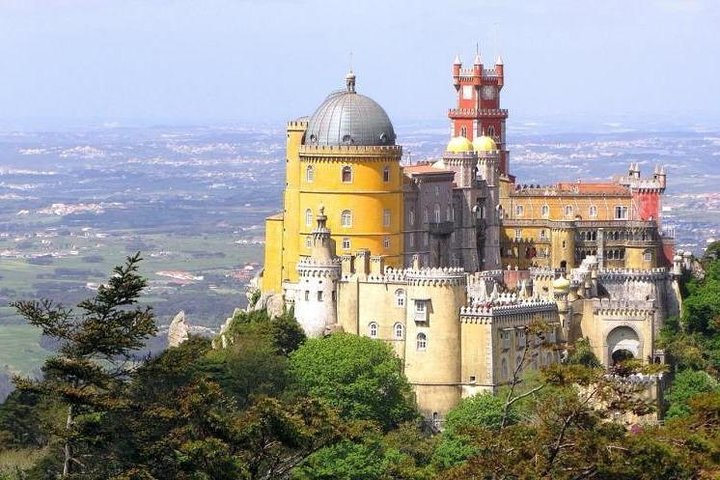
Sintra, Cabo da Roca, Guincho and CascaisThe fantastic Pena Palace is one of the greatest examples of romantic revival of the century. XIX in Portugal.
Situated on Monte da Pena, the Palace was built on the site of a former convent of friars of the Order of St. Jerome. It was the brainchild of D. Fernando de Saxe Coburgo-Gotha, who married Queen D. Maria II in 1836. In love with Sintra, he decided to acquire the convent and the surrounding land to build the summer palace of the royal family.
The king consort adopted Portuguese architectural and decorative forms for the palace, in the revivalist taste (neo-gothic, neo-manueline, neo-islamic, neo-renaissance) and in the surroundings decided to make a magnificent English park, with the most varied tree species. exotic
Inside, still decorated to the liking of the kings who lived there, stands the chapel, where you can see a magnificent alabaster marble altarpiece attributed to Nicolau Chanterenne (one of the architects of the Jeronimos Monastery in Lisbon). Also worthy of mention are the trompe l'oeil murals and the tile coverings.Time to wander the narrow streets of Vila de Sintra and enjoy your convent confectionery.
The following are two options for view:
1 - National Palace; 2 - Quinta da RegaleiraThe millennial history of Sintra Town Hall begins during Muslim rule in the Iberian Peninsula. Already mentioned in the 11th century, the early Moorish palace - owned by the Portuguese Crown after the conquest of Lisbon by D. Afonso Henriques (1147), 1st King of Portugal - is first intervened in 1281, during the reign of D. Dinis. New constructive bodies are added over time under the reigns of D. Dinis, D. João I and D. Manuel I, maintaining their silhouette since the mid-16th century.
The arrangement of the spaces in height, adapting to the terrain; the intimate organization of the open-air inner courtyards, where the running water is heard; its windows with outdated arches; and the tile coverings of rich geometric patterns show the Moorish connection of the craftsmen who built and embellished the Palace.Quinta da Regaleira is one of the most amazing monuments of the Serra de Sintra. Situated at the end of the historic center of the village, it was built between 1904 and 1910, in the last period of the monarchy.
The romantic domains that once belonged to the Viscountess of Regaleira were acquired and expanded by Dr. António Augusto Carvalho Monteiro (1848-1920) to found his place of choice. Holder of a prodigious fortune, which earned him the nickname of Monteiro dos M Millions, he associated with his unique architectural and landscape project the creative genius of Italian architect and set designer Luigi Manini (1848-1936) as well as the mastery of sculptors, flowerbeds and carvers. who had worked with him at the Palace Hotel do Buçaco.
A man of scientific spirit, vast culture and rare sensitivity, a remarkable bibliophile, a discerning collector and a great philanthropist, this vision of a cosmology, a synthesis of the spiritual memory of humanity, has its roots in the mythical Lusa and Universal Tradition. The architecture and art of the palace, chapel and other constructions were scenically conceived in the context of an Edenic garden, emphasizing the predominance of neo-Manueline and Renaissance styles.
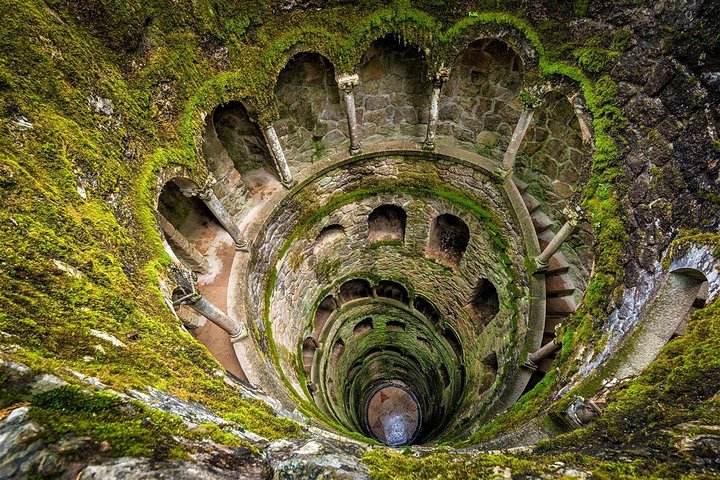
The garden, a representation of the microcosm, is revealed by the succession of places imbued with magic and mystery. Paradise is materialized in coexistence with an inferius - a Dantesque underground world - to which the neophyte would be led by Ariadne's thread of initiation.
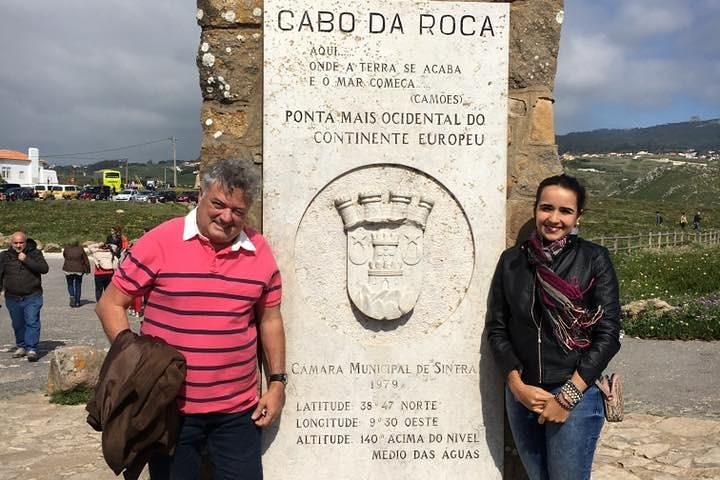
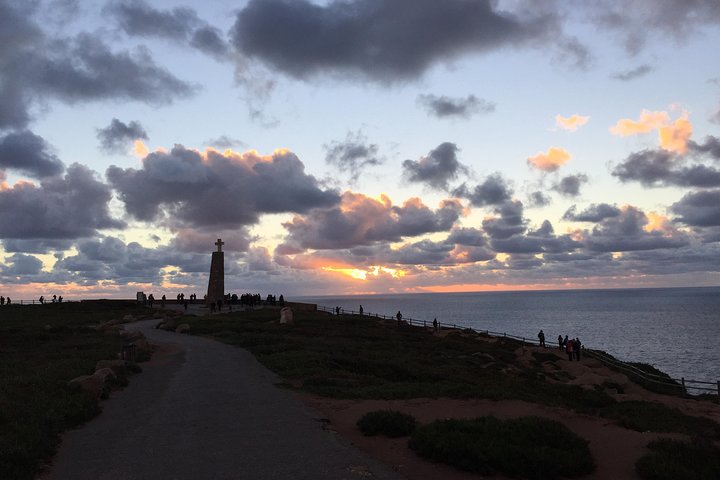
With these scenarios, the representation of an initiatory journey, as vera peregrinat mundi, is concretized, through a symbolic garden where we can feel the Harmony of the Spheres and peer into the alignment of an asceticism of consciousness that travels through the great epics. There are glimpses of mythology, Olympus, Virgil, Dante, Camoes, the Templar mission of the Order of Christ, great mystics and thaumaturgists, the enigmas of the Royal Art, the Great Alchemical Work. This symphony of stone reveals the poetic and prophetic dimension of a Luso Philosopher's Mansion. Here Heaven and Earth merge into a sensible reality, the same one that presided over the theory of Beauty, Architecture and Music, which the acoustic shell of the Celestial Worlds Terrace allows to propagate to infinity.Cabo da Roca is the westernmost point of the European Continent or, as Luís Vaz de Camões wrote, the place “From where the earth ends and the sea begins” (in Os Lusíadas, Canto VIII). A stone pattern with a tombstone mark this geographical feature to all who visit this place. Cabo da Roca is also referred to as “Focinho da Roca” by people connected with things of the sea, and more poetically by “Promontório da Lua”. It is part of the Sintra Cascais Natural Park, which encompasses a vast area of natural interest and beauty. from the Citadel of Cascais to the mouth of the Falcão river. From Cabo da Roca you can follow various eco-trails. In Cabo da Roca, the visitor faces a spectacular landscape, an imposing lighthouse and various infrastructures. It is also here that one of the rarest plant species is found, the 'armeria pseudoarmeria'. Being inserted in an area of easy access and of great tourist affluence are countless people who visit it.On the outskirts of Cascais, the extensive sandy beach of Guincho Beach is much sought after by bathers during the summer season and year-round by surfers and windsurfers, sports for which this beach offers excellent conditions.
Along the road by the sea, numerous top-quality restaurants offer excellent fresh fish and seafood dishes.Situated by the sea and traditionally a fishing village, Cascais had an important development in the 19th century. XIV, when it was a port of call of great movement for the ships that went to Lisbon.
It was however from the 2nd half of the century. By the nineteenth century, when the sea baths began to be appreciated, Cascais underwent a boost that turned it into a very fashionable summer resort. The main driver of the transformation was King of Portugal D. Luís I, who in 1870 converted the citadel fortress into the summer residence of the Portuguese monarchy. This example was followed by the nobility who built palaces and beautiful villas here where they spent the hottest time of the year, completely transforming the old fishing village.
Cascais also began to attract the curious, whose access was made easier by the inauguration of the railway line between Pedrouços and Cascais in 1889. Nowadays, Cascais is a very lively and cosmopolitan place that still retains its aristocratic air. .
A stroll through its streets, which have excellent shops or a rest in one of the many terraces that are here, is recommended. The beaches continue to be one of the biggest reasons of attraction, being possible to choose between those located in the sheltered bay of the village, or those a little further away in the Guincho area (already integrated in the Sintra-Cascais Natural Park) that offer excellent conditions for surfing and windsurfing. Boca do Inferno, a recess of the coast surrounded by rugged cliffs and caves, remains a natural curiosity that attracts many visitors to see the force of the sea.
Gastronomy, especially fresh fish and seafood, can be enjoyed at the many restaurants in the region.A world-renowned resort, Estoril is a true cosmopolitan center of great nightlife and has all the necessary infrastructure for a great summer center - beaches, excellent hotels, golf courses, a casino and even a race track.
It was at the beginning of the century. XX, that the planned transformation of this locality began, due not only to the proximity of the sea that began to be a center of attraction, but also by the existence of hot springs then very fashionable.
The center of this new luxury resort was the Park and Casino (formerly Estoril), surrounded by arcade buildings and excellent hotels.
Formerly, Estoril was known for the various coast line Forts that ensured the defense of one of the possible entrances to Lisbon and the Recollection built by the Order of the Franciscan Friars in the 19th century. XVI turned into the College of Salesians.
From 1930, Estoril became one of the main exponents of tourism in Portugal, having been the place of choice for the exile of many deposed European monarchs, including the King of Spain D. Juan Carlos.
During World War II it was the refuge of writers, politicians, artists, traders and many Jews persecuted by the III Reich.