Egypt · Archaeology

CAIRO, LUXOR AND ALEXANDRIA OVERLAND

6 Days Round trip from Pickup service provided in Cairo. Easy pace

The journey

Trip highlights
  • 01 Visit the Great Pyramid of Giza and the Great Sphinx
  • 02 Explore Saqqara, including the Step Pyramid of King Djoser
  • 03 Discover the Egyptian Museum and the treasures of Tutankhamun
  • 04 Tour Cairo Citadel, the Mosque of Muhammad Ali, and Coptic Cairo
  • 05 Fly to Luxor to see the Valley of the Kings and Karnak Temple
  • 06 Visit Luxor Temple, the Temple of Hatshepsut, and the Colossi of Memnon
  • 07 Enjoy a full-day excursion to Alexandria
  • 08 See the Catacombs of Kom El Shoqafa, Roman Amphitheatre, and Montazah gardens

Discover some of Egypt’s most iconic ancient and religious landmarks on this 6-day overland journey through Cairo, Luxor, and Alexandria. From the Great Pyramid of Giza and the Sphinx to the treasures of the Egyptian Museum, this itinerary brings together world-famous monuments, archaeological sites, and historic city highlights.

Travel south to Luxor to explore the Valley of the Kings, Karnak Temple, Luxor Temple, the Temple of Hatshepsut, and the Colossi of Memnon, then continue your journey with a day trip to Alexandria to visit the Catacombs of Kom El Shoqafa, the Roman Amphitheatre, and Montazah gardens. With private transfers, guided sightseeing, domestic flights, and 5-star accommodation in Cairo included, this tour offers a comprehensive introduction to Egypt’s remarkable heritage.

Discover some of Egypt’s most iconic ancient and religious landmarks on this 6-day overland journey through Cairo, Luxor, and Alexandria.

From the itinerary

At a glance

What this trip includes

Duration 6 Days
Tour type Private
Activity level Easy
Accommodation Included
Transport Included
Wheelchair access Not applicable
Cities Alexandria, Cairo, Giza, Luxor, Saqqara, Memphis
Languages English, French, German

Day by day

The itinerary

1
Day 01

Arrival Cairo

Our representative will meet and assist you to finish the arrival procedures, then he assist you to have your luggage, he will escort you to the hotel in Cairo by deluxe vehicle air-conditional, at hotel he will assist you to check-in and confirm your pick up times for your tours.

2
Day 02

Giza Visit

we will pick you up to visit pyramids of Giza and the sphinx, where you will see the great pyramid of King Khufu, one of the seven wonders of the ancient world.

The Great Sphinx of Giza, commonly referred to as the Sphinx of Giza or just the Sphinx, is a limestone statue of a reclining sphinx, a mythical creature with the body of a lion and the head of a human. Facing directly from West to East, it stands on the Giza Plateau on the west bank of the Nile in Giza, Egypt. The face of the Sphinx is generally believed to represent the pharaoh, Khafre.

The Great Pyramid of Giza (also known as the Pyramid of Khufu or the Pyramid of Cheops) is the oldest and largest of the three pyramids in the Giza pyramid complex bordering present-day Giza in Greater Cairo, Egypt. It is the oldest of the Seven Wonders of the Ancient World, and the only one to remain largely intact.

Based on a mark in an interior chamber naming the work gang and a reference to the Fourth Dynasty Egyptian pharaoh Khufu, some Egyptologists believe that the pyramid was thus built as a tomb over a 10- to 20-year period concluding around 2560 BC. Initially standing at 146.5 metres (481 feet), the Great Pyramid was the tallest man-made structure in the world for more than 3,800 years until Lincoln Cathedral was finished in 1311 AD. Originally, the Great Pyramid was covered by limestone casing stones that formed a smooth outer surface; what is seen today is the underlying core structure. Some of the casing stones that once covered the structure can still be seen around the base. There have been varying scientific and alternative theories about the Great Pyramid's construction techniques. Most accepted construction hypotheses are based on the idea that it was built by moving huge stones from a quarry and dragging and lifting them into place.

Saqqara

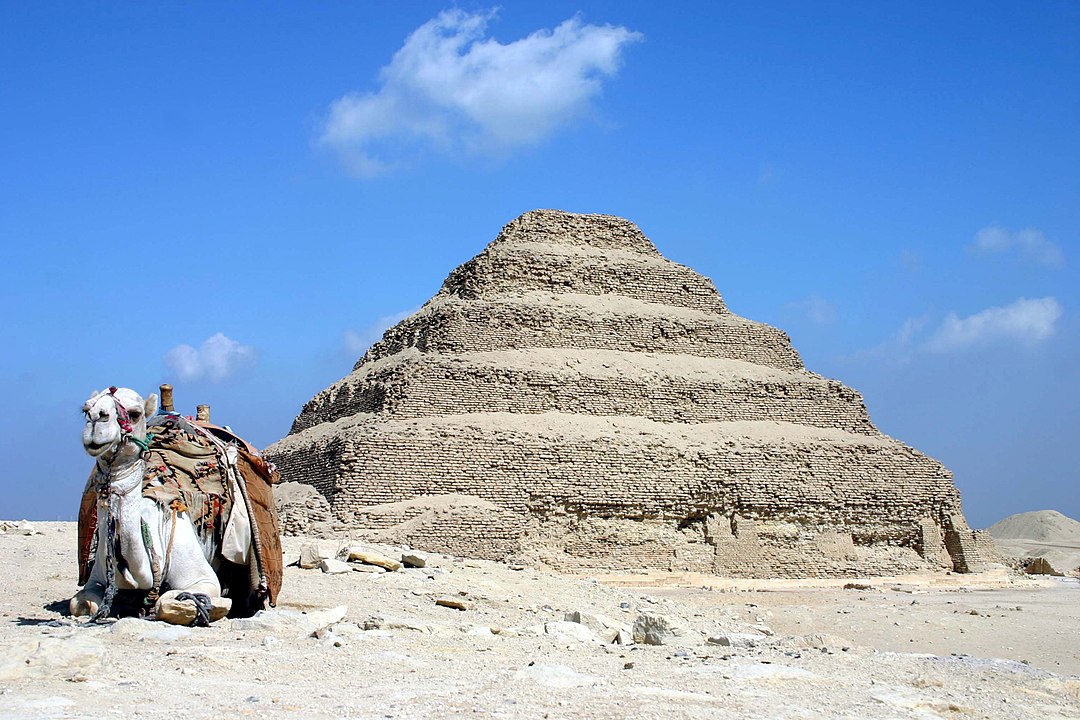
after your lunch, you will be taken to Sakkara to see the step pyramid of king Djoser, over their our tour guide show you the Mastabas (including the Mastaba of Mereruka ) the largest Mastaba of Egypt

Saqqara also spelt Sakkara or Saccara in English /səˈkɑːrə/, is a vast, ancient burial ground in Egypt, serving as the necropolis for the Ancient Egyptian capital, Memphis. Saqqara features numerous pyramids, including the world-famous Step pyramid of Djoser, sometimes referred to as the Step Tomb due to its rectangular base, as well as several mastabas (Arabic word meaning 'bench').

Memphis

Enjoy visiting Memphis the ancient capital of Egypt.

Memphis (‎ Manf pronounced [mænf]; Greek: Μέμφις) was the ancient capital of Inebu-hedj, the first name of Lower Egypt. Its ruins are located near the town of Mit Rahina, 20 km (12 mi) south of Giza in Greater Cairo, Egypt.

According to legend, as related by Manetho, the city was founded by the Pharaoh Menes. It was the Capital of ancient Egypt during the Old Kingdom and remained an important city throughout ancient Egyptian history. It occupied a strategic position at the mouth of the Nile Delta and was home to bustling activity.

Its principal port, Peru-nefer, featured a high density of workshops, factories, and warehouses that distributed food and merchandise throughout the ancient kingdom. During its golden age, Memphis thrived as a regional centre for commerce, trade, and religion.

3
Day 03

Egyptian museum

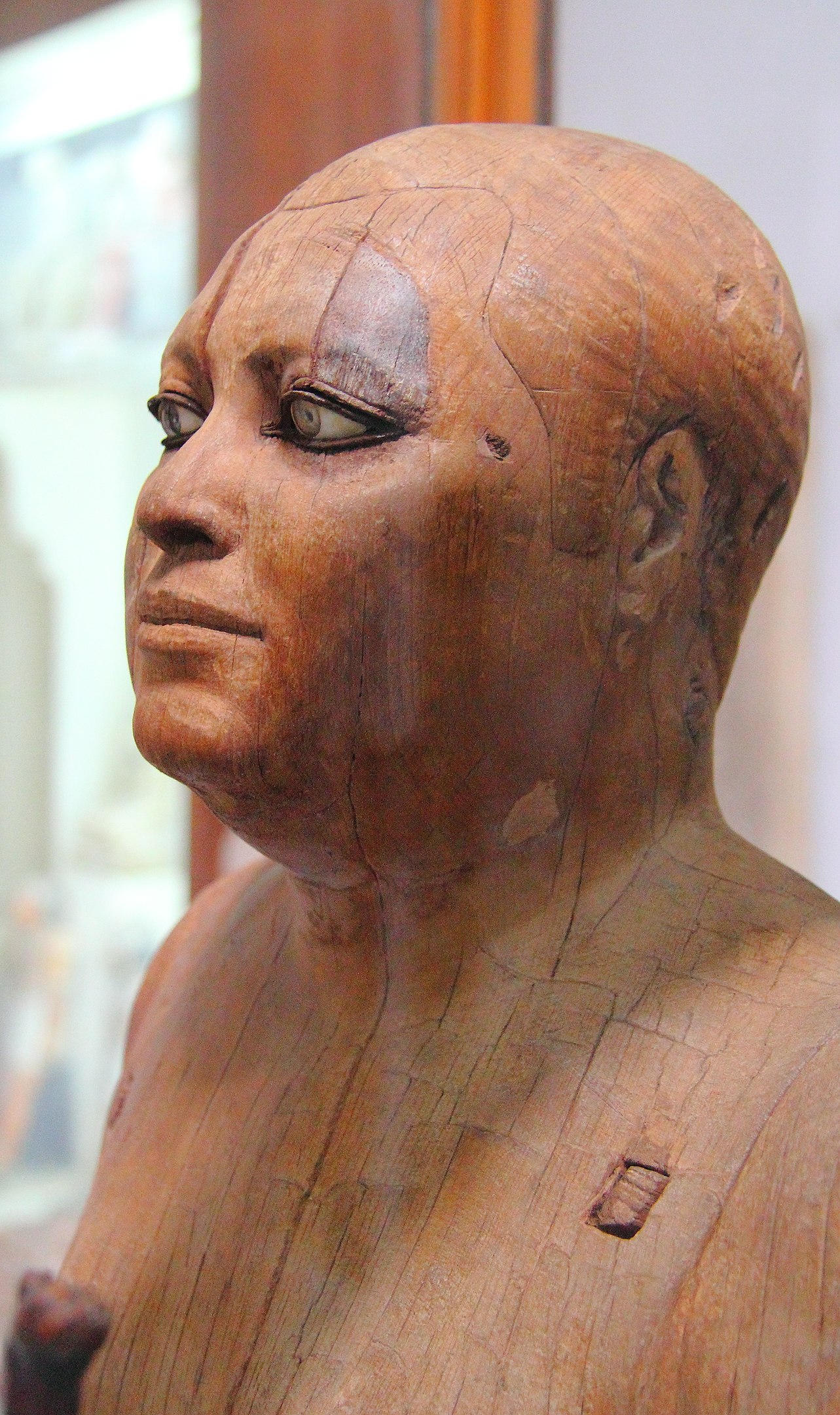
after breakfast at your hotel, you will have another beautiful full day, start it with a visit to the Egyptian museum. over there thousands of artefacts are waiting for your visit (including the golden collection of king Tut Ankh Amun)

The Museum of Egyptian Antiquities, known commonly as the Egyptian Museum or Museum of Cairo, in Cairo, Egypt, is home to an extensive collection of ancient Egyptian antiquities. It has 120,000 items, with a representative amount on display, the remainder in storerooms. Built-in 1901 by the Italian construction company Garozzo-Zaffarani to a design by the French architect Marcel Dourgnon, the edifice is one of the largest museums in the region.

As of March 2019, the museum is open to the public. In 2020 the museum is due to be superseded by the new Grand Egyptian Museum at Giza.

Citadel of Saladin

After lunch, you will be taken to visit the citadel of Saladin.

The Citadel of Cairo or Citadel of Saladin is a medieval Islamic-era fortification in Cairo, Egypt, built by Salah ad-Din (Saladin) and further developed by subsequent Egyptian rulers. It was the seat of government in Egypt and the residence of its rulers for nearly 700 years from the 13th to the 19th centuries. Its location on a promontory of the Mokattam hills near the centre of Cairo commands a strategic position overlooking the city and dominating its skyline. At the time of its construction, it was among the most impressive and ambitious military fortification projects of its time. It is now a preserved historic site, including mosques and museums.

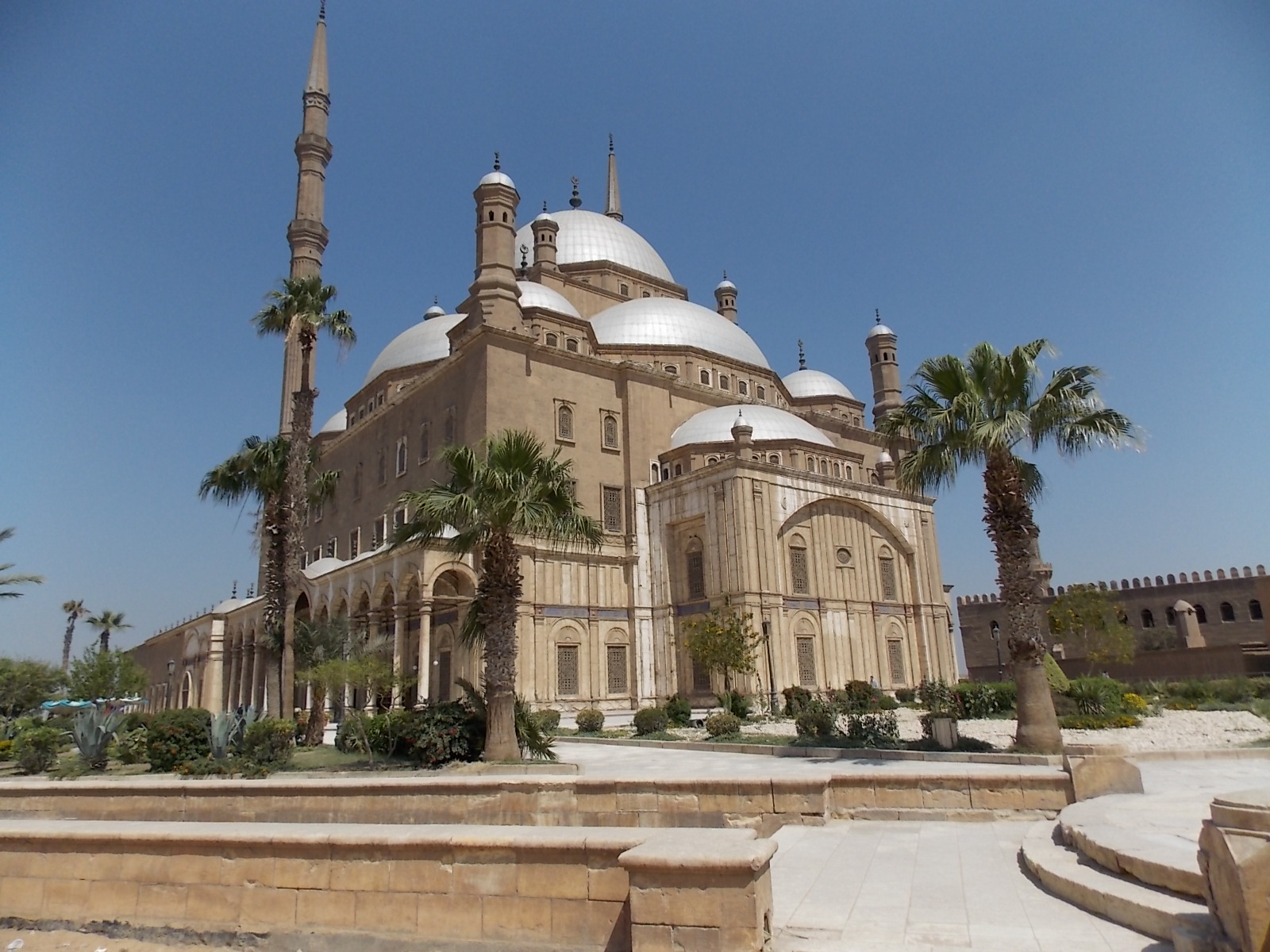
Mohamed Ali Basha mosque

The Great Mosque of Muhammad Ali Pasha or Alabaster Mosque is a mosque situated in the Citadel of Cairo in Egypt and was commissioned by Muhammad Ali Pasha between 1830 and 1848.

Situated on the summit of the citadel, this Ottoman mosque, the largest to be built in the first half of the 19th century, is, with its animated silhouette and twin minarets, the most visible mosque in Cairo.

The mosque was built in memory of Tusun Pasha, Muhammad Ali's oldest son, who died in 1816.

This mosque, along with the citadel, is one of the landmarks and tourist attractions of Cairo and is one of the first features to be seen when approaching the city in any direction.

Coptic Cairo

Have a chance to visit the famous churches in old Cairo, including the hanging church of st. George, and also you will see the church Abu Serga, where they believed its the place of the rest of the holly family during their journey in Egypt.

Coptic Cairo is a part of Old Cairo which encompasses the Babylon Fortress, the Coptic Museum, the Hanging Church, the Greek Church of St. George and many other Coptic churches and historical sites.

It is believed in Christian tradition that the Holy Family visited this area and stayed at the site of Saints Sergius and Bacchus Church (Abu Serga). Coptic Cairo was a stronghold for Christianity in Egypt until the Islamic era, though most of the current buildings of the churches in Coptic Cairo were built after the Muslim conquest of Egypt in the 7th century.

Khan el-Khalili

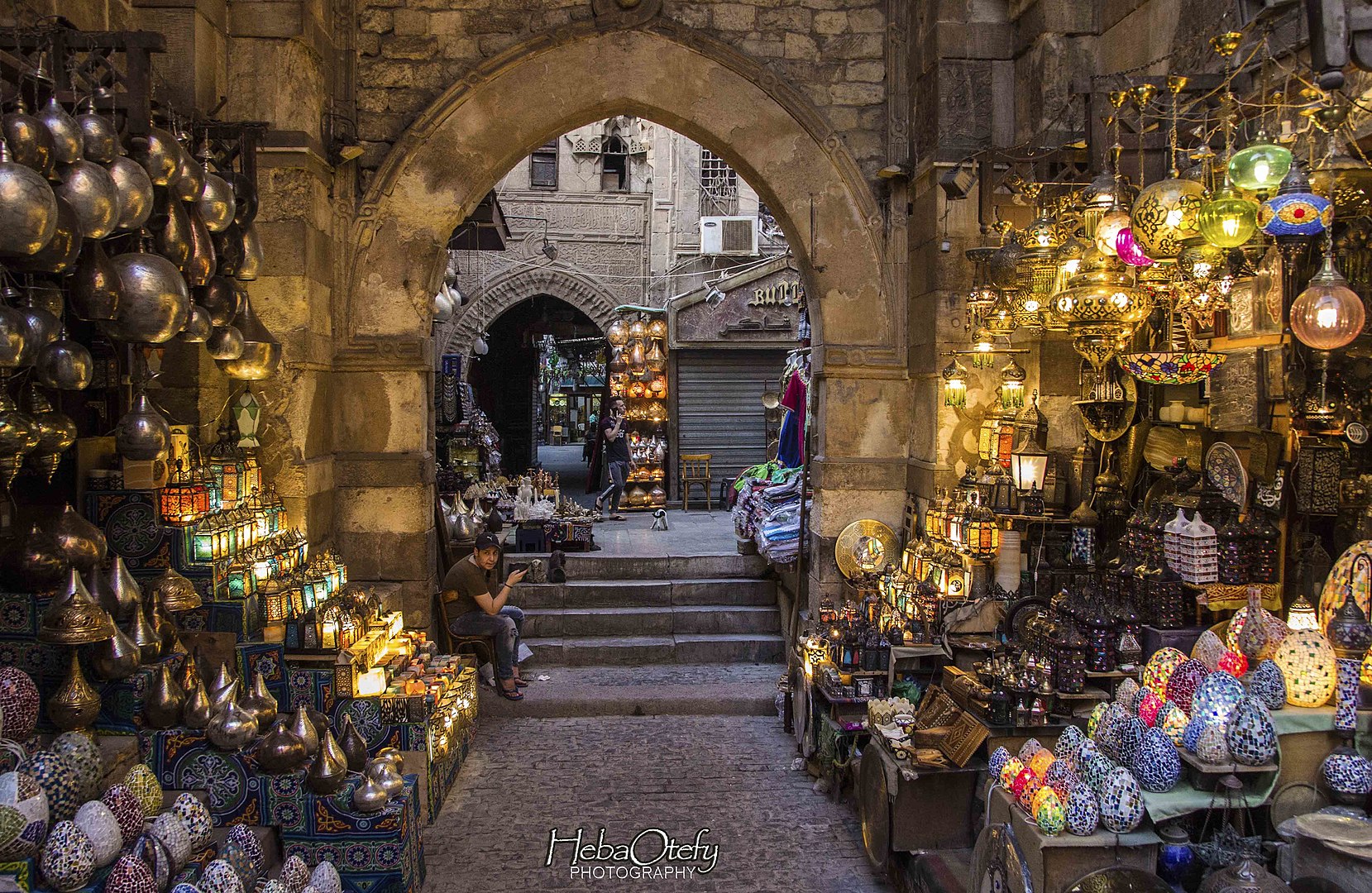
Before you drive back to your hotel, Visit the oldest market in the middle east (Khan el Khalili)

Khan el-Khalili is a famous Egyptian bazaar and souq (or souk) in the historic centre of Cairo, Egypt. The bazaar district is one of Cairo's main attractions for tourists and Egyptians alike. It is also home to many Egyptian artisans and workshops involved in the production of traditional crafts and souvenirs.

4
Day 04

fly to Luxor

After your breakfast at the hotel you will check out and our representative will pick you up to the airport to fly to Luxor, and by Luxor airport, our representative will wait for you to pick you up to visit the west bank of Luxor.

Vally of the Kings

The Valley of the Kings, also known as the Valley of the Gates of the Kings, it is a valley in Egypt for a period of nearly 500 years from the 16th to 11th century BC, rock-cut tombs were excavated for the pharaohs and powerful nobles of the New Kingdom (the Eighteenth to the Twentieth Dynasties of Ancient Egypt).

Hatshepsut Temple

Explore The wonderful temple of Queen Hatshepsut.

The Mortuary Temple of Hatshepsut, also known as the Djoser-Djeseru, is a mortuary temple of Ancient Egypt located in Upper Egypt. Built for the Eighteenth Dynasty pharaoh Hatshepsut, it is located beneath the cliffs at Deir el-Bahari on the west bank of the Nile near the Valley of the Kings.

This mortuary temple is dedicated to Amun and Hatshepsut and is situated next to the mortuary temple of Mentuhotep II, which served both as an inspiration and later, a quarry. It is considered one of the "incomparable monuments of ancient Egypt."

Colossi of Memnon

End your visit by visiting the Colossi of Memnon

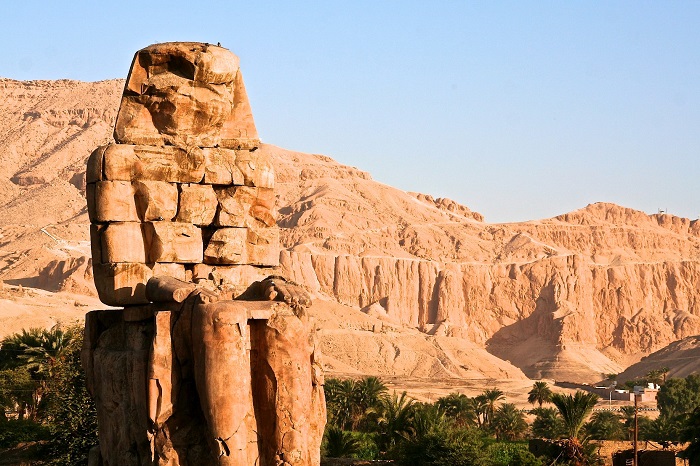
The Colossi of Memnon are two massive stone statues of the Pharaoh Amenhotep III, who reigned in Egypt during the Dynasty XVIII. Since 1350 BCE, they have stood in the Theban Necropolis, located west of the River Nile from the modern city of Luxor.

Lunch, East Bank visits

After lunch, you will start your visit to the East Bank.

Karnak temple

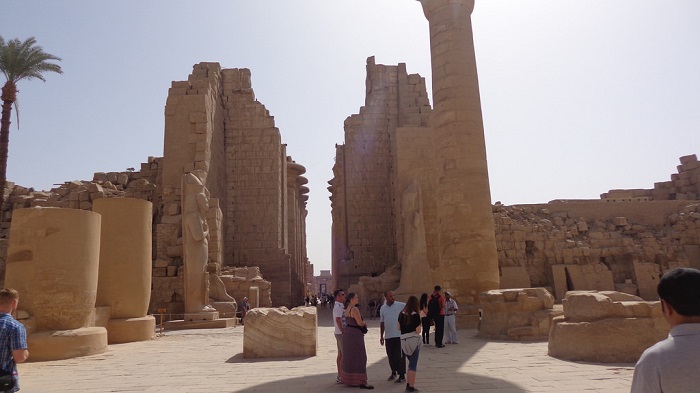
The Karnak Temple Complex, commonly known as Karnak, comprises a vast mix of decayed temples, chapels, pylons, and other buildings near Luxor, in Egypt. Construction at the complex began during the reign of Senusret I in the Middle Kingdom and continued into the Ptolemaic period, although most of the extant buildings date from the New Kingdom. The area around Karnak was the ancient Egyptian Ipet-isut ("The Most Selected of Places") and the main place of worship of the eighteenth dynasty Theban Triad with the god Amun as its head. It is part of the monumental city of Thebes. The Karnak complex gives its name to the nearby, and partly surrounded, modern village of El-Karnak, 2.5 kilometres (1.6 miles) north of Luxor.

Luxor Temple

Luxor Temple is a large Ancient Egyptian temple complex located on the east bank of the Nile River in the city today known as Luxor (ancient Thebes) and was constructed approximately 1400 BCE. In the Egyptian language, it is known as "ipet resyt", "the southern sanctuary".

In Luxor, there are several great temples on the East and west banks. Four of the major mortuary temples visited by early travellers and tourists include the Temple of Seti I at Gurnah, the Temple of Hatshepsut at Deir el Bahri, the Temple of Ramesses II (a.k.a. Ramesseum), and the Temple of Ramesses III at Medinet Habu. the two primary cults temples on the east bank are known as the Karnak and Luxor.

Flight back to Cairo

Drive back to Luxor airport, for your flight back to Cairo, and again our representative will wait for you by Cairo airport to pick you up to your hotel.

5
Day 05

Alexandria

After breakfast at the hotel, you will be transported by our deluxe car to visit Alexandria which built by "Alexander the great".

Alexandria was founded around a small, ancient Egyptian town c. 332 BC by Alexander the Great, king of Macedon and leader of the Greek League of Corinth, during his conquest of the Achaemenid Empire.

Alexandria became an important centre of Hellenistic civilization and remained the capital of Ptolemaic Egypt and Roman and Byzantine Egypt for almost 1,000 years, until the Muslim conquest of Egypt in AD 641, when a new capital was founded at Fustat (later absorbed into Cairo). 

Catacombs of Kom El Shoqafa

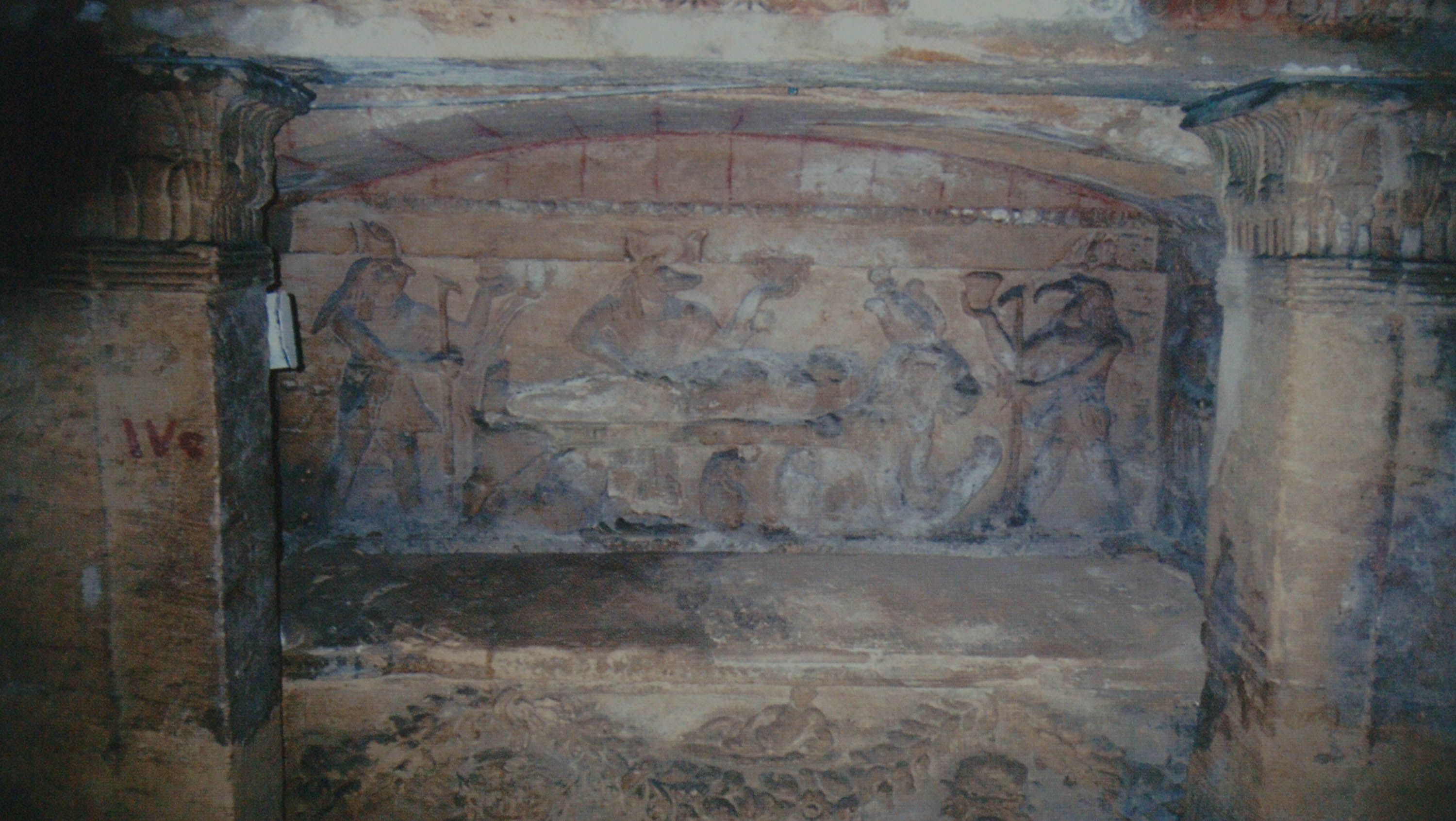
The catacombs of Kom El Shoqafa (meaning "Mound of Shards") is a historical archaeological site located in Alexandria, Egypt, and is considered one of the Seven Wonders of the Middle Ages.

The necropolis consists of a series of Alexandrian tombs, statues and archaeological objects of the Pharaonic funeral cult with Hellenistic and early Imperial Roman influences. Due to the time, many of the features of the catacombs of Kom El Shoqafa merge Roman, Greek and Egyptian cultural points; some statues are Egyptian in style, yet bear Roman clothes and hairstyle whilst other features share a similar style.

A circular staircase, which was often used to transport deceased bodies down the middle of it, leads down into the tombs that were tunnelled into the bedrock during the age of the Antonine emperors (2nd century AD).

The facility was then used as a burial chamber from the 2nd century to the 4th century, before being rediscovered in 1900 when a donkey accidentally fell into the access shaft. To date, three sarcophagi have been found, along with other human and animal remains which were added later. It is believed that the catacombs were only intended for a single-family, but it is unclear why the site was expanded to house numerous other individuals.

Roman Amphitheater

Visit the Roman Amphitheater

The Roman Amphitheatre in Alexandria is the only Roman amphitheatre in Egypt, dating back to the second century AD. It was discovered by chance in 1960 by Egyptian-polish expedition in Kom El-Dekka. It was found when the team of the expedition was trying to remove some remains of Napoleon's times. The theatre dates back to the 1st -2nd century BC. During times this place was changing its plan and function until in 6th century it became a place for celebration religion feasts. 

Montazah garden

End your visit to this fantastic city by visiting the Montazah garden.

Montaza Palace is a palace, museum and extensive gardens in the Montaza district of Alexandria, Egypt. It was built on a low plateau east of central Alexandria overlooking a beach on the Mediterranean Sea.

The extensive Montaza Palace grounds first had the Salamlek Palace, built-in 1892 by Khedive Abbas II, the last Muhammad Ali Dynasty ruler to hold the Khedive title over the Khedive of Egypt and Sudan. It was used as a hunting lodge and residence for his companion.

The larger Al-Haramlik Palace and royal gardens were added to the Montaza Palace grounds, being built by King Fuad I in 1932, as a summer palace. It is in a mixture of Ottoman and Florentine styles, with two towers. One of these towers rises distinctively high above with elaborated Italian Renaissance design details. The palace has long open arcades facing the sea along each floor.

Back to Cairo

after lunch, you will be driven back to Cairo.

6
Day 06

Final Departure

Your final day starts with breakfast at your hotel, after check out, transfer to the airport for your final departure.

The route

Where you'll travel

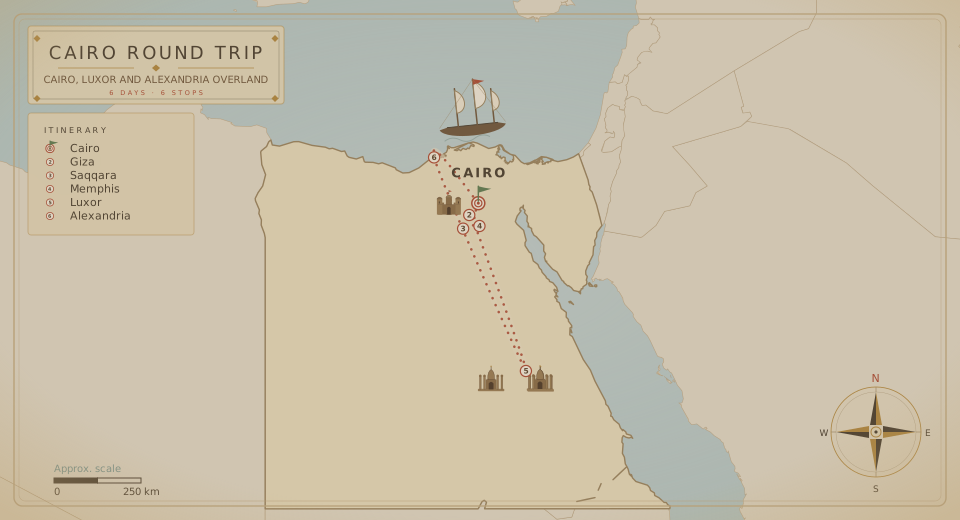
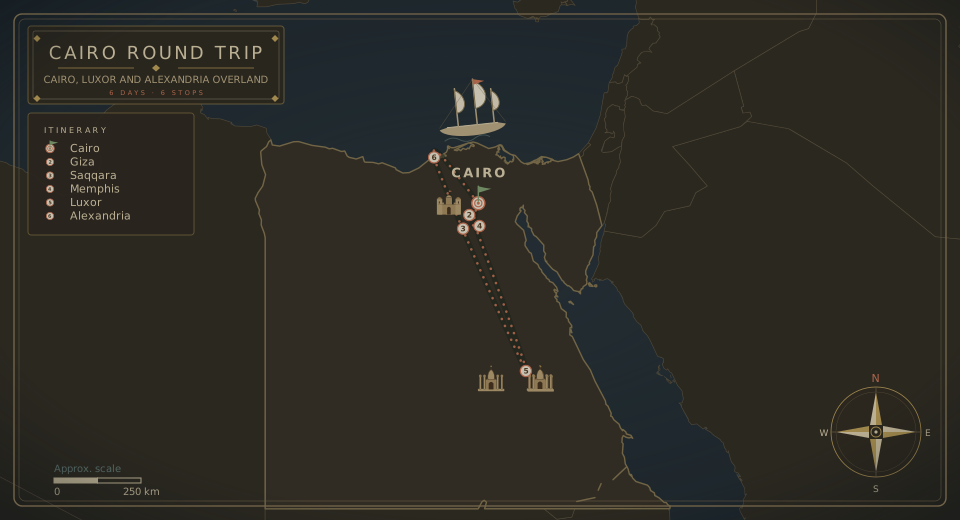
Tour route map
Round trip from Pickup service provided in Cairo. 6 cities · 6 Days

The fine print

Trip details

What's Included

  • 5 night’s accommodation in Cairo at a 5-star hotel on bed and breakfast basis.
  • All transfers as per above mentioned program.
  • Private English speaking Egyptologist.
  • Entrance fees for all sightseeing.
  • Private air-conditioned vehicle for all transportation.
  • Arrival/departure assistance.
  • Domestic flights: Cairo to Luxor and Luxor to Cairo.
  • Luggage handling at airports and hotels.
  • All taxes & service charge.

What's Not Included

  • Any extras not mentioned in the program.
  • Tipping.

Logistics

Meeting & route

Meeting point
Pickup service provided in Cairo.
Tour start
Pickup service provided in Cairo.
Tour ends at the same location as the start point.
End of the journey

Your 6 days finish where they began, in Pickup service provided in Cairo..

Watch the tourHQ film Watch the film

Create your own adventure

Can't find the perfect tour? Tailor your dream trip.

  • Tell us your destination, dates and group size.
  • Our travel experts and local guides design a tailored itinerary, just for you.
  • Enjoy your trip with peace of mind, knowing everything is taken care of.
Plan my holiday

Say goodbye to travel stress.