Pakistan · Trekking

19-Day Snow Lake Trek in Pakistan via Hispar Pass and Hunza

19 Days Round trip from New Islamabad Airport Rd Hard pace

The journey

Trip highlights
  • 01 Trek through Hispar Pass to reach the iconic Snow Lake
  • 02 Cross the ancient ice highway of the Biafo and Hispar glaciers
  • 03 Capture spectacular mountain views from the top of Hispar Pass
  • 04 Travel along the ancient Silk Route on the Karakoram Highway
  • 05 Explore Baltistan, Skardu, Hunza, and Karimabad's historic forts
  • 06 See dramatic Karakoram peaks including Latok, Sosbun Brakk, and Baintha Brakk

Embark on an adventurous expedition to breathtaking Snow Lake via Hispar Pass, trekking across the ancient ice highway of the Biafo and Hispar glaciers. Along the way, take in glorious views of peaks including Sosbun Brakk, Mango Gusor, Bakhor Das, Latok, and Baintha Brakk, while camping high in the Karakoram near Hispar Pass. The journey also connects Baltistan, Skardu, and Hunza, with travel along the legendary Karakoram Highway and time to explore Karimabad, Baltit Fort, and the surrounding valley.

The view of Snow Lake from the top of Hispar Pass at 5151 m is inspirational.

From the itinerary

At a glance

What this trip includes

Duration 19 Days
Tour type Shared
Activity level Hard
Accommodation Included · Standard
Transport Included
Wheelchair access No
Cities Islamabad, Rawalpindi, Hunza, Skardu, Chilas, Naran, Askole, Biafo Glacier
Languages English

Day by day

The itinerary

1
Day 01

Arrival in Islamabad and Rawalpindi Exploration

  • Meet and greet your tour guide, receive a trek briefing, and transfer to the hotel.

  • For the rest of the day, explore the bazaars of Rawalpindi and the new town of Islamabad.

Overnight stay at the hotel.
2
Day 02

Flight to Skardu

  • Begin with a morning transfer to the airport for your flight to Skardu, followed by a transfer to the resort. This flight is subject to suitable weather conditions, so if it is cancelled, we will drive by road to Naran/Chilas.

Meals and overnight stay at the hotel.

3
Day 03

Skardu or Road Journey from Chilas

  • If we travel by road, we will make the journey from Chilas to Skardu. If you travel by air, then enjoy a free day in Skardu.

  • Overnight in the hotel with meals.

4
Day 04

Skardu to Askoli by Jeep

  • Set off in soft-top 4x4 jeeps for a bumpy ride to the trekking trailhead.

  • Enjoy the views of Mango Gusor (6208 m) and Bakhor Das (5809 m) peaks.

Camp at 2950 m at Askoli.

5
Day 05

Askoli to Namla via Braldu River

  • Walk alongside the Braldu River for about an hour to reach the village of Askoli. This is the last permanent settlement along our trekking route.

  • Proceed to the Biafo Glacier.

  • After setting foot on the glacier, arrive at Namla campsite at 3400 m.

6
Day 06

Namla to Biantha Across the Biafo Glacier

  • Cross an area of crevasses where extreme care is needed. It is important to follow our guide closely.

  • Gently ascend the glacier, enjoying spectacular views of Latok 1 (7145 m) and Latok 2 (7108 m) along the trek. The track follows the ablation valley past a small lake, then heads out across the lateral crevasses to the smooth white centre of the Biafo Glacier.

  • Spend the night at the campsite at Biantha at 4025 m on a grassy area with a clear stream flowing through dense willows and alpine flowers.

7
Day 07

Biantha to Karfogoro

  • Spend the first hour of the trek on a lovely walk along the valley, crossing many small lakes surrounded by willows and wildflowers. This area is the habitat of bears and Himalayan ibex.

  • Make a gradual climb over smooth ice. If there is fresh snow on the glacier, we must rope up and walk using a flying belay while enjoying stunning views of Sosbun Brakk (6418 m).

Camp at 4025 m.

8
Day 08

Karfogoro to Snow Lake

  • Make a predawn departure from camp to walk safely over the soft snow on the medial moraine.

  • After two hours of steady plodding, arrive at the intersection of the Sim-gang Glacier with Snow Lake.

Camp at around 4780 m close to Hispar Pass.

9
Day 09

Snow Lake Exploration

  • Enjoy the spectacular views of Snow Lake. For the first 40 years of the last century, explorers believed that Snow Lake was an ice cap like those in polar regions, from which glaciers flow in each direction, and its size was estimated at 777 sq. km. It is now estimated to cover 77 sq. km. The lake was named by explorer Martin Conway in 1892, who gave a dramatic account of the area in his book 'Climbing expeditions in Karakoram - Himalaya'.

10
Day 10

Snow Lake to Khanibasa via Hispar Pass

  • Make an early morning departure to climb the pass. Gaiters are essential, as snow can be deep even in the morning.

  • Hike in single file, roped together. The route passes through the centre of the pass around giant crevasses and striped, greenish-blue seracs towering on either side. The view of Snow Lake from the top of Hispar Pass at 5151 m is inspirational. Numerous glaciers emerge from Snow Lake and disappear between nameless unclimbed Karakoram peaks. The highest of these peaks is Baintha Brakk (7285 m), Ogre, first climbed by Chris Bonington and Doug Scott in 1977. On the other side of the pass, the snow-covered Hispar Glacier stretches as far as the eye can see, and to the north rises the white pyramid of Workman Peak (19,300 ft.).

  • Descend from the pass to camp on the glacier's northern moraine at 4580 m.

11
Day 11

Khanibasa to Yutmaru

  • Soon after leaving camp, spend about 90 minutes crossing the Khanobasa Glacier. Enjoy spectacular views of Kanji Sar (7700 m), the 29th highest peak in the world.

  • Follow the lateral moraine and marvel at the hanging glaciers and frequent avalanches on the southern ice walls. Yutmaru at 4330 m is a flat, sheltered field in a valley, surrounded by willows and alpine flowers. It also offers fine views of Hispar Pass and the Balchish Range.

12
Day 12

Yutmaru to Bitanmal

  • Go for an hour's leisurely walk through the valley to the Yutmaru Glacier, which we then take about two hours to cross, negotiating high ice walls and deep crevasses.

  • Make a steep climb that provides panoramic views back to Hispar Pass. As we descend, there are also views of the Kunyan Chish Range (7852 m), the 22nd highest peak in the world. The Pumari Chish Glacier flows south from this mighty mountain.

  • Walk along a path 100 m above Hispar Glacier to reach our campsite at 3902 m.

13
Day 13

Rest Day in Bitanmal Valley

  • Rest in the Bitanmal valley. The Bitanmal valley campsite is a wide-open summer pasture surrounded by willows and flowers. In summer, shepherds from Hispar Village move here to live with their herds of goats, sheep, and yaks. It is a perfect place for a rest day.

14
Day 14

Walk to Hispar Village

  • Walk through the green pastures, past willows and cedars, and among herds of goats, sheep, cattle, and donkeys.

  • Reach the south bank of the Hispar River and a vast alluvial fan rippling in terraces down to a cliff above the river.

  • Cross a wooden bridge over the river and climb steeply to enter Hispar village, with its mud houses, apricot, willow, and poplar trees, and fields of wheat, peas, and beans, along with the ever-present wild poppies and marijuana.

  • After spending some time here, walk for another hour to our camp close to a roaring river at 3200 m.

15
Day 15

Hispar to Huru and Onward to Hunza

  • In the morning, walk for two hours through the dry landscape to Huru and board soft-top 4x4 jeeps for the short ride to Karimabad, the capital of Hunza Valley. You are never short of spectacular views here - Rakaposhi (7788 m), Ultar 1 (7388 m), Ultar 2, and Golden Peak tower above the valley.

  • Enjoy a free afternoon.

Meals and overnight stay at the hotel.

16
Day 16

Karimabad and Hunza Valley Exploration

  • Enjoy free time in Karimabad to explore the valley and visit the Altit and Baltit forts.

  • If time permits, we may drive 35 km further north along the Karakoram Highway to the picturesque village of Passu for thrilling views of the Passu and Batura glaciers.

  • Enjoy a Hunza cultural dance in the evening.

Meals and overnight stay at the hotel.

17
Day 17

Hunza to Chilas via Upper Hunza

  • Begin with a morning excursion to Upper Hunza to enjoy the views of Passu Peak, Passu Glacier, Batura, and other peaks of the Karakoram.

  • Drive back along the Karakoram Highway to Chilas.

Meals and overnight stay at a hotel.

18
Day 18

Chilas to Islamabad

  • Proceed towards Islamabad with your Pakistani mountain guide.

Overnight stay at the hotel.

19
Day 19

Departure from Islamabad

  • Proceed to the airport and board your return flight.

The route

Where you'll travel

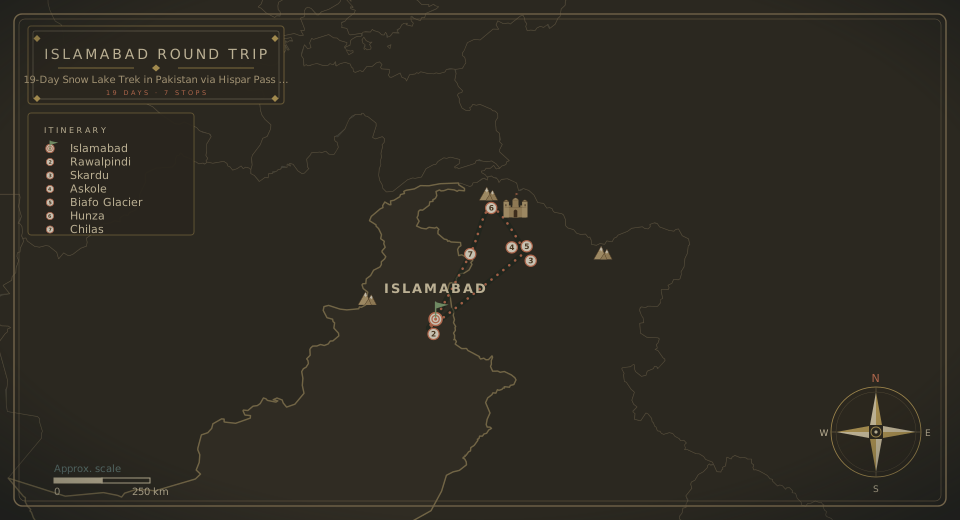
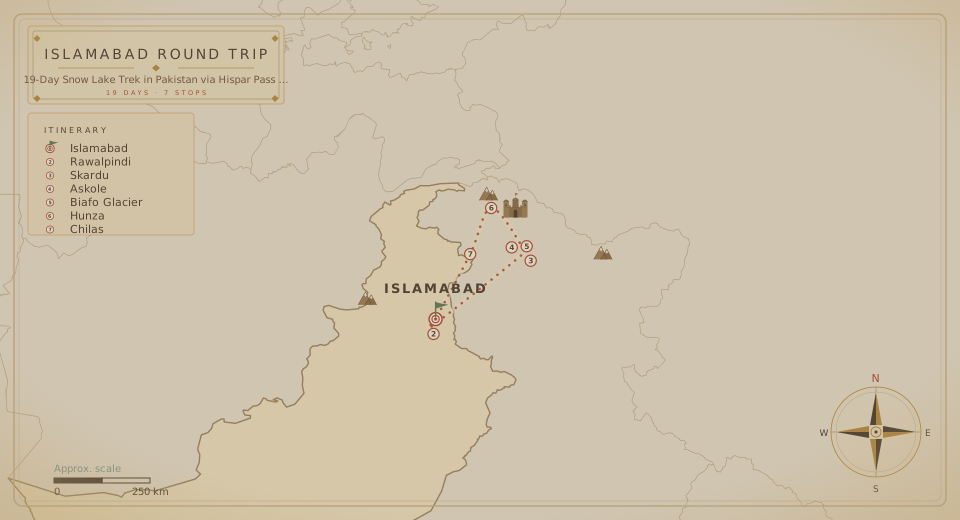
Tour route map
Round trip from New Islamabad Airport Rd 8 cities · 19 Days

The fine print

Trip details

What's Included

  • Accommodation on a twin-share basis at standard category hotels in towns
  • 2-person tent during camping
  • Meals: half board at hotels
  • Full board during the trek
  • Transport: air-conditioned bus on the Karakoram Highway, soft-top 4x4 jeeps for Hunza
  • Camping facilities: 2-person dome tents with mattresses, dining tent with folding table and chairs, kitchen tent and staff, toilet tent, and portage of 15 kg during the trek
  • Tips and portage at airports and hotels
  • Entrance fees at sites and museums
  • English-speaking Pakistani mountain guide

What's Not Included

  • Domestic/international airfares and airport taxes

  • Any expenses due to cancellation of flights, landslides, other natural calamities, or acts of God beyond the control of Rock Valley Tours, their staff, and suppliers

  • Any expenses of a personal nature not mentioned above

Know before you go

  • While on an organized trek, it is best to pack all items for your trip in one large piece and one carry-on. The large piece must be a duffel bag weighing no more than 12.5 kg, because duffels are easier for porters to carry. A small day pack is suggested as carry-on to keep items that you will use during the trek, bus, or jeep ride.
  • Large duffel bag with a lock. It is not recommended to put your stuff in a backpack, as the straps might get damaged while being transferred from bus to jeeps, jeeps to campsites, and during loading and unloading by porters each day. A small padlock that fits through the zipper of your duffel bag is recommended.
  • Day pack. Large enough for camera gear, cap, sunglasses, water bottle, jacket, and other items you may like to use while on the trek.
  • Extra carry-on for storing city clothes in Skardu.
  • Money belt. A small fanny pack, money belt, or around-the-neck passport bag is suggested to keep your passport, travel documents, and money safe.
  • Sleeping bag. As we shall be sleeping for four nights at Concordia at 4,700 meters or at Snow Lake and Hispar Pass at 5151 meters above sea level, the bag should be rated for 0 degree F or -18 degree C. Ratings are relative, since the amount of insulation needed for a particular person to stay comfortable depends on their rate of metabolism. A down bag will be warmer for its weight and pack smaller, but it does not retain its insulative properties when wet. A waterproof breathable shell or a bivy bag will keep the bag dry. A synthetic bag keeps you warm even when wet and is a less expensive alternative, but will weigh more for a given amount of warmth.
  • Trekking boots. The single most important item on this list. Never take brand-new boots on a trek; make sure they are well broken in before departure. Good trekking boots are hard to get in Pakistan. If you are buying a new pair from abroad, look for medium-weight boots of fabric or a fabric/leather combination. They should provide adequate ankle support. A Vibram or other deep lug sole will protect you from rocks and add support. Always use thick socks when trying shoes so that you get the correct size. Short shoes can jam your toes painfully during steep descents. You could also try to get new "Grouted" shoes that provide protection against water and are good while walking in rain or snow. Make sure you can fit crampons on your shoes, as it is vital for crossing different passes.
  • Camp shoes. Jogging shoes or sneakers to slip into at the end of the day. Teva sandals are ideal for this trek, as you can use them while crossing streams and also at the campsite for strolls.
  • Crampons. You may need crampons on certain treks, sometimes only for one day. They help provide a better grip on hard snow when fitted to your boots. Look for easy-to-fix ones. Check with us for your specific trek if you need crampons or not. From our regular trek list, you would need to bring crampons for Gondogoro La, Biafo Hispar, and Wartum Peak.
  • Thermal socks. The socks you wear are a critical element. A cotton/wool combination is useful while on the glacier, and for warmer conditions, cotton socks are best. For those who are sensitive to wool, synthetic/cotton socks are recommended.
  • Liner socks. A thin, wickable material. Polypropylene, Capilene, Thermax, and Drylete all work very well. Silk does not work nearly as effectively as any of the above.
  • Polyester fleece/pile jacket or pullover. Stays warm even when wet.
  • Polyester fleece pants. Good for afternoon strolls, same as above.
  • Rain gear. A rain suit available from the local market is best for rain, doubles as a windbreaker, and fits over a pile jacket and pants.
  • Wicking long underwear (tops & bottoms). Wicks moisture to keep you warm and comfortable and dries quickly. Two sets are a good idea.
  • Ski hat. Covers your ears properly; use one with a cotton liner. A woollen cap is also good.
  • Mittens or gloves. Woollen gloves are useful at higher elevations and during windy conditions when the temperature drops quickly.
  • Brimmed sun hat. Very important for this trek, as when we start the trek and until we arrive at Concordia, we are generally walking towards the east. This can be annoying in the morning, as the sun is low and hits your eyes.
  • Bathing suit. Men can bathe by the rivers or occasional lakes in ablation valleys.
  • Toiletries. Keep everything you normally use. Just remember to bring effective sunscreen, chapstick/lip balm, skin lotion, and laundry soap.
  • With your knowledge of Pakistani culture, you are well aware of the precautions to be taken while traveling through remote areas. Clothes for the trek should be durable, comfortable, and easy to wash and dry. In good weather, you will spend much of your time in a T-shirt or medium shirt and outdoor trousers. You will need warmer clothes for the evening in the camps. Temperature falls rapidly as soon as the sun goes down.
  • Men could wear shorts once we are through the populated areas, which means from the third day of the trek. Women are advised to use cotton salwar kameez (loose long shirts and baggy trousers), the traditional Pakistani dress, as these are comfortable during warm conditions and are also appreciated and respected by the locals.
  • Headgear
  • Parka
  • Wool shirt & trousers
  • Sweater
  • Cotton shirt & pants
  • Gloves & mittens
  • Rain/wind suit
  • Cotton & wool undergarments
  • Socks (cotton & wool/synthetic)
  • Boots (trek & camp)
  • Belt
  • Down jacket
  • Salwar kameez (cotton)
  • Spare laces for boots
  • Miscellaneous items
  • Sunglasses
  • Towel
  • Washcloth
  • Bandanna/scarf for covering your mouth while riding in a jeep
  • Water bottle with a durable screw top
  • Sunscreen
  • Headlamp with flashlight, extra batteries, and bulb
  • Insect repellent
  • Swiss Army knife, or a similar one
  • Nylon cord for a clothesline
  • Personal medical kit
  • Pocket-size sewing kit
  • Lighter or matches for general use
  • Wristwatch
  • Thermarest. We provide close-cell mattresses, but you may want to supplement them for additional comfort.
  • Stuff sacks of various sizes for storing your used clothes
  • Toilet paper or a travel pack of tissues
  • An interesting book
  • Notebook and pen for journaling
  • Snacks: personal choice of dried fruit, candy, energy bars
  • Binoculars
  • Camera, film, extra batteries, cleaning supplies, and extra lenses
  • Sports gear (playing cards/Frisbee)
  • Water purification tablets

Logistics

Meeting & route

Meeting point
Airport Avenue, Islamabad Gandhara International Airport, Islamabad, Pakistan
Tour start
New Islamabad Airport Rd, Islamabad, Rawalpindi, Islamabad Capital Territory, Pakistan
Tour ends at the same location as the start point.
End of the journey

Your 19 days finish where they began, in New Islamabad Airport Rd.

Watch the tourHQ film Watch the film

Create your own adventure

Can't find the perfect tour? Tailor your dream trip.

  • Tell us your destination, dates and group size.
  • Our travel experts and local guides design a tailored itinerary, just for you.
  • Enjoy your trip with peace of mind, knowing everything is taken care of.
Plan my holiday

Say goodbye to travel stress.

Starting from

USD 2,950 /person
Book This Tour

When

Travellers

Total