Day 01
Arrival in Kathmandu
Arrive at Tribhuvan International Airport (TIA) in Kathmandu and head to your hotel.


Explore the world with tourHQ
Nepal · Trekking
The journey
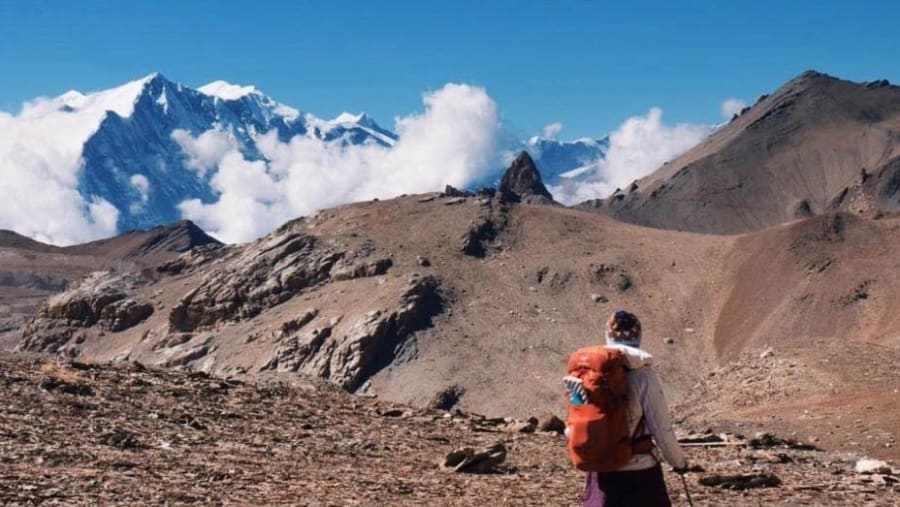
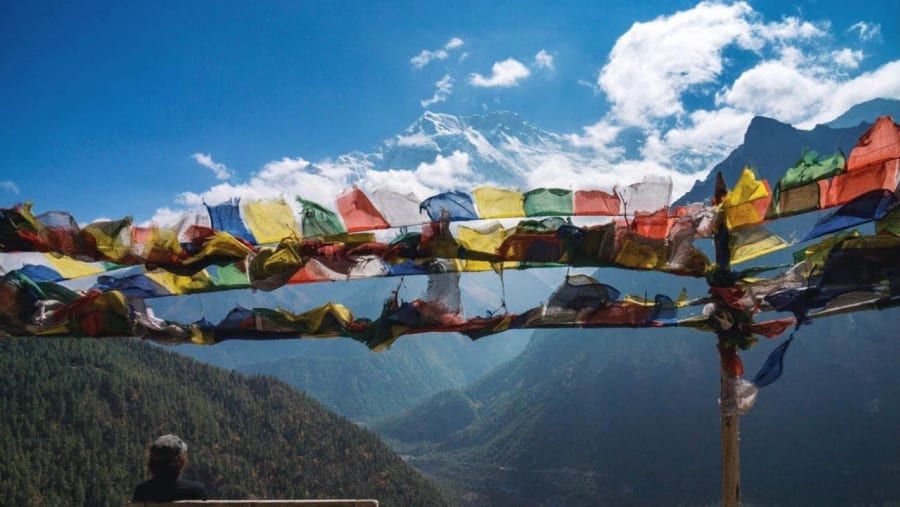
Embark on a liberating Annapurna Circuit trek with visits to Tilicho Lake and Poon Hill. This journey combines majestic panoramic views, deep valleys, high mountains, and a remarkable variety of culture and terrain, from subtropical landscapes to high, dry scenery resembling the Tibetan Plateau. Along the way, explore Kathmandu's sacred sites, cross Thorong La Pass, visit the holy temple of Muktinath, and experience the beauty of Nepal's diverse mountain villages.
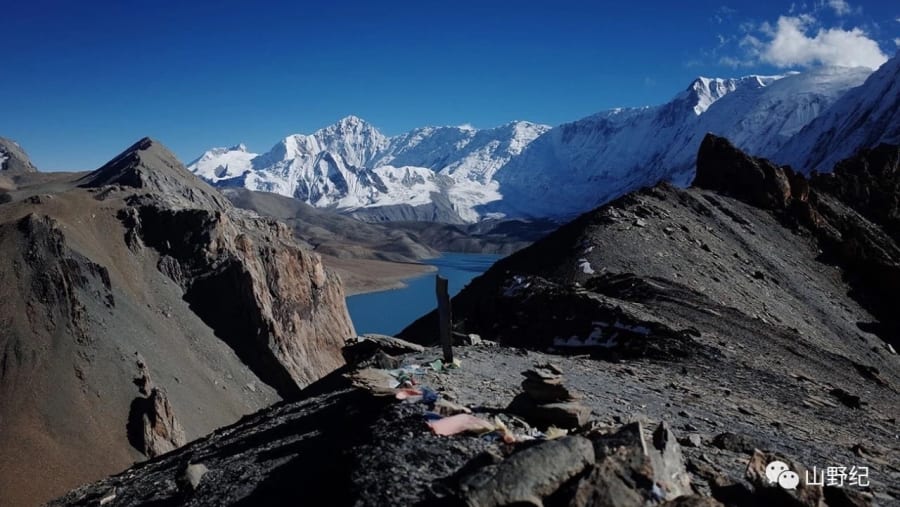
Visit Tilicho Lake, a large spectacularly set lake nestled at the foot of the north face of Tilicho Peak.
From the itinerary
At a glance
Day by day
Arrive at Tribhuvan International Airport (TIA) in Kathmandu and head to your hotel.
After breakfast, start a guided tour to several of the most historical and spiritual attractions in Kathmandu.
Visit the historic Durbar Square, the sacred Hindu temple of Pashupatinath, the famous "Monkey Temple" (Swayambhunath), and the Buddhist shrine of Boudhanath, one of the largest stupas in the world.
At noon, head out for a pre-trip discussion where you can meet your trek leader and other team members.
Spend the night in Kathmandu.
Begin your long drive to Syange early in the morning.
En route, enjoy the countryside of Nepal with its green hills, winding rivers, terraced farms, and of course the mighty Himalayas.
Stay the night in Syange.
Enter Manang district after crossing a large bridge near Tal.
Marvel as the trail passes through barley, rice, and potato fields, while waterfalls continue to accompany you.
Pass through the village of Kodo before reaching Dharapani, one of the biggest villages in the Manang Valley.
Stay the night in Dharapani.
Negotiate a few steep forested ridges along with several landslides on the route to Chame.
Do not forget to look up, though, as you will be greeted with remarkable views of Lamjung Himal, Annapurna II, and Annapurna IV (7,525 m).
Take a dip in the small hot springs that you come across.
Spend the night in Chame.
Walk through a steep and narrow valley to have your first view of Paungda Danda rock face, a dramatic curved wall of rock rising 1,500 m from the river.
From here, savour the views of Annapurna II to the south and Pisang Peak to the northeast.
Descend to the Manang Valley floor while enjoying the captivating landscape.
Spend the night in Pisang.
While there are two routes to Manang, choose the one that passes through Upper Pisang via Geru.
Get outstanding views of Mt. Annapurna, Pisang Peak, and others.
A short visit to Barge Monastery, the biggest monastery in the Manang District, should cheer you up.
Spend the night in Manang.
Utilize the day to acclimatize for the gruelling trek ahead.
Take a short hike to either Bhojo Gumba or Gangapurna Lake.
If you have the energy, hike to Vraga Village, where you can visit the Himalayan Rescue Association to get some idea about Acute Mountain Sickness (AMS).
Spend the night in Manang.
From Manang, head out through the western gates and follow the path down to the river.
Cross the river and continue walking on its southern side through coniferous forest.
After reaching Kangsar Village, walk further up towards Siri Kharka and pass a monastery on the way.
Let the presence of Gungang Himal and Mt. Chulu in the backdrop keep you company.
Spend the night in Siri Kharka.
Take note that while the path from Siri Kharka to Tilicho Base Camp is not very steep or physically strenuous, it can still be exhausting.
Walk on narrow paths through loose scree and landslide areas.
Marvel at the impressive rock formations as your trail goes through the middle of the landslide area.
Spend the night in Tilicho Base Camp.
Note that after the initial tough, steep, switchback ascent, your trail continues to hug the side of the mountain in a gradual to steep incline before reaching the watershed.
On the way, enjoy seeing yaks and deer grazing above and below your trail.
Visit Tilicho Lake, a large spectacularly set lake nestled at the foot of the north face of Tilicho Peak. The lake was referred to by the leader of the French expedition team as "The Great Ice Lake." The lake also holds an important place for Hindus, as this sacred lake features in one of their holiest texts, the Ramayan.
Retrace your steps and return to Siri Kharka for an overnight stay.
Leave Siri Kharka and descend towards Khangsar Village.
On the way, pass Tare Gumba, a thousand-year-old monastery that is very important to the local people.
Upon reaching Khangsar Village, notice that it is uninhabited except for occasional herders during festival times.
Follow a rock wall out of Khangsar and walk further until you reach a seasonal bridge in the Thorang Khola valley.
After crossing the river, ascend for a while to a plateau.
Continue walking until reaching Yak Kharka for the night.
Make an uphill walk to Thorong Phedi.
After walking for some time, cross a suspension bridge and reach Ledar village.
Ascend further and pass through towering cliffs before reaching Thorong Phedi, the last village before Thorong La.
Feel rewarded with one of the best views of Mt. Gundang, Mt. Syagang, Thorung Peak, and Mt. Khatungkan.
Stay the night in Thorong Phedi.
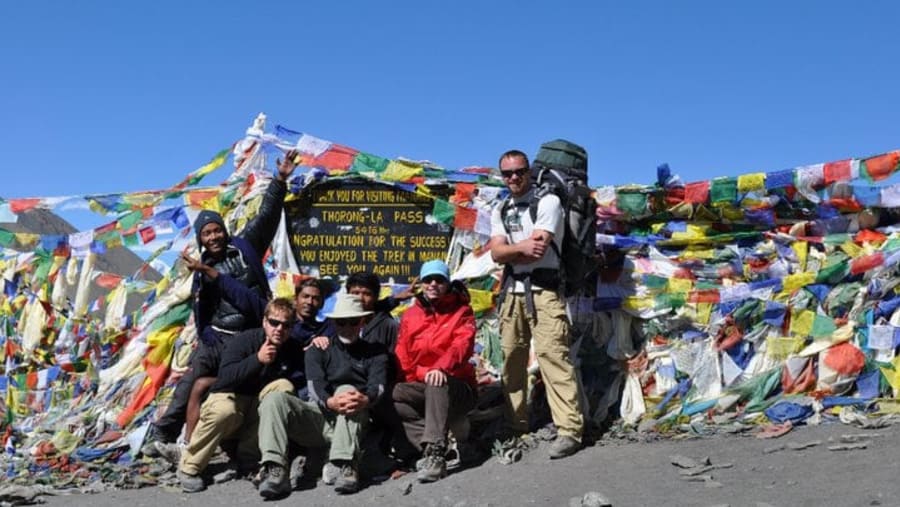
Crossing Thorong La Pass, one of the highest passes in the world, will be your ultimate objective today.
Get up around three in the morning and walk up the mountain as you cross the pass from east to west (Manang to Muktinath), which is the easiest and safest direction.
Reach the top and take a few photos before heading down to Muktinath Valley at the foot of the Thorong La Pass.
Spend the night in Muktinath.
Visit Muktinath Temple, a sacred place for both Hindus and Buddhists.
After the visit, drive to Tatopani and spend the night there.
Leave the Kali Gandaki and head up the Ghar Khola valley. The trail leads you through terraced farmland with mountains all around.
Pass through the villages of Shikha and Chitre before reaching a beautiful rhododendron forest.
Continue walking to reach Ghorepani, a beautiful village located on a ridge top.
Spend the night in Ghorepani.
To catch the sunrise over the Himalayas, make an early morning climb along the steep trail to the viewpoint of Poon Hill (3,210 m / 10,529 ft), the most popular trekking destination of the Annapurna region.
Savour the moment as you reach Poon Hill viewpoint and enjoy amazing views of Mustang, Pokhara, and more than 20 of the highest mountains, including close-up views of the Annapurna and Dhaulagiri ranges.
Get spellbound as the snowy peaks of the high mountains loom above and around you, glowing in the morning light.
After taking photographs, return to Ghorepani.
After breakfast, head east and climb a nearby ridge.
Descend through rhododendron forests, passing spectacular waterfalls, and reach Tadapani to spend the night.
Note that the trek from Tadapani to Ghandruk passes through a thick forest of rhododendron trees.
After trekking for a while, enter the village of Ghandruk, a slope settlement with stone houses mostly inhabited by the Gurung people.
From here, enjoy the towering views of the Fishtail, Annapurna South, and Hiunchuli mountains.
Trek further to Naya Pul, then drive to Pokhara.
Spend the night in Pokhara.
After breakfast, drive towards Kathmandu.
After reaching Kathmandu, take the rest of the day off to rest or do some souvenir shopping.
To celebrate the successful completion of the journey, head out for a farewell dinner in the evening.
Head to the airport and fly back.

Where this trip takes you
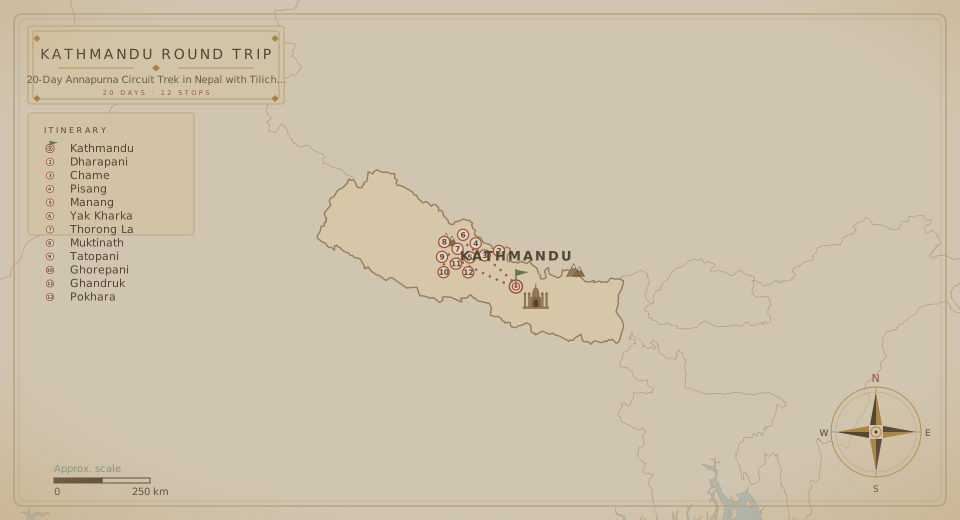
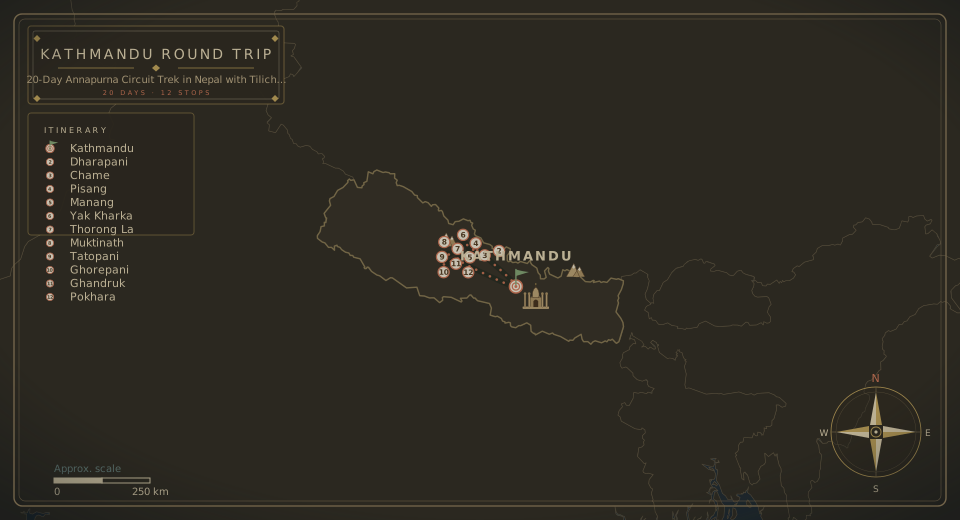
Tilicho Lake, Thorong La Pass, Poon Hill
The route
The fine print
Airport pickups and drops in a private vehicle
3-star category hotel accommodation in Kathmandu and Pokhara with breakfast
Teahouse accommodation during the trek
All meals (breakfast, lunch, and dinner) during the trek
Farewell dinner
Most ground transportation as per the itinerary
Public transportation from Muktinath to Tatopani
City tour in Kathmandu by private vehicle
An experienced, English-speaking, government-licensed trek leader and assistant trek leader
Porter service (2 trekkers: 1 porter)
Staff costs, including salary, insurance, equipment, food, and accommodation
All necessary paperwork and trekking permits (ACAP, TIMS)
Medical kit (carried by your trek leader)
All government and local taxes
Not included in the cost
Nepalese visa fee
International airfare to and from Kathmandu
Excess baggage charges
Lunch and dinner in Kathmandu and/or Pokhara
Extra night accommodation in Kathmandu and Pokhara in case of early arrival, late departure, or early return from the mountain due to any reason other than the scheduled itinerary
Travel and rescue insurance
Personal expenses (phone calls, laundry, bar bills, battery recharge, extra porters, bottled or boiled water, shower, etc.)
Tips for guide(s), porter(s), and driver
Valid passport
2 extra passport-size photos
Airline tickets
Separate photocopies of passport
Visa form
Proof of insurance
Dollars, pounds, or euros in cash
Credit cards, bank/ATM cards, or cash machine cards
Bandana or head scarf
Warm hat that covers your ears
Headlamp with extra batteries and bulbs
Sunglasses with UV protection
Prescription sunglasses (if required)
Polypropylene shirts (1 half-sleeve and 2 long-sleeve)
Light and expedition-weight thermal tops
Fleece wind-stopper jacket or pullover
Waterproof shell jacket
Down vest and/or jacket
Gore-Tex jacket with hood
1 pair of lightweight poly-liner gloves
1 pair of lightweight wool or fleece gloves
1 pair of mittens
Non-cotton underwear briefs
1 pair of hiking shorts
1 pair of hiking trousers
1 pair of lightweight thermal bottoms
1 pair of fleece or woolen trousers
1 pair of waterproof shell pants
2 pairs of thin, lightweight inner socks
2 pairs of heavy poly or wool socks
1 pair of hiking boots with spare laces
1 pair of trainers or running shoes and/or sandals
Cotton socks (optional)
Gaiters (winter only, optional)
1 sleeping bag
Fleece sleeping bag liner (optional)
1 medium rucksack
1 large duffel bag
A small daypack/backpack
Small padlocks for duffel-kit bags
2 large waterproof rucksack covers (optional)
Small personal first-aid kit
Aspirin, first-aid tape, and plasters (Band-Aids)
1 skin-blister repair kit
Anti-diarrhea pills
Anti-headache pills
Cough and/or cold medicine
Anti-altitude sickness pills
Stomach antibiotic
Water purification tablets or water filter
1 set of earplugs
Extra pair of prescription glasses and contact lens supplies
1 small roll of repair tape
1 sewing-repair kit
1 cigarette lighter
1 small box of matches
1 compass or GPS (optional)
1 alarm clock/watch
1 digital camera with extra cards and batteries
Large Ziploc bags
2 water bottles (1 liter each)
1 small folding knife
Binoculars (optional)
4 large, waterproof, disposable rubbish sacks
1 medium-sized quick-drying towel
Toothbrush/paste
Multi-purpose soap
Deodorants
Nail clippers
Face and body moisturizer
Female hygiene products
Small mirror
Wet wipes (baby wipes)
Tissue/toilet roll
Anti-bacterial hand wash
Reading book
Trail map/guide book
Journal and pen
iPod
Travel game, i.e. chess, backgammon, scrabble, or playing cards
1 modest swimsuit
Voltage converter (from 220 to 110)
Plug adapter (2 round pegs to 2 flat pegs)
Lightweight pillowcase
Important documents and items
Valid passport, 2 extra passport-size photos, and airline tickets
Separate photocopies of your passport, visa form (easily obtained at Kathmandu airport), and proof of insurance
Dollars, pounds, or euros in cash for purchasing a Nepalese visa at Kathmandu airport, paying for restaurants and hotels, gratuities, snacks, and your own drinks and gifts
Credit cards, bank/ATM cards, or cash machine cards for withdrawing funds from cash machines (bring a photocopy of your cards), traveler's checks, etc.
Head
Bandana or head scarf, also useful for dusty conditions
Warm hat that covers your ears (wool or synthetic)
Headlamp with extra batteries and bulbs
Sunglasses with UV protection
Prescription sunglasses (if required)
Upper Body
Polypropylene shirts (1 half-sleeve and 2 long-sleeve)
Light and expedition-weight thermal tops
Fleece wind-stopper jacket or pullover
Waterproof shell jacket, preferably breathable fabric
Down vest and/or jacket *
Gore-Tex jacket with hood, waterproof and breathable
Hands
1 pair of lightweight poly-liner gloves
1 pair of lightweight wool or fleece gloves
1 pair of mittens consisting of 1 Gore-Tex over-mitt matched with a very warm polar-fleece mitt liner (seasonal)
Lower Body
Non-cotton underwear briefs
1 pair of hiking shorts
1 pair of hiking trousers
1 pair of lightweight thermal bottoms (seasonal)
1 pair of fleece or woolen trousers
1 pair of waterproof shell pants, breathable fabric
Feet
2 pairs of thin, lightweight inner socks
2 pairs of heavy poly or wool socks
1 pair of hiking boots with spare laces (sturdy soles, water-resistant, ankle support, "broken in")
1 pair of trainers or running shoes and/or sandals
Cotton socks (optional)
Gaiters (winter only), optional, "low" ankle-high version
Sleeping
1 sleeping bag (good to -10 degrees C or 14 degrees F) *
Fleece sleeping bag liner (optional)
Rucksack and Travel Bags
1 medium rucksack (50-70 liters / 3000-4500 cubic inches, can be used for airplane carry-on)
1 large duffel bag *
A small daypack/backpack for carrying your valuables, with good shoulder padding
Small padlocks for duffel-kit bags
2 large waterproof rucksack covers (optional)
Medical
Small personal first-aid kit (simple and light)
Aspirin, first-aid tape, and plasters (Band-Aids)
1 skin-blister repair kit
Anti-diarrhea pills
Anti-headache pills
Cough and/or cold medicine
Anti-altitude sickness pills: Diamox or Acetylzolamide
Stomach antibiotic: Ciprofloxacin, etc. Do not bring sleeping pills, as they are a respiratory depressant.
Water purification tablets or a water filter
1 set of earplugs
Extra pair of prescription glasses and contact lens supplies
Practical Items
1 small roll of repair tape and 1 sewing-repair kit
1 cigarette lighter and 1 small box of matches
1 compass or GPS (optional)
1 alarm clock/watch
1 digital camera with extra cards and batteries
Large Ziploc bags
2 water bottles (1 liter each)
1 small folding knife
Binoculars (optional)
4 large, waterproof, disposable rubbish sacks
Toiletries
1 medium-sized quick-drying towel
Toothbrush/paste (preferably biodegradable)
Multi-purpose soap (preferably biodegradable)
Deodorants
Nail clippers
Face and body moisturizer
Female hygiene products
Small mirror
Personal Hygiene
Wet wipes (baby wipes)
Tissue/toilet roll
Anti-bacterial hand wash
Extras/Luxuries
Reading book
Trail map/guide book
Journal and pen
iPod
Travel game, i.e. chess, backgammon, scrabble, or playing cards (to help you pass the time at teahouses and/or camps)
1 modest swimsuit
Binoculars (optional)
Voltage converter (from 220 to 110)
Plug adapter (2 round pegs to 2 flat pegs)
Lightweight pillowcase (in case your teahouses provide you with pillows), or use your own stuff as a pillow
Note: If you arrive earlier for personal reasons than the itinerary schedule, the money will not be refunded.
Logistics
Your 20 days finish where they began.
 Watch the film
Create your own adventure
Say goodbye to travel stress.
Starting from
Estimated room rates
When
Travellers
Total
—