
12-Day Cameroon Culture and Rainforest Tour with Dja and Foumban

12 Days Round trip from Douala Moderate pace

The journey

Trip highlights
  • 01 Enter the UNESCO-listed Dja Faunal Reserve by pirogue and on foot with Baka guides
  • 02 See the Lobé Falls drop directly into the Atlantic near Kribi
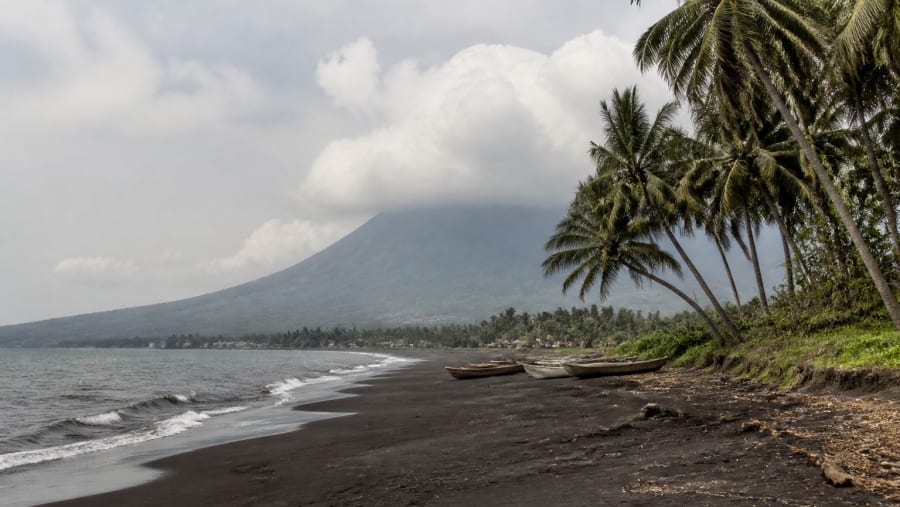
  • 03 Explore Limbe's black volcanic beaches beneath Mount Cameroon
  • 04 Visit Bimbia's little-visited slave-trade ruins on the Fako coast
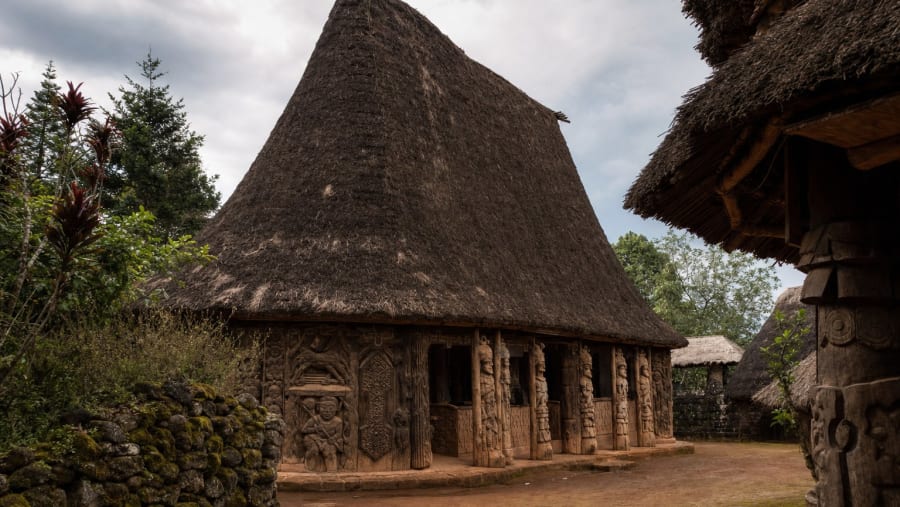
  • 05 Discover the living Bamileke chefferie at Bandjoun in the western highlands
  • 06 See King Njoya's script, royal regalia, and artisan workshops in Foumban

Cameroon has been called Africa in miniature for so long that the phrase has gone soft, but in twelve days the arithmetic holds up. This route runs from Atlantic surf on black volcanic sand beneath Mount Cameroon to the equatorial rainforest of the Dja Faunal Reserve, then up into the cool green Grassfields kingdoms of the western highlands. Along the way, it takes in Bimbia's slave-trade ruins, the Lobé Falls dropping straight into the sea, and the living courts of Bandjoun and Foumban. It is not an easy country to travel casually, which is exactly why this itinerary is built around what is actually safe, actually rewarding, and actually worth the drive.

At a glance

What this trip includes

Duration 12 Days
Tour type Private
Activity level Moderate
Accommodation Included · Standard
Transport Included
Wheelchair access No
Cities Yaounde, Douala, Bafoussam, Foumban, Kribi, Mount Cameroon, Limbe
Languages English

Day by day

The itinerary

1
Day 01

Douala Arrival on the Wouri Estuary

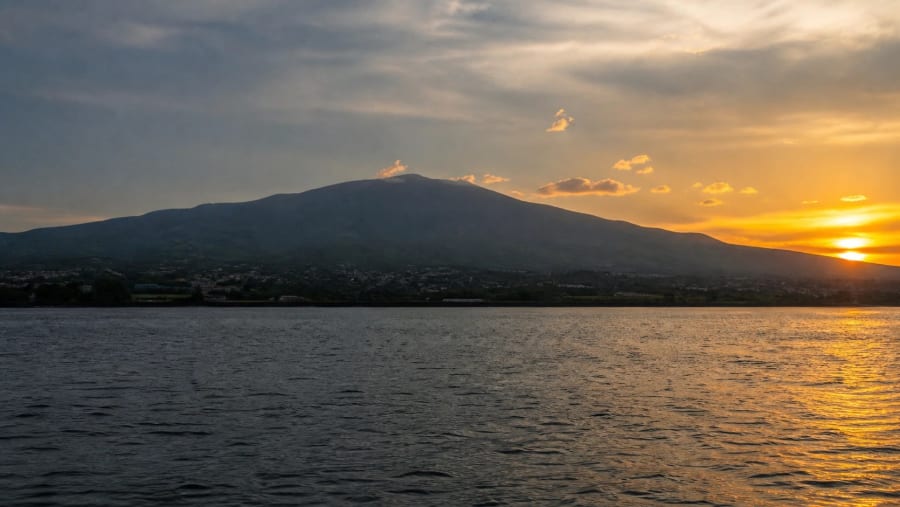
Fly into Douala, Cameroon's port and its loudest city, and meet the team at the airport. The rest of the day is intentionally soft after a long flight: a first drive through a city of markets, traffic, and rain-blackened concrete, and, if the light is right, the estuary at sunset, where Mount Cameroon rises out of the sea on the far horizon - the view that tells you what kind of country you have landed in.
2
Day 02

Douala to Limbe and the Black Sand Coast

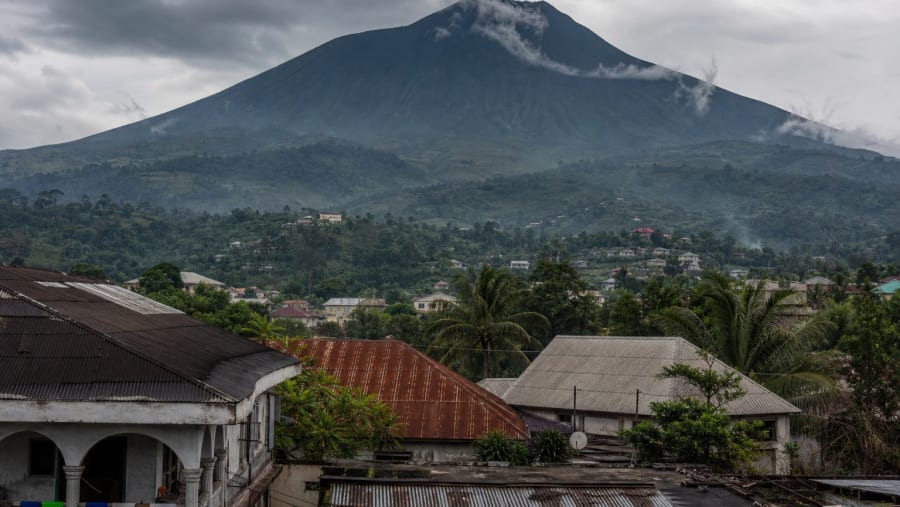
Travel west along the coast to Limbe, an hour and a half away at the foot of Mount Cameroon. The Limbe Botanic Garden has been running since 1892 and is a good, shaded introduction to what grows here; the Limbe Wildlife Centre next door holds drills, chimpanzees, and gorillas recovered from the bushmeat trade and is the best-run conservation project on this coast.

The afternoon is for the black volcanic beaches at Down Beach and Seme, and grilled fish where the boats land.

3
Day 03

Bimbia Ruins and the Lower Slopes of Mount Cameroon

A short drive and a walk through forest bring you to Bimbia, where the ruins of one of the busiest slave-trade departure points in this part of Africa sit almost unvisited: the barracoon foundations, the chained-together stones, and the path down to the water. It is a quiet, difficult, necessary morning.

In the afternoon, climb into the lower slopes of Mount Cameroon through old lava flows and tea estates for the view back down over the coast.

4
Day 04

Limbe to Kribi and the Lobé Falls at Dusk

A long coastal transfer south, skirting Douala, brings you to Kribi, a small Atlantic town with the best beaches in the country and a great deal less noise than anywhere you have been so far. You arrive with the afternoon still in hand and go straight to the Lobé Falls, five kilometres down the coast, where the river drops across the rock shelf into the surf.

Dinner is fish on the beach, which is what Kribi is for.

5
Day 05

Lobé River Pirogue and Ebodjé Turtle Coast

Take a morning pirogue up the Lobé River above the falls, into forest where Bagyeli families live and fish, with time to walk and talk rather than photograph and leave.

In the afternoon, continue south to Ebodjé, a fishing village on a turtle-nesting coast where a community conservation project monitors the beaches; between November and February you may see nests, and out of season you will at least understand the work. Return to Kribi in the evening.

6
Day 06

Kribi to Yaoundé and the Capital's Museums

Head north-east away from the coast, through rubber and palm plantations and small roadside towns, to Cameroon's capital. Yaoundé is spread over seven hills, greener and calmer than Douala, and the afternoon takes in the National Museum in the old presidential palace - the best single explanation of the country's hundreds of cultures - and the view over the city from Mont Fébé before dinner.

7
Day 07

Yaoundé to Somalomo on the Edge of the Dja

This is a hard, interesting day east and then south on deteriorating road, past Ayos and the Nyong, into the forest belt and the village of Somalomo on the northern edge of the Dja Faunal Reserve. The last stretch is slow going.

You arrive in the afternoon, meet the reserve staff and the Baka guides who will take you in, and settle into simple guesthouse accommodation; this is the least comfortable night of the trip and the most interesting place you will sleep.

8
Day 08

Inside the Dja Faunal Reserve

Spend the whole day inside the reserve. Travel by pirogue on the Dja itself, then continue for hours on foot with Baka trackers on trails that were not made for visitors: buttress roots the size of walls, hornbill calls overhead, elephant sign in the mud, and monkey troops moving through the canopy.

The Dja holds forest elephants, western lowland gorillas, and chimpanzees, but this is dense forest and it does not hand you sightings. What it gives you instead is the closest thing left to an intact Congo Basin rainforest, and people who read it like text.

9
Day 09

A Day with the Baka and Return West

The morning belongs to the Baka community: the forest pharmacy walk, the traps and the net hunt, and, if the mood is right, the polyphonic singing that anthropologists have been trying to notate for fifty years. This is arranged directly with the community and paid to it.

In the afternoon, start back west, breaking the drive at Ayos or Abóng-Mbang so the following day is not brutal.

10
Day 10

Into the Grassfields and Bandjoun Chefferie

Travel north-west out of the forest and up onto the western highlands, a change of climate from wet heat to cool green hills terraced with maize and coffee.

In the afternoon, visit the Bandjoun chefferie, one of the great living courts of the Grassfields, known for its carved wooden pillars, conical thatch, and beaten-earth courtyards. The museum beside it helps explain what you are seeing rather than leaving you to guess.

11
Day 11

Foumban and the Bamoun Sultanate

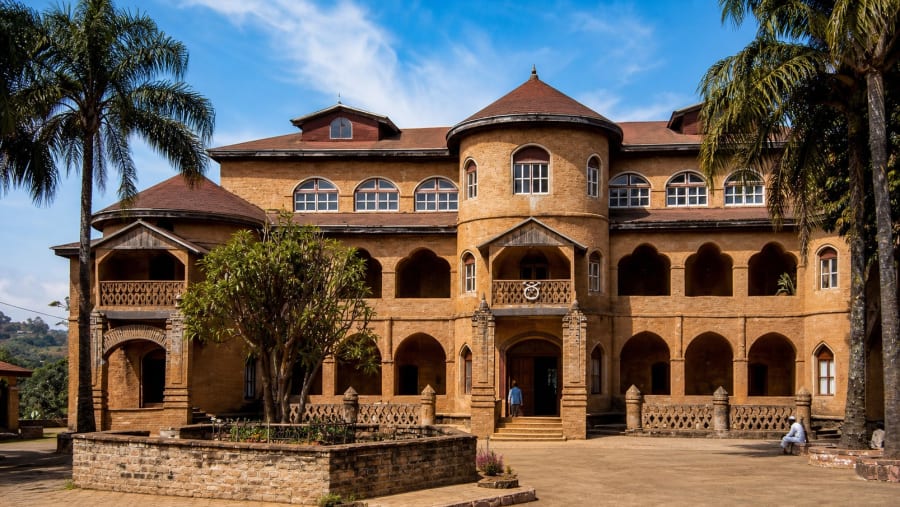
Travel east across the Noun to Foumban and the Bamoun court, unbroken since 1394. The royal palace of 1917 and the museum inside it hold the thrones, the beaded masks, and the manuscripts written in King Njoya's invented script; the newer Museum of the Bamoun Kings tells the dynasty's story in full.

The afternoon is for the artisans' quarter - bronze casters, carvers, embroiderers, the best craft street in Central Africa - and the Sultan's Friday court if the day falls right.

12
Day 12

Foumban to Douala for Departure

Make the long descent back to the coast, out of the highlands and down through the plantations to Douala, timed for an evening international departure. It is a full driving day and the journey is broken properly; if your flight is late enough, there is time for a last lunch and a shower before the airport.

Gabon or São Tomé can be added to either end of this route.

The route

Where you'll travel

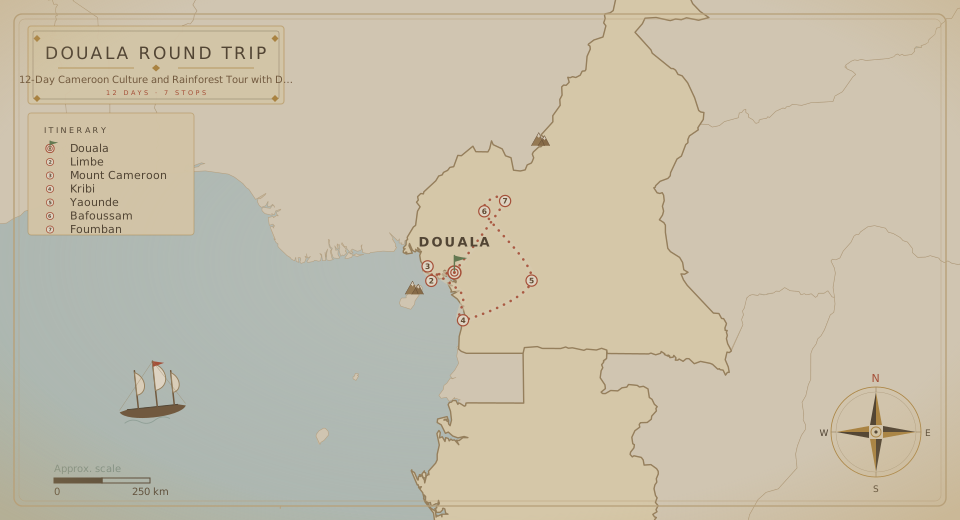
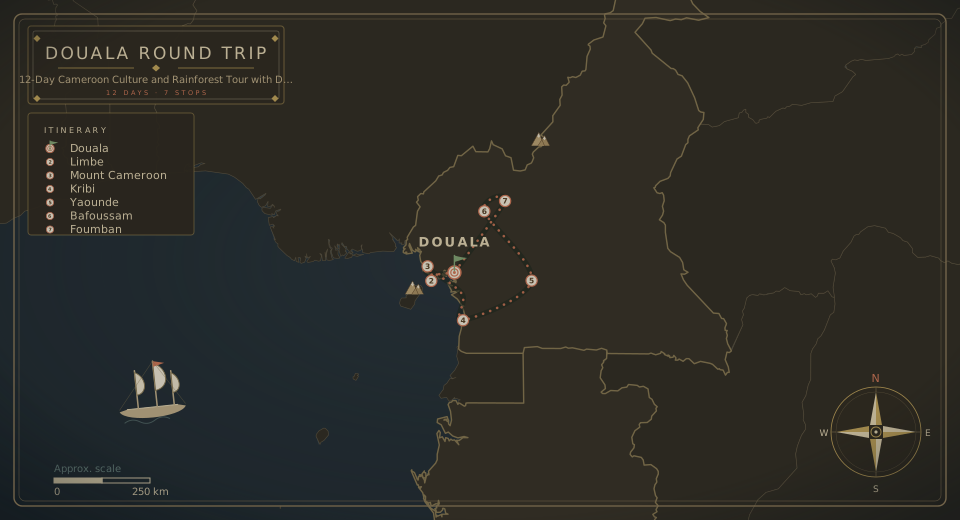
Tour route map
Round trip from Douala 7 cities · 12 Days

The fine print

Trip details

What's Included

  • Littoral, Southwest coast (Fako), South, Centre, East, and West; the Far North and the interior of the Northwest are deliberately not on this route.
  • Eleven nights: comfortable hotels in Douala, Limbe, Kribi, Yaoundé, Bafoussam, and Foumban, and two nights in simple guesthouse accommodation at the edge of the Dja.
  • Limbe Botanic Garden and Wildlife Centre (Day 2); Bimbia (Day 3); Lobé Falls and the river pirogue (Days 4-5); Ebodjé and the turtle project (Day 5); the National Museum (Day 6); two full days in the Dja Reserve with Baka guides (Days 8-9); the Bandjoun chefferie (Day 10); the Foumban palace, museums, and artisans' quarter (Day 11).
  • Private 4WD with a professional driver for the full route, all airport transfers, and every pirogue.
  • An English-speaking Cameroonian guide throughout, plus reserve rangers and Baka guides in the Dja and local guides at Bimbia, Bandjoun, and Foumban.
  • Dja Reserve entry and guiding fees, all site and museum entries, and the community payments to the Baka and Bagyeli communities.
  • Daily breakfast, and all meals on the two Dja days, where there is nowhere else to eat. Other lunches and dinners are at your own expense: Cameroonian roadside cooking is one of the pleasures of the trip, and your guide knows where to stop.

What's Not Included

  • International flights to Douala
  • The Cameroon e-visa
  • Travel insurance
  • Remaining meals
  • Alcohol
  • Personal expenses
  • Tips

What to bring

  • Comfortable walking shoes
  • Sun protection and a hat
  • A light layer for cooler evenings
  • Your passport valid for at least six months
  • Some cash in local currency

Logistics

Meeting & route

Meeting point
Douala
Tour start
Douala
Tour ends at the same location as the start point.
End of the journey

Your 12 days finish where they began, in Douala.

Watch the tourHQ film Watch the film

Create your own adventure

Can't find the perfect tour? Tailor your dream trip.

  • Tell us your destination, dates and group size.
  • Our travel experts and local guides design a tailored itinerary, just for you.
  • Enjoy your trip with peace of mind, knowing everything is taken care of.
Plan my holiday

Say goodbye to travel stress.

Starting from

USD 6,215 /person
Book This Tour

When

Travellers

Total
