
8-Day Kilimanjaro Lemosho Route Trek to Uhuru Peak

8 Days Round trip from Moshi Moderate pace

The journey

Trip highlights
  • 01 Follow the quieter, scenic Lemosho Route with gradual elevation gain and excellent acclimatization
  • 02 Trek through changing ecosystems: rainforest, moorland, Shira Plateau, and alpine desert
  • 03 Acclimatization milestones including Shira Cathedral (conditions permitting) and Lava Tower (~4,600 m)
  • 04 Conquer the famous Barranco Wall with guided support (non-technical, hands for balance in places)
  • 05 Midnight summit attempt to Uhuru Peak (5,895 m) via Stella Point, then descend to Mweka Gate and return to Moshi

Trek to the roof of Africa on an 8-day Mount Kilimanjaro adventure via the scenic Lemosho Route, starting from the Arusha/Moshi area. This route is known for its beautiful, varied landscapes—beginning in lush rainforest, crossing the wide-open Shira Plateau, and climbing through stark alpine desert toward the summit.

Built for strong acclimatization, you’ll “climb high, sleep low” at key points like Lava Tower and enjoy iconic sections such as the Barranco Wall before a midnight summit push to Uhuru Peak (5,895 m). After celebrating at the top, descend to Mweka Camp and finish with a final rainforest walk to Mweka Gate for park formalities and your certificate (if applicable), then transfer back to Moshi.

At a glance

What this trip includes

Duration 8 Days
Tour type Private
Activity level Moderate
Accommodation Included · Luxury
Transport Included
Wheelchair access No
Cities Moshi, Mount Kilimanjaro
Languages English

Day by day

The itinerary

1
Day 01

Londorossi Gate to Mti Mkubwa Camp

After breakfast, drive toward Londorossi Gate for registration and park formalities. Continue to the Lemosho trailhead and begin your trek through the beautiful montane rainforest.

The first section is peaceful and relatively gentle, with opportunities to see forest birds and other wildlife. Your first mountain dinner and overnight stay will be at Mti Mkubwa (Big Tree) Camp.

Elevation: approximately 2,100-2,900 m
Hiking: 3-4 hours
Overnight: Mti Mkubwa Camp
Environment: Rainforest
2
Day 02

Mti Mkubwa to Shira 1 Camp

Leave the rainforest behind as the landscape changes into open moorland. The trail climbs gradually toward the Shira Plateau, with increasingly impressive views of Kibo.

Arrive at Shira 1 Camp, enjoy lunch, and take time to relax and acclimatize.

Elevation: approximately 2,900 to 3,500-3,600 m
Hiking: 5-7 hours
Overnight: Shira 1 Camp
Environment: Moorland

3
Day 03

Shira 1 via Shira Cathedral to Moir Area

Today is designed as an important acclimatization day.

Cross the spectacular Shira Plateau and, conditions permitting, make a short acclimatization excursion toward Shira Cathedral. After enjoying the panoramic views, continue toward the Moir area/Moir Hut, one of the quieter sections of the route.

The evening is spent resting, hydrating, and preparing for the higher elevations ahead.

Elevation: approximately 3,600 to 4,000+ m
Hiking: 5-7 hours
Overnight: Moir area/Moir Camp
Environment: High moorland/alpine terrain

4
Day 04

Moir Area to Lava Tower and Barranco Camp

This is one of the most important acclimatization days.

Climb gradually toward Lava Tower, reaching around 4,600 m. After lunch and an acclimatization break, descend toward Barranco Valley.

This follows the important "climb high, sleep lower" principle: you experience a higher altitude during the day before sleeping lower at Barranco.

The descent reveals spectacular volcanic landscapes and giant groundsels before reaching Barranco Camp.

Highest point: approximately 4,600 m at Lava Tower
Barranco Camp: approximately 3,950 m
Hiking: 6-8 hours
Overnight: Barranco Camp
Environment: Alpine desert

5
Day 05

Barranco Wall to Karanga Camp

Wake early for the spectacular Barranco Wall section.

With your mountain crew's guidance, climb the wall using the established trekking trail. No technical climbing is required, although there are some sections where you use your hands for balance.

At the top, enjoy magnificent views across the Barranco Valley before continuing toward Karanga Valley.

This shorter afternoon gives you valuable time to rest and prepare for the summit phase.

Elevation: approximately 3,950 to 4,000 m
Hiking: 4-5 hours
Overnight: Karanga Camp
Environment: Alpine desert

6
Day 06

Karanga to Barafu High Camp

A relatively short but important day.

The trail climbs steadily toward Barafu Camp, your high camp and starting point for the summit attempt.

After arriving, have lunch, organize your summit equipment, and receive a briefing from your guide.

Enjoy an early dinner and rest as much as possible because the summit attempt begins during the night.

Elevation: approximately 4,000 to 4,600 m
Hiking: 3-4 hours
Overnight: Barafu Camp
Environment: Alpine desert

7
Day 07

Summit Day to Uhuru Peak and Descent to Mweka Camp

Around midnight, begin the final ascent.

Move slowly through the darkness toward the crater rim. After reaching Stella Point, continue along the crater rim toward Uhuru Peak, the highest point in Africa.

Uhuru Peak - 5,895 m

Celebrate your achievement, take photographs, and enjoy the incredible summit views as conditions allow.

After the summit, descend carefully toward Barafu for a short rest and refreshments. Continue down to Mweka Camp, where you spend your final night on the mountain.

Barafu: ~4,600 m
Stella Point: ~5,750 m
Uhuru Peak: 5,895 m
Mweka Camp: ~3,100 m
Trekking: approximately 12-15 hours
Overnight: Mweka Camp
Environment: Alpine desert to upper forest

8
Day 08

Mweka Camp to Mweka Gate and Return to Moshi

After breakfast, begin your final descent through the lush Kilimanjaro rainforest.

Reach Mweka Gate, complete the park formalities, and receive your summit certificate if applicable.

Your vehicle will then transfer you back to Moshi for a well-earned shower, celebration, and overnight stay or onward travel.

End of the Kilimanjaro adventure.

Elevation: approximately 3,100 to 1,640-1,800 m
Hiking: 3-5 hours

The route

Where you'll travel

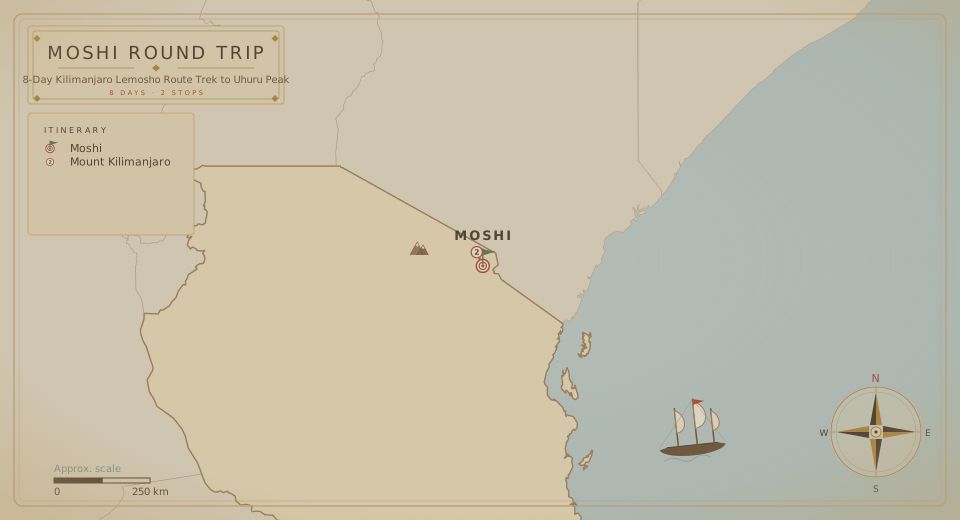
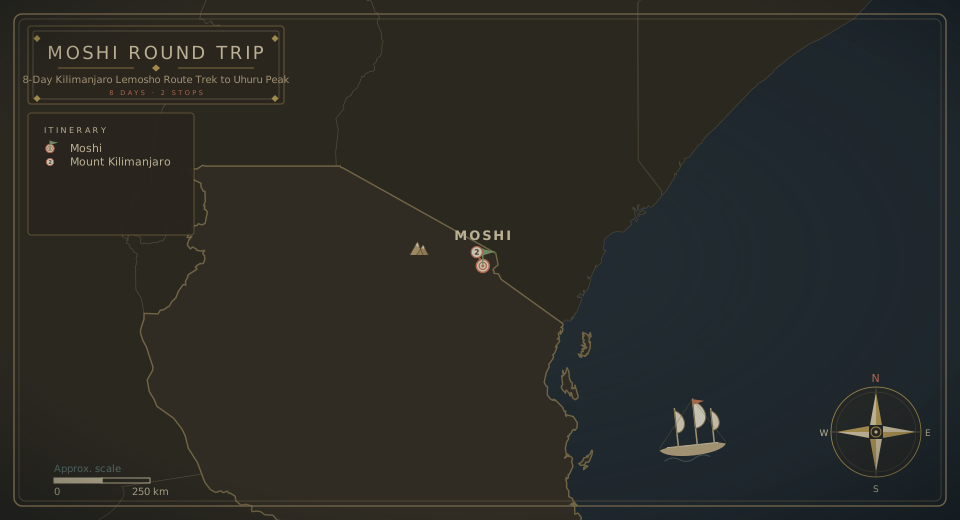
Tour route map
Round trip from Moshi 2 cities · 8 Days

The fine print

Trip details

What's Included

  • Hotel accommodation before or after the climb, unless stated

  • Private Kilimanjaro trekking program

  • Professional, experienced English-speaking mountain guide

  • Assistant guides depending on group size

  • Professional mountain crew

  • Mountain crew wages and staff support

  • All Kilimanjaro National Park entry fees

  • Camping fees

  • Rescue/evacuation fees required by the park

  • 7 nights mountain camping

  • Quality 3-season mountain tents

  • Sleeping mats

  • Dining tent and camping furniture

  • All meals on the mountain: breakfast, lunch, and dinner

  • Drinking water throughout the trek

  • Hot water for washing each day

  • Park and camping permits

  • Government taxes and applicable conservation fees

  • Emergency first-aid kit

  • Oxygen cylinder for emergency use

  • Pulse oximeter for altitude monitoring

  • Summit briefing and safety guidance

  • Airport/Arusha-Moshi transfers as specified in the package

  • Trekking certificates after successful summit completion

  • Porter support for group equipment and luggage

  • Pre-climb briefing and equipment check

What's Not Included

  • International flights

  • Tanzania visa fees

  • Travel insurance

  • Personal medical insurance

  • Personal trekking equipment and clothing

  • Sleeping bag, unless specifically added to the package

  • Meals and drinks outside the mountain package

  • Alcoholic and soft drinks

  • Tips for guides, porters, and other mountain crew

  • Personal expenses

  • Laundry services

  • Internet/Wi-Fi expenses

  • Personal snacks and energy supplements

  • Extra accommodation caused by early arrival, delayed departure, or failed summit attempt

  • Helicopter evacuation or other costs not covered by the applicable rescue arrangement/insurance

  • Any additional activities not mentioned in the itinerary

  • Anything else not specifically listed under Included

What to bring

  • Clothing

    • 3-4 moisture-wicking T-shirts

    • 2-3 trekking trousers

    • 1-2 thermal base-layer tops

    • 1 thermal bottom

    • Fleece jacket

    • Warm/down insulated jacket

    • Waterproof rain jacket

    • Waterproof rain trousers

    • Warm gloves + lightweight gloves

    • Warm hat/beanie

    • Sun hat/cap

    • Buff or neck gaiter

    • 4-5 pairs of hiking socks

    • Underwear for the trek

  • Footwear

    • Broken-in waterproof hiking boots

    • Lightweight camp shoes/sandals

    • Gaiters

  • Summit-night equipment

    • Warm insulated jacket

    • Thermal layers

    • Warm gloves

    • Warm hat

    • Headlamp + spare batteries

    • Sunglasses

    • Balaclava/face covering

    • Sleeping bag suitable for around -10°C to -15°C; confirm your operator's specific requirement.

  • Daypack

    • 20-30 L comfortable daypack

    • 2-3 L reusable water capacity

    • Water treatment if required

    • Snacks/energy bars

    • Sunscreen

    • Lip balm

    • Personal medication

    • Small personal first-aid items

    • Camera/phone

  • Duffel bag

    • Main trekking clothes and personal belongings

    • Keep the total weight within your operator/porter arrangement; porter loads are subject to park regulations.

  • Personal items

    • Toothbrush/toothpaste

    • Wet wipes

    • Toilet paper

    • Hand sanitizer

    • Small towel

    • Biodegradable soap

    • Personal toiletries

    • Small dry bags/plastic bags for keeping wet items separate

  • Electronics & documents

    • Passport

    • Travel/trekking insurance details

    • Phone

    • Camera

    • Power bank

    • Charging cables

    • Spare batteries if needed

Know before you go

  1. Fitness & Preparation
    Kilimanjaro is a high-altitude trek, not a technical climb. You should be comfortable walking for several hours on consecutive days. Training with hiking, uphill walking, and stair climbing before the trip is helpful.

  2. Altitude Is the Main Challenge
    The summit is 5,895 m (19,341 ft). Altitude sickness can affect anyone, regardless of fitness. The best approach is to:

    • Walk slowly - "pole pole"

    • Drink regularly

    • Eat even when your appetite is low

    • Follow your guide's instructions

    • Report symptoms such as headache, dizziness, nausea, or unusual weakness immediately

    • Never hide symptoms from your guide

  3. Expect Changing Weather
    You can experience warm sunshine, rain, strong wind, and freezing temperatures during the same trek. Temperatures near the summit can be well below freezing, particularly at night.
    Bring suitable layered clothing and waterproof protection.

  4. Pack Light
    Porters carry the permitted trekking luggage, but you should carry a small daypack containing essentials such as:

    • Water

    • Rain jacket

    • Warm layer

    • Sunscreen

    • Sunglasses

    • Personal medication

    • Snacks

    • Camera/phone

  5. Good Footwear Matters
    Wear comfortable, broken-in hiking boots or suitable trekking shoes. Do not start the mountain with brand-new footwear.
    Bring several pairs of good hiking socks.

  6. Hydration Is Important
    Carry sufficient water each day. Your mountain team will provide drinking water according to the itinerary.
    Avoid relying on thirst alone - drink regularly throughout the trek.

  7. Food on the Mountain
    Meals are prepared by the mountain cooking team. Tell us before departure about allergies, vegetarian requirements, or other dietary needs so the menu can be planned appropriately.

  8. Summit Night Is Different
    The summit attempt begins very early, usually around midnight. Expect a long trekking day involving darkness, cold temperatures, and significant elevation gain.
    The goal is to maintain a slow, steady pace rather than rushing.

  9. Medical Preparation
    Travelers should discuss high-altitude travel with a qualified healthcare professional if they have medical conditions, take regular medication, or have concerns about altitude.
    Bring your personal medication and keep it accessible.

  10. Travel Insurance
    Comprehensive travel insurance is strongly recommended. Check that your policy specifically covers high-altitude trekking up to the altitude of Kilimanjaro and emergency evacuation where applicable.

  11. Documents
    Before traveling, make sure you have:

    • Valid passport

    • Tanzania visa if required

    • Travel insurance documents

    • Flight information

    • Emergency contacts

    • Copies of important documents

  12. Communication
    Mobile coverage can be limited in some mountain areas. Your guide will remain your main point of contact, and the mountain team carries essential safety equipment.

  13. Leave No Trace
    Kilimanjaro is a protected environment. Travelers should:

    • Take all rubbish down

    • Avoid damaging vegetation

    • Stay on established trails

    • Respect wildlife and local regulations

    • Avoid unnecessary plastic waste

  14. Respect the Mountain Crew
    Guides, cooks, and porters are an important part of your Kilimanjaro experience. Treat the entire crew with respect and follow their safety instructions.

Logistics

Meeting & route

Meeting point
Hotel in Moshi
Tour start
Moshi
End of the journey

Your 8 days run from Moshi to Moshi.

Watch the tourHQ film Watch the film

Create your own adventure

Can't find the perfect tour? Tailor your dream trip.

  • Tell us your destination, dates and group size.
  • Our travel experts and local guides design a tailored itinerary, just for you.
  • Enjoy your trip with peace of mind, knowing everything is taken care of.
Plan my holiday

Say goodbye to travel stress.

Starting from

USD 1,850 /person
Book This Tour

When

Travellers

Total
