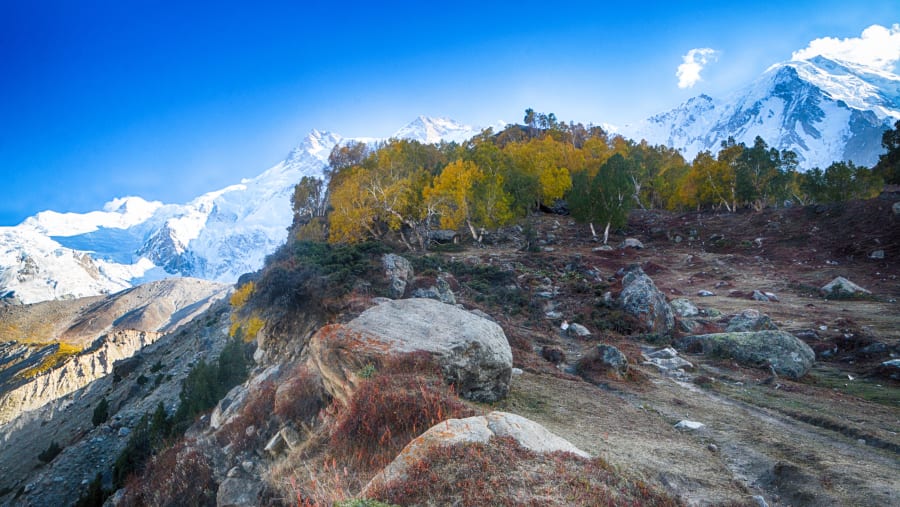
Day 01
Arrival in Islamabad
Start from your homeland to reach Islamabad and connect with your tour representative.


Explore the world with tourHQ
Pakistan · Trekking
The journey
This adventurous trek from Islamabad to Nanga Parbat via Mazeno Pass combines rugged terrain, breathtaking landscapes, and a demanding high-altitude route through one of Pakistan's most spectacular mountain regions. Travel along the Karakoram Highway to the trek head, then cross glaciers, alpine meadows, deep valleys, and remote camps with magnificent views of Nanga Parbat, the Rupal Valley, and surrounding peaks. The journey includes camping in the wilderness, encounters with local mountain communities, and challenging sections that require stamina, endurance, and technical trekking skills. Designed for experienced trekkers, it is a rewarding expedition through dramatic scenery and some of the most remote terrain in the world.
This adventurous trek from Islamabad to Nanga Parbat via Mazeno Pass combines rugged terrain, breathtaking landscapes, and a demanding high-altitude route through one of Pakistan's most spectacular mountain regions.
From the itinerary
At a glance
Day by day
Start from your homeland to reach Islamabad and connect with your tour representative.
Transfer to your hotel to freshen up. Board a minibus to start the tour by driving towards Chilas. You will travel on the Grand Trunk Road, which leads straight to Afghanistan. After an hour's drive on G.T. Road, turn north onto the Karakoram Highway. The Karakoram Highway is a joint effort of the Pakistan Army and Chinese engineers.
Lunch at Besham. Afterwards, continue the drive through the deep Indus gorge.
Arrive at Chilas on the bank of the Indus.
Transfer to a hotel for an overnight stay.
Drive early in the morning to Jaglot on the KKH. From Jaglot, board 4x4 jeeps and drive to the trek head.
Take a halt at Astore, 56 km from Jaglot. Astore is an important place, as many treks and jeep roads towards Deosai and Kashmir start here. The beginning of Rupal Valley is 30 km away from Astore. Most of the population here is Kashmiri- and Shina-speaking. In Trashing, the camping staff will welcome you.
Overnight camping in Trashing.
The first half-hour of the trek is steep, climbing up to the lateral moraine of Trashing Glacier. Then, it takes another half an hour to cross the glacier. On the other side of the glacier lies the lower Rupal Valley, with two large summer settlements and big wheat fields. From the lower Rupal Valley, the trail is green and gradually ascending.
After about a three-hour walk from here, you will reach Bazin, just under the solid ice wall of the east face of Nanga Parbat.
Camp overnight.
Today, start by walking on the Bazin Glacier, which takes about two hours.
After crossing the glacier, the trek goes through Juniper and Willow trees. The trail continues up the Rupal River. An hour's walk brings you to a place called Herligkoffer Base Camp. He was a famous climber and led eight expeditions to Nanga Parbat. Herligkoffer was also the leader of the Nanga Parbat Expedition in 1953, when Herman Buhl climbed it for the first time.
After a short stay here, walk further for about an hour and reach a place called Second Base Camp, another summer settlement. The campsite at Shaigiri is not very far from here. Usually, porters ask for a goat to slaughter and arrange a campfire with local songs and dances. Enjoy the beautiful views of the South Face.
Follow the lateral moraine of Rupal Glacier. You will see Nanga Parbat, Rupal Peak, and Laila Peak behind you. The campsite is at 4200 m altitude, with a few Juniper trees and a small water stream.
The trek is comparatively steep, ascending to the Mazeno Glacier, which comes straight from Mazeno Pass. The campsite is no longer green because of the height. Water is available. The high base camp is at 4724 meters.
Start early in the morning before sunrise. Climbing up to the pass is not very difficult, but the other side is steep and requires a rope, ice axe, seat harness, and crampons. The steep section is about 250 m in length.
After crossing the pass, the Loiba Glacier begins. Camp here at Upper Loiba at a height of 4300 m.
Today, trek down from Upper Loiba to Lower Loiba, called Loiba Meadows. It is a comfortable walk through lush green meadows and trees. The campsite consists of many shepherd houses at 4000 m.
Today, enjoy beautiful views of Nanga Parbat. The trek is very easy through pine and birch trees.
Enter the Kachal summer settlement at the base of Kachal Pass, 4400 m.
Camp at 3000 m.
From Kachal, four trek trails intersect. One goes to Kachal Pass, the second goes to Zangot, the third goes back to Loiba, and the fourth goes to Diamer Base Camp. Take the Diamer Base Camp trek.
En route, take a short stay in Kigali.
Reach Diamer Face Base Camp. The world's most famous mountaineer, Reinhold Messner, climbed Nanga Parbat from this side in 1979 and lost his brother on the way back. Take a short stay here for exploration and photography.
Walk back by the same route and camp at Zangot, 4200 m.
Start a steep trek down to the Diamer River to reach Dimroi.
From Dimroi, take 4x4 jeeps and continue towards Gilgit, the capital of the Northern Areas of Pakistan.
Reach Gilgit and transfer to your hotel.
Start with an early morning drive on the Karakoram Highway along the Indus River to Besham and catch exciting views of Nanga Parbat again from the Karakoram Highway.
Arrive at Besham, on the bank of the Indus.
Overnight in a motel.
Continue driving on the greener part of the Karakoram Highway to Islamabad. If time permits, you may stop at Taxila, the archaeological site of the Gandhara Buddhist civilization.
Arrive at Rawalpindi / Islamabad.
Transfer to a hotel for an overnight stay.
In the morning, transfer to the airport for your departure flight.
End of tour.
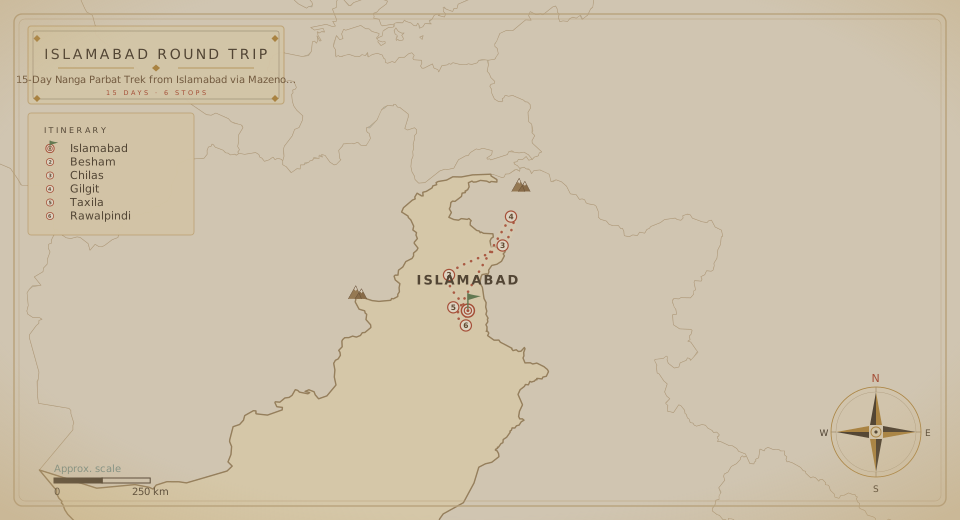
The route
The fine print
Accommodation on a twin-sharing basis at standard category hotels in cities, and in two-person dome tents during the trek
Meals: half board at the hotels, full board during the trek
Air-conditioned transport and soft-top 4x4 jeeps to the trek head and trek end
Camping facilities: two-person dome tents with mattresses, a dining tent with folding table and chairs, a kitchen tent with complete kitchenette and staff, and a toilet tent
Portage of 15 kg during the trek
Tips and portage at the airport and hotels
Entrance fees to sites and museums
English-speaking Pakistani tour guide
Domestic/international airfare and airport taxes
Any expenses due to forced measures, cancellation of flights, landslides, natural calamities, or circumstances beyond the control of our staff and agents
Any expenses of a personal nature not mentioned above
Headgear
Parka
Wool shirt & trousers
Sweater
Cotton shirt & pants
Cotton & wool undergarments
Belt
Spare laces for boots
Miscellaneous items
Sunglasses
Towel
Washcloth
Bandana/scarf for covering your mouth while riding in a jeep
Water bottle, with a durable screw top
Sunscreen
Headlamp with a flashlight with extra batteries and a bulb
Insect repellent
Swiss Army knife, or a similar multipurpose knife
Nylon cord for a clothesline
Personal medical kit
Pocket-size sewing kit
Lighter or matches for general use
Wristwatch
Thermarest. We provide closed-cell mattresses, but you may want more for additional comfort.
Sacks of various sizes for storing your used clothes
Toilet paper or a travel pack of tissues
An interesting book
Notebook and pen for a journal
Snacks: personal choice of dried fruit, candy, and energy bars
Binoculars
Camera, film, extra batteries, cleaning supplies, and extra lenses
Sports gear (playing cards/frisbee)
Water purification tablets
While on an organized trek, it is best to pack all items for your trip in one large piece and one carry-on. The large piece should be a duffel bag weighing no more than 12.5 kg, because duffels are easier for porters to carry. A small day pack is suggested as a carry-on to keep items that you will use while on the trek, bus, or jeep.
Bring a large duffel bag with a lock. It is not recommended to put your stuff in a backpack, as the straps might get damaged while being transferred from bus to jeeps, jeeps to campsites, and during loading and unloading by porters each day. A small padlock that fits through the zipper of your duffel bag is recommended.
The day pack should be large enough for camera gear, cap, sunglasses, water bottle, jacket, and other items you may like to use while on the trek.
A small fanny pack, money belt, or passport bag is suggested for safely keeping your passport, travel documents, and money.
Your sleeping bag should be suitable for sleeping in Concordia at 4,700 meters or at Snow Lake and Hispar Pass at 5151 meters above sea level, so the bag should be rated for 0 degrees F or -18 degrees C. Ratings are relative, since the amount of insulation needed for a particular person to stay comfortable depends on their rate of metabolism. A down bag will be warmer for its weight and packs smaller, but it does not retain its insulative properties when wet. A waterproof breathable shell or a bivy bag will help keep the bag dry. A synthetic bag keeps you warm even when wet and is a less expensive alternative, but it will weigh more for a given amount of warmth.
Trekking boots are the single most important item on this list. Never take brand-new boots on a trek; make sure they are well broken-in before departure. Good trekking boots are hard to get in Pakistan. If you are buying a new pair from abroad, look for medium-weight boots of fabric or a fabric/leather combination. They should provide adequate ankle support. Always use thick socks when trying shoes so that you get the correct size. Small shoes can jam your toes painfully during steep descents. You could also try to get new
Logistics
Your 15 days finish where they began, in New Islamabad Airport Rd.
 Watch the film
Create your own adventure
Say goodbye to travel stress.
Starting from
When
Travellers
Total
—