
Day 01
Arrival in Islamabad
Arrive at Islamabad International Airport, meet your tour guide, and transfer to the hotel.
Reach the hotel for dinner and an overnight stay.


Explore the world with tourHQ
China, Pakistan · Trekking
The journey
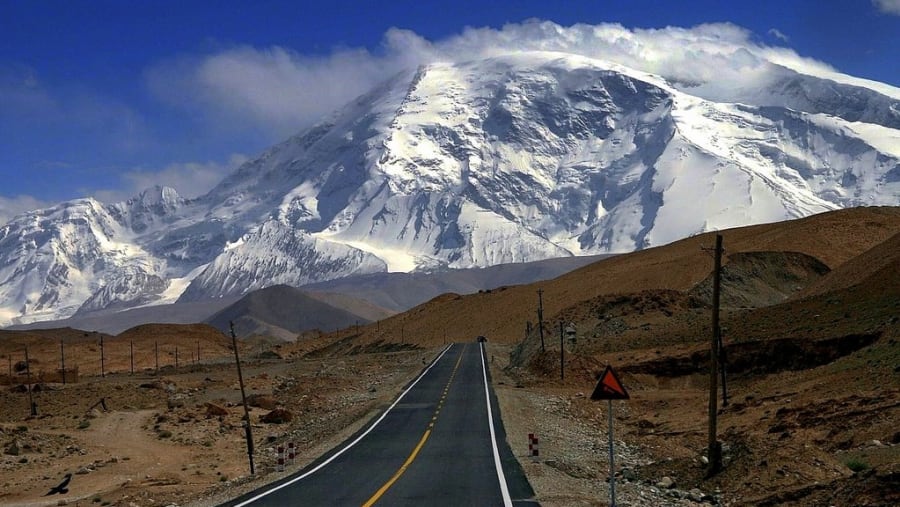
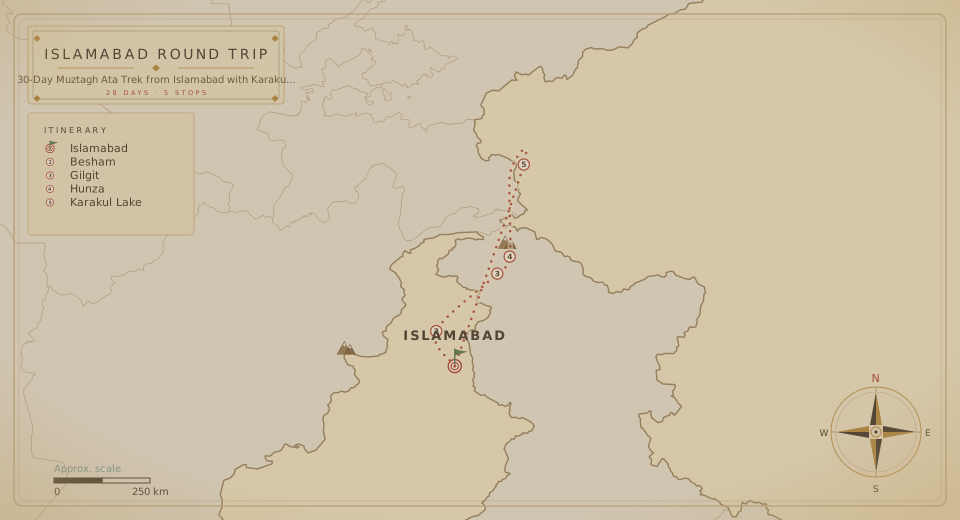
Join an expedition to Muztagh Ata (7,546 m), the "Ice Mountain's Father," in China's Xinjiang province. This 30-day journey travels overland from Islamabad through Gilgit, Hunza, Sust, and Tashkurgan to Karakul Lake before trekking to base camp and climbing this vast snow-covered peak. Along the way, experience the dramatic landscapes of the Karakoram Highway, high mountain pastures, and snow-capped summits. After the ascent, return via Hunza Valley and Islamabad.
Join an expedition to Muztagh Ata (7,546 m), the "Ice Mountain's Father," in China's Xinjiang province.
From the itinerary
At a glance
Day by day
Arrive at Islamabad International Airport, meet your tour guide, and transfer to the hotel.
Reach the hotel for dinner and an overnight stay.
Take a 7-hour drive along the Karakoram Highway to reach Bisham.
Arrive at the hotel in Bisham for dinner and an overnight stay.
Take a 9-hour drive to Gilgit.
Arrive at a hotel in Gilgit for dinner and an overnight stay.
Drive to Hunza from Attabad Lake and then continue to Sust.
Arrive at a hotel in Sust for dinner and an overnight stay.
Cross the Chinese border to reach Tashkurgan.
Arrive in Tashkurgan for dinner and an overnight stay.
Drive to Karakul Lake through breathtaking scenery of high mountain pastures and snow-capped peaks.
Overnight stay in Karakul.
Take a short drive to Subash Village and begin walking to base camp, with camels carrying the team's equipment.
Trek over a level plain and then climb steadily through barren hills to reach base camp in about 4 hours.
Arrive at base camp for dinner and an overnight stay.
Base camp is at an altitude of approximately 4,350 m (14,500 ft), so time is needed to adapt to the altitude. The grassy site is tucked between a moraine and the foot of the steeper slopes of the mountain - a great place to relax now and recover later.
Enjoy some fresh food and prepare for the next day's trek.
Overnight stay at base camp.
Climb Muztagh Ata.
We use three camps above base camp.
The first camp is likely to be close to the snow line. In this case, we will use pack animals to transport all expedition supplies to Camp 1.
Above this point, all team members will need to participate in load-carrying between camps. In addition to putting the necessary supplies in place, this also provides essential acclimatization and fitness for the summit attempt.
Camp 1 is at about 5,350 m, reached by a steep, stony ascent from base camp, and sits right on the edge of the glaciers that blanket the upper 2,000 m of the mountain.
From Camp 1, the route is a steady ascent up a snowy and sometimes icy slope through an area of crevasses and a small "valley" in the glacier. This is the steepest part of the whole route.
Above the "valley," a long and unrelenting ascent leads up to Camp 2, a small shelf in the glacier at about 6,100 m. There will probably be 2 or 3 ascents to Camp 2, carrying loads for this camp and the one above. This is great for acclimatization and for skiers, as there is an 800 m run back to Camp 1 with an empty sack.
It is possible to fix a camp virtually anywhere on the upper part of the mountain. The leaders will choose where to site camps, taking into account prevailing conditions and the activities of other parties on the mountain. In recent years, the next camp has been placed at 6,450 m. Alternatively, teams may use Camp 3 at 6,800 m. Issues such as acclimatization, load-carrying, snow conditions, sleeping comfort, and average group speed will be considered when deciding what approach to use.
The route to the summit is straightforward from 6,800 m to 7,400 m. A long gradual slope slowly eases, becoming gentler and gentler. Finally, with the ground appearing almost level, the small rise to the summit rock appears.
Overnight stay at a camp.
Climb Muztagh Ata from day 10 to 24.
Descend from the summit and cross the Pakistan border to arrive in Hunza Valley.
Overnight stay in Hunza.
Spend the day in Upper Hunza and explore the valley at your leisure.
Overnight stay in Hunza.
Drive to Besham City from Hunza.
Arrive at a hotel in Besham for dinner and an overnight stay.
Drive back to Islamabad from Besham.
Overnight stay in a hotel in Islamabad.
Spend the day at your leisure.
Overnight stay in a hotel in Islamabad.
Travel to Islamabad International Airport for your flight back home.

Where this trip takes you
Muztagh Ata, Karakul Lake, Karakoram Highway, Hunza Valley
The route
The fine print
Liaison with the Gilgit-Baltistan tourism department for the climbing permit process
Processing of import or export permits from the Ministry of Tourism
Clearance of cargo before the arrival of the team and its storage
Assistance upon arrival and departure
Briefing or debriefing at the Tourism Department
Hotel accommodation in Rawalpindi or Islamabad, Hunza, Chilas, and Skardu
All meals during the trek and at base camp, as per the itinerary
Porterage of 75 kg per person of expedition equipment and high-altitude food, etc. to base camp, and 50 kg per person on return from base camp
Road transfers between the airport and hotel, and within the city, as per the itinerary
Local Pakistani tour guide
Sleeping tents, mattresses, mess, kitchen and toilet tent, with tables, field stools, and camping ground fees
Kitchen equipment, crockery, cutlery, fuel, and related community gear
Wages and basic kit of the English-speaking guide, Sardar, cook, and assistant
Insurance of our field staff and low-altitude porters, except helicopter rescue
Porterage at airports and hotels, toll taxes, and parking fees
Mail handling and forwarding to base camp or overseas, except postage charges
The hiring of HAPs and any other crew as required (wages and kit to be arranged by the team)
Pollution and environmental fees, or any other fee required to be paid to the Government of Pakistan
One bottle of mineral water per person per day in cities
Climbing permit fee
Liaison Officer kit and equipment, allowances, travel, hotels, meals, insurance, and personal expenses of any kind
International and domestic airfare, airport tax, and excess baggage charges
Surface transfers in case of flight cancellations to the kick-off point
High-altitude porters or any crew above base camp
Tents, sleeping bags, personal and climbing equipment of any kind beyond base camp, including high-altitude food and oxygen
Medications, ground evacuations, and helicopter rescue charges of any kind
Room service, laundry, beverages, phone or communication bills, and items of a personal nature
Insurance liability of member(s) and others under force majeure conditions
Clearing agent charges
Any other service not mentioned in this condition sheet
Domestic or international airfare and airport taxes
Any expense due to force majeure, flight cancellation, landslides, natural calamities, acts of God, or other circumstances beyond our staff's and suppliers' control
Any expense of a personal nature and additional cold drinks
Warm clothes
Trekking shoes
Muztagh Ata lies on the broad plains of western China. In appearance, it is a broad and lofty peak with gently angled flanks. The climbing route is moderately straightforward, with only a couple of steeper sections. The whole climb can be skied down and is not particularly difficult.
Approach the mountain through Pakistan by road to Gilgit and then over Khunjerab Pass (the border between Pakistan and China) to Karakul Lake. The last leg involves a camel trek to base camp at around 4,200 m.
We will visit varied and interesting places and have established an excellent liaison with the locals, helping to secure good-quality accommodation, transport, and food.
Visit Kashgar in western China, a major settlement during the Silk Road days.
It is a 30-day trip from Islamabad to Islamabad.
Logistics
Your 30 days finish where they began, in New Islamabad Airport Rd.
 Watch the film
Create your own adventure
Say goodbye to travel stress.
Starting from
When
Travellers
Total
—