
Day 01
Arrival and Departure from Home
We will depart from home by flight.


Explore the world with tourHQ
Pakistan · Mountain Exploration
The journey
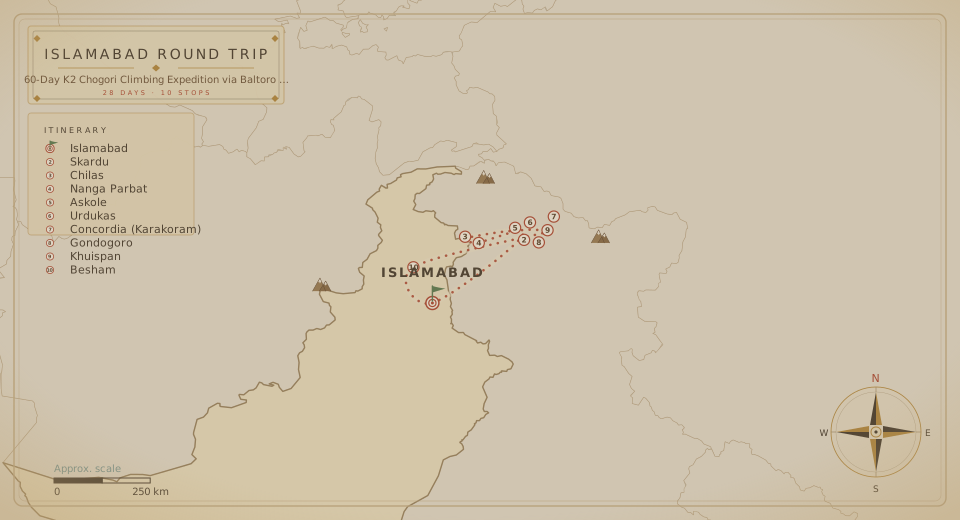
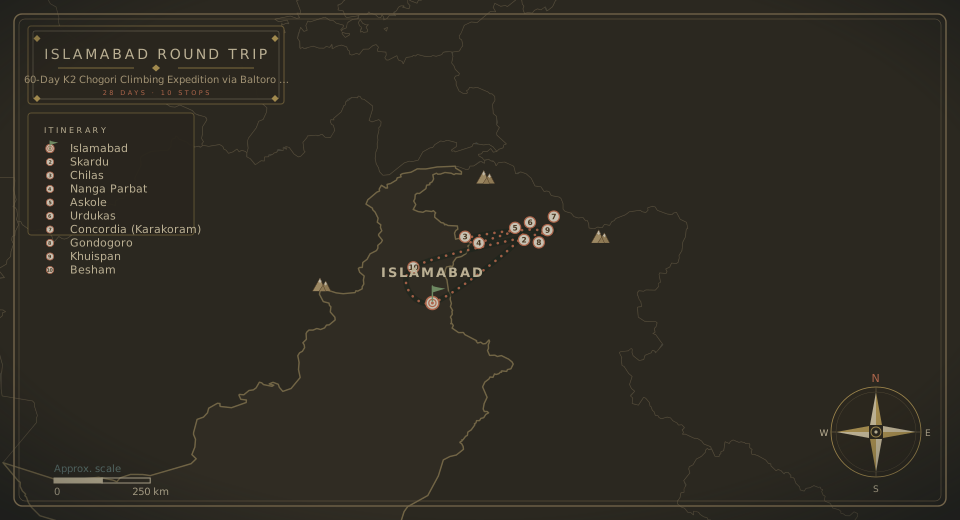
Climb in the Karakoram, whose name in Turkish means "Black Rubble," on a major expedition to K2, locally known as Chogori. The journey travels from Islamabad to Skardu and Askole before trekking across the Baltoro Glacier to Concordia and K2 Base Camp, followed by an extended period for acclimatization and climbing. Along the way, you experience the dramatic mountain landscapes of the Baltoro region, including views of Nanga Parbat, Cathedral Towers, Gasherbrum IV, Mitre Peak, and the mighty K2. The expedition concludes with the return trek via Gondogoro La, Khuspang, Hushe, Skardu, and Islamabad.
The journey travels from Islamabad to Skardu and Askole before trekking across the Baltoro Glacier to Concordia and K2 Base Camp, followed by an extended period for acclimatization and climbing.
From the itinerary
At a glance
Day by day
We will depart from home by flight.
Welcome reception at the Alpine Club of Pakistan. Overnight at the hotel.
Fly to Skardu on PK-451 (09:30 - 10:30). The flight is subject to weather conditions. Upon arrival, transfer to the hotel for an overnight stay.
In case of flight cancellation, drive by coach to Chilas (480 km), which takes about 12-14 hours via the Karakoram Highway. Overnight at the hotel.
Day free in Skardu. If you are driving, complete the road journey to Skardu (275 km), which takes about 7-8 hours.
En route, there are good views of Nanga Parbat (8125 m) at the confluence of the Indus River, along with the rapids and falls of the Indus River. Overnight at the hotel.
Final preparation day in Skardu. Overnight at the hotel.
Drive to Askole (3000 m).
Travel by jeep to Askole in 8-9 hours. This is the last village, with about 50 houses. The villagers grow their own cereals, vegetables, and fruit, and keep large herds of sheep, goats, yaks, and dzos. Overnight in a tent.
Trek to Jhola (3200 m).
Start with a 2-3 hour walk across wasteland and traverse the Biafo Glacier, a tiny ocean of moving boulders and crevasses 2 km wide. Cross the glacier and, after a lunch break, continue to Jhola for another 4-5 hours.
Cross the Dumardo River Bridge and camp at a rather dusty campsite surrounded by a few bushes and a side stream. Overnight in a tent.
Trek to Paiyu (3600 m).
Start on a moderately easy trail for 3-4 hours, crossing the Bardumal campsites along a 2-km stretch of sandy river beach. After a lunch break, continue towards Paiyu for another 2-3 hours.
The trail climbs to a vantage point providing a view of the snout of Baltoro. In the far distance, there is a marvelous panorama of the Cathedral Towers and, to the left, the triangle of K2 for the first time. Paiyu is a herded campsite. Overnight in a tent.
Paiyu (3600 m).
Traditional rest day at Paiyu. Overnight in a tent.
Khuburtze (4000 m).
Start for a 5-8 hour trek with a slight climb up the Baltoro Glacier on the southern edge. After about two hours, the path divides at the snout of the Baltoro Glacier, where the left side goes to the base camp of Trango Tower and the Sarpo Lago Pass.
Continue on the right side, climbing onto the glacier that stretches up the valley for 62 km and is 2 km wide. Follow the southern edge to Liliwa and onward to Khuburtze, with lovely walking for about 90 minutes to the campsite with clear water. Overnight at camp.
Urdukas (4200 m).
Enjoy a lovely 4-5 hour walk, mostly along the crest of the lateral moraine, with stunning views of Paiyu Peak, Chorichi, Uli Biaho, Tango Towers, and more.
Urdukas is a scenic campsite. However, like Paiyu, this site is overused and polluted. Overnight at camp.
Goro II (4500 m).
Walk for 6-8 hours on the glacier. The first hour is across difficult side crevasses; however, the route becomes smoother and easier in the center. Continue for 2-3 hours to Goro I, opposite the Yermanendo Glacier falling from the Mashebrum Pass.
For the next 3-4 hours, continue east up the Baltoro Glacier, following the telephone wire from Army HQ Goro to Gasherbrum IV. Goro II campsite is pitched on rough stones and ice in the heart of the glacier, with water from glacier melt. Overnight in a tent.
Concordia (4700 m) / K2 Base Camp (5100 m).
Enjoy a slightly easy 6-8 hour walk with spectacular views and a titanic mountain panorama, including Muztagh Tower, Gasherbrum IV, Mitre Peak, and the mighty K2.
The camp at Concordia was named by Martin Conway after the Place de la Concordia in Paris. Lunch at Concordia. You will encounter some crevasses near the Godwin Austin Glacier. Overnight in a tent.
Day 14-58: 45 days for acclimatization and climbing.
Day 59: Vigne Glacier or Ali Camp (4800 m).
Continue for 5-6 hours on the Vigne Glacier, with gorgeous views of Chogolisa and Mitre Peak, creating a rare mountain panorama. Camp just below the pass. Overnight at camp.
Day 60: Gondogoro La (5680 m) / Khuspang (4680 m).
Start very early in the morning for the uneasy and steep ascent to Gondogoro La, the high pass, followed by another 3-4 hours of descent to the high camp at Khuspang on the other side. This is also the base camp for Gondogoro Peak.
Continue trekking to Dalzampa (4300 m), with another 4-5 hours of easy descent over glacier moraine to the exotic campsite of Dalzampa, the "field of flower." A climb to the lateral moraine provides fantastic views of the glacier and jagged spires. Overnight in a tent.
Day 61: Shaieshcho (3600 m) / Hushe (3300 m).
Walk for 4-5 hours on the lateral moraine through wild roses, gooseberry, cedar, and tamarisk bushes. The Charka Valley joins the Gondogoro at Shaieshcho, and the route leads towards the base camp of K6 and K7.
Another 4-5 hours on the last day of the trek follow the east bank of the Hushe River on an easy path through the fields, with camp outside the village.
We will have base camp and climbing days camp.
We will have base camp and climbing days camp.
We will have base camp and climbing days camp.
We will have base camp and climbing days camp.
We will have base camp and climbing days camp.
We will have base camp and climbing days camp.
We will have base camp and climbing days camp.
We will have base camp and climbing days camp.
We will have base camp and climbing days camp.
Base Camp & Climbing Days Camp 08 - 44 (38 days for climbing).
We will have base camp and climbing days camp.
We will have base camp and climbing days camp.
We will have base camp and climbing days camp.
We will have base camp and climbing days camp.
We will have base camp and climbing days camp.
We will have base camp and climbing days camp.
We will have base camp and climbing days camp.
We will have base camp and climbing days camp.
We will have base camp and climbing days camp.
We will have base camp and climbing days camp.
We will have base camp and climbing days camp.
We will have base camp and climbing days camp.
We will have base camp and climbing days camp.
We will have base camp and climbing days camp.
We will have base camp and climbing days camp.
We will have base camp and climbing days camp.
We will have base camp and climbing days camp.
We will have base camp and climbing days camp.
We will have base camp and climbing days camp.
We will have base camp and climbing days camp.
We will have base camp and climbing days camp.
We will have base camp and climbing days camp.
We will have base camp and climbing days camp.
We will trek to Concordia.
Overnight in camp.
We will move towards Ali Camp.
Overnight in camp.
We will go to Khuispan over Ghondogoro La (5600 m).
Overnight in camp.
We will visit Dalsangpa.
Overnight in camp.
We will visit Saicho.
Overnight in camp.
Skardu (2340 m).
Drive by jeep to Skardu via Khaplu, the second-largest kingdom in old Baltistan, which safeguarded the trade route to Ladakh along the Shyok River. Overnight at the hotel.
Islamabad / Chilas.
Fly to Islamabad on PK-452 (11:20 - 12:20), subject to weather conditions. Upon arrival, transfer to the hotel.
In case of flight cancellation, drive to Chilas. Overnight at the hotel.
We will fly to Islamabad or drive to Chilas or Besham.
Overnight in the hotel.
We will visit Islamabad and attend the debriefing.
Overnight in the hotel.
Transfer to the airport for the departure flight.
The route
The fine print
Cost includes:
Cost excludes:
The expedition members will arrive in Islamabad on the date mentioned above and will go together towards Base Camp as a group. No member can split from the group except in an emergency situation.
If any member wishes to join the expedition later at the base camp due to personal reasons, it is possible. However, any extra expenses arising in such cases must be paid by the climbers.
While returning from base camp, all members will travel together. If any climber splits from the expedition for any reason, the extra expenses will be charged to the expedition members. It should be noted that the Liaison Officer has the authority to make final decisions.
No service above base camp is included in the package. However, on extra payment, such services can be provided on advance request.
The climbing strategy is decided mutually by the expedition members; therefore, no responsibility is taken by RVT.
The last date for submission of an application for the climbing permit is 31st December 2017. You can submit this application to the Pakistan embassy, or you can send the paper amount to us and we will complete the remaining process.
The Government of Pakistan has revised the royalty rates for peaks of various heights, as given below. Mountaineering parties seeking permission for climbing summits for the next year may be asked to deposit royalty accordingly. The rates will be effective in the year 2017.
Mountaineering - Rules and Regulations
A foreign mountaineering expedition desirous of climbing a peak in Pakistan shall apply on the application form (Annexure A), with one extra copy, at the nearest embassy or consulate of Pakistan. A copy, along with a photocopy of the royalty receipt, should be sent directly to the Gilgit Baltistan Council Secretariat, Provident Fund Building, Zero Point, G-7/1, Islamabad.
Application forms for allotment of peaks should be accepted by a Pakistani embassy or consulate. Such applications would then be sent by the said embassy or consulate immediately to the Tourism Division, where they would be processed on a "first come, first served" basis.
Incomplete application forms, or forms received either before or after the stipulated dates, may not be entertained.
If a party is not sure of the composition of the team, it shall apply stating the fact and without attaching particulars of members with the application form. In such cases, peaks will be provisionally booked. A formal permission letter shall be issued only after particulars at Annexure-B are received by the Gilgit Baltistan Council Secretariat, Provident Fund Building, Zero Point, G-7/1, Islamabad, at least three months in advance of the party's arrival in Pakistan. If particulars of new members are not received within the stipulated period and the party arrives in Pakistan, departure to the mountains may be delayed until clearance of the new members is obtained, which may take about a week. Under this procedure, a party shall not leave for Pakistan unless it has received the formal permission letter. No mountaineer may be a member of more than one expedition during a season.
A party shall indicate, in order of preference, at least 3-4 peaks so that available peaks can be allotted. A party may be given permission for more than one 8000 metre peak only with special permission from the Joint Secretary, Gilgit Baltistan Council Secretariat, Provident Fund Building, Zero Point, G-7/1, Islamabad.
Gilgit Baltistan Council Secretariat shall endeavor to send the mountaineering permit to a party within 60 days of receipt of the application form in the Tourism Division. Depending on the availability of the peak for the chosen period, the Tourism Division will send provisional booking of the peak upon receipt of the completed application.
The Government reserves the right to allow a particular peak through any route to more than one party in the same season.
The Government has the right to cancel the allotment of a peak at any time without assigning any reason. Amounts of royalty deposited shall be refunded in such cases.
If, however, a party postpones or cancels its mountaineering plan for its own reasons, it must inform the Tourism Division by the quickest possible means. In such a case, the royalty deposited shall neither be refunded nor carried forward for future mountaineering in Pakistan. Change in the booking period during the same mountaineering season is possible, subject to availability of the peak or route for the revised date. Briefing or debriefing can be planned.
Upon arrival in Rawalpindi or Islamabad, the expedition should meet the officer concerned in the Tourism Division to arrange the meeting with the Liaison Officer and receive assistance on matters such as insurance, purchase of rations, and allied matters. After completing these formalities, the leader of the expedition shall ask for a date for the formal briefing. For this purpose, a minimum notice of 24 hours is required, excluding Friday and holidays. The preparatory work would entail a stay of about four to five days in Islamabad or Rawalpindi.
On return from the mountains, the leader of the party shall inform the concerned officer in the Tourism Division and obtain a date for debriefing by giving a minimum notice of 24 hours, excluding Friday and holidays. Note: No party will leave for the mountains without formal briefing or leave the country without formal debriefing.
A party shall include in the expedition, as its member, at least one Liaison Officer to be detailed by the Government of Pakistan.
A party shall pay for the Liaison Officer's food, accommodation, and transport to the mountains and back from the reporting date of the expedition in Islamabad until the date the party is debriefed.
During the stay of a party in Rawalpindi/Islamabad, the Liaison Officer will be given a daily allowance at the rate of US$ 30 per day. In a city of the Northern Areas, such as Skardu or Gilgit, the Liaison Officer is to be paid US$ 15 per day and accommodation.
A Liaison Officer shall carry personal equipment like any other member of the party.
A Liaison Officer shall be consulted on routes and local customs and, if desired, on matters such as transport, accommodation, and rations. If, however, a leader disagrees with the Liaison Officer, the reasons for such disagreement shall be given in writing.
A Liaison Officer shall extend maximum assistance to a party in making purchases and similar matters. However, the Liaison Officer shall not handle any cash or undertake any financial transactions on behalf of a leader or party.
A Liaison Officer shall accompany a party to a maximum height with the consent of the leader, or at least stay at the base camp until the party descends and return with the party for debriefing in Islamabad. For this purpose, a party shall provide, free of cost, the necessary kit and equipment as detailed at Annexure-C in order to enable the Liaison Officer to perform duties without risk.
Kit and equipment for the Liaison Officer should be brought according to the measurements sent to a party in advance. If a party does not receive measurements before departure for Pakistan, it may bring standard-size kit and equipment. Shirts and jean trousers may be purchased in Pakistan to avoid size problems.
A low altitude porter shall accompany a party up to the base camp, with a maximum height of 5,500 metres. For this purpose, a party shall provide the porter with standard kit and equipment as detailed at Annexure-D, free of cost.
If a low altitude porter is required by the party to go above 5,500 metres, except passes en route, the porter shall be entitled to kit, equipment, and ration as prescribed for high altitude porters at Annexure-E.
The cook will be provided with the kit and equipment, except climbing tools, of a high altitude porter.
A party shall arrange to provide, free of cost, standard kit and equipment to a high altitude porter as detailed at Annexure-E in order to enable the porter to perform duties.
A party shall be equipped with reasonable communication means such as walkie-talkie, radio/transistor set, and a high-powered transmitter for communication from the mountains with district headquarters. Optional frequencies allotted are 5201 KHZ, 6996 KHZ, 10282 KHZ, 15951 KHZ, and 16411 KHZ.
Kit and equipment for porters shall be handed over to them in the presence of the Liaison Officer prior to the start of the caravan.
No party shall be allowed to proceed to its destination if the kit and equipment provided to the Liaison Officer or porters is found incomplete or sub-standard in quality. Before leaving Rawalpindi or Islamabad, a Liaison Officer shall satisfy himself that the kit and equipment is complete and of the required standard. Kit and equipment given to the Liaison Officer is returnable, but items of personal use and clothing such as jackets, trousers, shirts, gloves, socks, caps, approach march boots, pullovers, rucksack, and sleeping bag are to be retained by the Liaison Officer.
Use of a communication system is advisable for a party. The Liaison Officer will also be provided with appropriate communication equipment. Clearance for the communication system to be used by the party is indispensable and should be intimated well in time on the prescribed form (Annexure-K).
Equipment, non-consumable and consumable stores imported by a party into Pakistan shall be subject to the following conditions: equipment and non-consumable stores will be allowed temporary entry free of customs duty and sales tax, subject to an undertaking (Annexure-F) by the leader of the expedition that the equipment will be re-exported out of Pakistan on completion of the mission and that no part of it will be sold or otherwise disposed of in Pakistan, failing which duty and sales tax will be paid. Consumable stores and medicines will be allowed exemption from customs duty and sales tax subject to the same undertaking that they will be used for the purpose for which they were imported and will not be sold or otherwise disposed of in Pakistan, failing which customs duty and sales tax will be paid. The unconsumed portion will be re-exported out of Pakistan on completion of the mission. These conditions shall not apply when donation of consumable stores and medicines is made in Pakistan with prior permission of the Government, for which an official receipt will be issued.
A party shall send to the Tourism Division an application in triplicate as per Annexure-F, along with three copies of the list of equipment. The cost price of all items shall also be shown on the list. The Tourism Division shall return one copy to the party after affixing signature and seal. Another copy shall be sent to the customs authority at the point of entry, who shall clear the equipment when it arrives with the party.
If some equipment is to be sent to Pakistan in advance, the Tourism Division shall be informed. In that case, one copy of the application at Annexure-F, along with its enclosures, shall be handed over to a clearing and forwarding agent nominated for this purpose by the party. Another copy shall be sent to the customs authority at the point of entry.
After clearance of the equipment, the local agency shall arrange for its transport, storage, and protection until it is handed over to the party on arrival. The agency shall also pay local octroi duty, if any, and is advised to contact a representative of the Tourism Division in case of difficulty.
A rough idea of wages and charges for animal and mechanical transport will be communicated to the party along with the formal permission letter.
Payment of wages to porters shall be made when they are discharged. However, if a porter requires an advance payment, this may be given in the presence of the Liaison Officer or guide, and a receipt obtained.
In addition to daily wages, a party shall provide a low altitude porter with free rations as per Annexure-G, or money in lieu of rations as fixed by the Government, from the day the porter is engaged until the day of discharge.
Similarly, free rations shall be provided to a high altitude porter as per Annexure-H from the day the porter goes above 5,500 metres.
Except in the case of sickness or injury, no wages shall be paid to a porter for a day on which the porter does not work. If, however, a party wants to have a rest day, porter wages shall be paid in full.
For forced halts on bad weather days, a party shall pay the porter full daily wages and rations. The leader's decision about movement on such days shall be final. If, however, the Liaison Officer feels that the weather is too bad to march, the Liaison Officer may ask the leader to halt the party. In case of disagreement, the leader should give the reasons in writing.
A porter marching with a party for more than seven days shall be allowed every seventh day as a holiday with full daily wages.
A Liaison Officer shall be covered by insurance of Rs. 300,000 only. In case of partial disablement, the amount of compensation shall be proportionate to the percentage of disablement as declared by a competent authority.
A high altitude porter shall be insured for a sum of Rs. 200,000. In case of partial disablement, the amount of compensation shall be proportionate to the percentage of disablement as declared by a Civil Surgeon.
A low altitude porter shall be insured for a sum of Rs. 100,000. In case of partial disablement, the amount of compensation shall be proportionate to the percentage of disablement as declared by a Civil Surgeon.
Insurance cover shall be provided through a Pakistani company, and the Government shall help a party in getting this facility in Pakistan if requested.
If, in the opinion of a doctor or first-aid specialist, evacuation of a sick or injured porter from the mountain to a hospital in a district headquarters such as Gilgit, Skardu, or Chitral is necessary, the party shall pay for evacuation by helicopter or other means. If a Liaison Officer feels that the porter is very sick and is not being evacuated, the Liaison Officer shall ask the leader to arrange evacuation. If the leader disagrees, the reasons shall be given in writing and countersigned by the expedition's doctor or first-aid specialist.
A party is not responsible for paying for the evacuation and medical treatment of a sick or injured Liaison Officer, as this shall be borne by the detailing or recommending authority.
During sickness or injury in the mountains, or hospitalization, a party shall pay half of the daily wages to a porter until the date it leaves the district headquarters for Rawalpindi or Islamabad.
Medical facilities, including surgical operations, are generally provided free of cost in Pakistani hospitals. Should sickness or injuries to porters entail expenditure, a party shall pay for the same. In case of death of a porter, cook, or other hired person, the expedition shall be responsible for transport of the dead body from the place of casualty to the place of hiring.
Following are the royalty rates for scaling peaks of various heights in Pakistan: K-2 (8611 m) US$ 12,000, with US$ 3,000 for each additional member exceeding 7 per team; 8001-8500 m US$ 9,500, with US$ 3,000 additional; 7501-8000 m US$ 4,000, with US$ 1,000 additional; 7001-7500 m US$ 2,500, with US$ 500 additional; 6000-7000 m US$ 1,500, with US$ 500 additional. These rates are subject to periodic revision. Additional fees will be charged if the party attempts more than one peak. Expeditions are required to deposit the full amount of royalty with the nearest Embassy, Consulate, or Tourism Division of the Government of Pakistan at the time of making an application for booking of a peak. The head of account for depositing the royalty is "1391-Fees, Fines and Forfeitures" for accounting of receipts relating to royalty or trekking fees realized from mountaineering and trekking.
An Embassy or Consulate shall forward to the Tourism Division a copy of the royalty receipt issued to the expedition. The amount of royalty, number, and date of receipt issued should be clearly mentioned in the covering letter.
A party shall indicate in its application form its order of preference for attempting the peak. If the preference is for a lower peak and the party is allotted a higher peak from its preference list, it shall deposit the balance of the royalty within two weeks of receipt of communication from the Tourism Division. If the balance is not deposited within the stipulated period, the allotment shall automatically stand cancelled. The amount of royalty collected shall not be refunded to the party whose allotment has been cancelled.
If the first preference of a party is for a higher peak but it is allotted a lower peak from its preference list, the balance of the royalty shall be refunded by the concerned Embassy or Consulate of Pakistan on receipt of a letter of authorization from the Tourism Division.
It shall be binding on a party to accept the allotment of a peak if it is one of those mentioned in its application form. In case of refusal to accept the allotment, the amount of royalty shall stand forfeited.
If a party indicates its order of preference within a list of peaks submitted and all those peaks have already been allotted to other parties, it shall be asked to identify more peaks. In case of inability to do so, the whole of its royalty shall be refunded.
A foreign-cum-Pakistan party and a Pakistani-cum-foreign party shall deposit the full amount of royalty for allotment of a peak. If the party qualifies for a 50% discount on the royalty, the balance shall be refunded accordingly. A foreign expedition party may include Pakistani members only from a Pakistani Mountaineering Club registered with the Tourism Division. Similarly, such a Pakistani Club may organize a Pakistani-cum-foreign expedition if it is registered with the Tourism Division.
Aerial photography of mountain peaks en route to the Northern Areas and Chitral is allowed after notifying the pilot of the aircraft or the Liaison Officer.
A party shall not photograph the following objects during its stay in Pakistan: any Army, Navy, or Air Force installations; any equipment of the Armed Forces such as ships, establishments, guns, tanks, vehicles, aircraft, and arms; any Pakistan aerodromes or connected buildings and installations; any tribal lady or ladies; and any other notified prohibited area or place.
Subject to the above, a party attempting a peak situated in a closed zone, such as the 10-mile belt and 30-mile belt of Pakistan's border with foreign countries, may take photographs or make films under the direct supervision of a Liaison Officer.
For this purpose, a party shall identify one member of its team as the photographer for shooting a film of academic interest. If, however, a party wants to include professional photographers for shooting professional films, those photographers shall be accompanied by an additional Liaison Officer under the same terms and conditions as for the Liaison Officer. Under this arrangement, professional photographers shall not be allowed to break into units.
Export of such films out of Pakistan shall be allowed only after the Liaison Officer has certified that defence installations and prohibited areas or places were not photographed.
A Liaison Officer shall inform a party of the objects that are allowed to be photographed or filmed. If the Liaison Officer is convinced that key or defence installations are being photographed, the Liaison Officer shall forbid the photographer from taking such photographs or making such films. If a photographer does not comply, the matter shall be reported to the police, who shall proceed under the Official Secrets Act, 1923.
Still photographs, commercial films, and films of academic interest taken or made in the rest of Pakistan shall not be subject to these restrictions except those mentioned at para 54 and 58.
Permission to photograph is subject to the condition that a party shall supply to the Government of Pakistan, free of cost and freight, one copy or print of a film of academic interest or commercial film made, and one set of photographs taken.
A party assuming the nature of a joint expedition, including Pakistanis as climbers, shall get a discount of 50% on the amount of royalty. In this case, the number of Pakistani climbers shall not be less than half of the total number of foreign members in a party, including its leader. In special cases, the Tourism Division may relax the number of Pakistanis to one-third of foreigners.
If, however, the said one-third number cannot be mustered, there shall be no collaboration between a Pakistani party and a foreign party.
Particulars of Pakistani climbers, in five copies, shall be obtained on proforma at Annexure-I by a foreign party from any Pakistani Alpine Club, which shall ensure that experienced climbers are nominated for the purpose on an all-Pakistan basis. These particulars shall then be attached to an application form.
Under these arrangements, the leader shall be a foreigner while the deputy leader shall be a Pakistani.
A Pakistani party that may include foreign nationals as members shall pay 50% of the royalty chargeable for a peak proposed to be attempted. In this case, the number of foreign climbers shall not exceed that of Pakistani climbers or be less than one-third of the total number of Pakistanis. However, a party having a single foreigner will stand exempt from the operation of this paragraph.
Particulars of all foreign climbers shall be obtained by a Pakistani party on proforma at Annexure-B and supplied in five copies, along with an application form at Annexure-A to the Tourism Division at least four months in advance of their arrival.
Under these arrangements, the leader shall be Pakistani while the deputy leader may be a foreigner.
A foreign-cum-Pakistani or a Pakistani-cum-foreign expedition party shall be accompanied by a Liaison Officer.
A party consisting only of Pakistani climbers shall be exempt from payment of royalty. It shall, however, deposit with the Tourism Division particulars of all members, including the leader, on proforma at Annexure-I. Pakistani expeditions need no Liaison Officers.
Foreigners and Pakistanis climbing peaks under these arrangements shall be subject to relevant provisions of these terms and conditions wherever applicable.
Only two joint expeditions will be allowed every year on a first-come, first-served basis, and they must be recommended by a club registered with the Pakistan Sports Board or affiliated with the UIAA.
In case of accident or death of a member of a party, the leader shall notify the Liaison Officer, who shall report the matter to the nearest police station and contact the Deputy Commissioner of the area for any assistance that may be necessary.
If any assistance from the Pakistan Army is needed, the Liaison Officer shall inform the Deputy Commissioner, who shall arrange such assistance.
If a helicopter is needed, FCNA or the local administration would arrange it on a payment basis. Mountaineering expeditions will guarantee rescue operation funds to the tune of US$ 4000, or provide a guarantee from their respective Diplomatic Mission in Pakistan or an undertaking from Government-approved tour operators, failing which they will not be allowed to attempt peaks in Pakistan.
In case of death of a member, a Liaison Officer shall obtain the necessary death certificate from the local Deputy Commissioner before leaving the area.
In case of accident, injury, or death of a low or high altitude porter, action shall be taken on the above lines. In addition, a Liaison Officer shall obtain from the Civil Surgeon concerned a certificate of disablement or death for insurance purposes.
In case of injury or death of a Liaison Officer, the leader shall inform the Deputy Commissioner of the area, who in turn shall inform the army authorities and the Tourism Division.
A party shall invariably encash foreign exchange from an authorized bank or money changer. For this purpose, a certificate about the amount of foreign exchange surrendered shall be obtained from the bank or authorized money changer.
Exchange booths of banks authorized to deal in foreign exchange at exit points are authorized to reconvert up to Rs. 500 per person out of the unspent balance of Pakistani rupees obtained by encashment of foreign currency. For reconversion of an amount exceeding this limit, an office of the State Bank of Pakistan shall be approached through a bank authorized to deal in foreign exchange.
A party shall convert foreign currency into Pakistani rupees at Rawalpindi or Islamabad, which shall then be taken to Gilgit, Skardu, and Chitral. A party may, however, deposit the surplus or reserve amount in a bank at the above-mentioned places before leaving for the mountains.
Encashment of foreign exchange from anybody other than a bank or an authorized money changer is an offence under the Foreign Exchange Regulation Act, 1947.
A party shall confine its activities to its objectives as declared in the application form.
A party shall not indulge in any activity that might offend the religious sentiments and social or moral usages and customs of the local people.
A party shall not at any stage operate in more than one area and scale more than one peak.
A party shall not scale a peak by a route that goes through another peak.
A party shall not split into small groups while in the mountains. In cases of emergency, a Liaison Officer has the authority to allow splitting of a party.
A party shall not deviate from the specified route except in an emergency and with the permission of a Liaison Officer.
Maps, if applied for and issued to a party, shall be returned to the Government of Pakistan through the Liaison Officer before the expedition's departure from Pakistan. A nominal amount of non-refundable money may also need to be deposited with the Government for use of these maps.
Duplicate copies of photographic data collected during mountain climbing shall be handed over to the Liaison Officer.
Should a party be of a mountaineering-cum-scientific or exclusive nature, the leader shall submit to the Pakistan authorities concerned for inspection all data, specimens, collections, and similar materials.
Export of all such collections without prior permission of the Government of Pakistan is prohibited. A leader shall also provide a set of all such specimens to the Government of Pakistan. Copies of research papers or documents prepared shall also be supplied, in duplicate, to the Government of Pakistan.
It is imperative to keep the mountains clean. Instructions contained in the subsequent paragraphs on the subject shall be strictly observed.
Every mountaineering party, irrespective of its size, shall contribute US$ 200 or equivalent in Pakistani currency to the Environment Protection Fund. The head of account for depositing this contribution is "Receipt of Tourism Division 130000-139000." This may be deposited after arrival in Pakistan at the State Bank of Pakistan or an authorized branch of the National Bank of Pakistan.
Mountaineering parties shall also deposit a refundable amount of US$ 1000, or equivalent in Pakistani currency, in an authorized bank in Pakistan. The amount will be subject to forfeiture in full or in part if the expedition or any of its members causes damage to the environment.
A party shall leave a campsite clean. On return, a Liaison Officer shall furnish a certificate that this condition has been fully complied with by the party.
A party or its porters shall not damage the forest or animal wealth of the area. On return, a Liaison Officer shall furnish a certificate that this condition has also been fully complied with by the party.
If it is established that a certain Liaison Officer gave a false certificate, the matter would be brought to the notice of the detailing authority, which would proceed under the laid-down rules. In the case of a civilian Liaison Officer or guide, registration would be cancelled and the person would be disqualified as a guide for a period of four years.
In case of breach of these rules, a party or all members of such a party shall be disqualified from any further mountaineering expedition to Pakistan for a period of four years. In addition, they may also be proceeded against under the relevant laws.
A party shall engage porters through the local administration.
A low altitude porter shall carry a maximum weight of 25 kilos. The porter shall cover a minimum distance of 10 kilometers and a maximum distance of 13 kilometers per day, with suitable stoppages of 5-10 minutes after every hour. If there are traditional night halts on the way that are shorter than the said 10-13 kilometers, the porter may stay there for the night and make up for the loss of mileage the next day.
A high altitude porter shall carry maximum weight according to the following scale: 20 kg between 5,001 and 6,000 metres; 17 kg between 6,001 and 7,000 metres; 14 kg between 7,001 and 8,000 metres; and 12 kg beyond 8,000 metres.
While carrying this load beyond base camp, a porter shall make only one trip from one camp to another. This trip shall include both going up and coming down. The leader of a party shall use discretion in setting up camps beyond base camp, taking into consideration the location of mountains, terrain, and avalanche areas.
A porter shall sign an undertaking of good behavior as per Annexure-J. One copy of the undertaking shall be deposited with a representative of the local administration, another copy shall be handed over to the leader, and the third copy shall be provided to the porter.
A party shall try to follow the date of arrival fixed by the Government in order to avoid pressure on transport and accommodation.
As soon as a party gets the permission letter, it shall immediately contact the nearest PIA office or an office of any other airline for reservation of seats and booking of equipment from Rawalpindi to the Northern Areas or Chitral, giving the following information: number of persons, total weight of equipment to be flown, and probable dates of flights from Rawalpindi to the Northern Areas or Chitral.
Flights to the Northern Areas and Chitral are subject to weather conditions, and as such PIA or any other airline may not be able to give firm booking dates. In such cases, a party would need to request the airline to pass on the above information to the officer in charge, Northern Areas, PIA Office, The Mall, Rawalpindi.
A party shall come prepared to stay for a period of 2-3 weeks in Rawalpindi and the Northern Areas or Chitral, respectively, in case the weather suddenly turns bad.
A party shall register itself with the Foreigners Registration Officer in the office of the Senior Superintendent of Police at Rawalpindi before leaving for the mountains. Similarly, a party shall inform the said Foreign Registration Officer before leaving Rawalpindi or Islamabad on departure from Pakistan.
To avoid language difficulty, a party coming from a non-English-speaking country shall invariably include an English-speaking member in the expedition.
A party shall not serve forbidden items such as pork to the Liaison Officer or porters.
Terms and conditions for winter mountaineering expeditions visiting Pakistan.
The terms and conditions for the Liaison Officer would remain the same as provided under item IV above, except the following.
The kit and equipment would be of such make and quality as to withstand the extreme temperature of -35ºC to -40º.
Logistics
Your 60 days finish where they began, in Islamabad.
 Watch the film
Create your own adventure
Say goodbye to travel stress.
Starting from
When
Travellers
Total
—