Pakistan · Mountain Exploration

13-Day Cultural and Mountain Tour of Pakistan with Hunza and Kalash

13 Days Round trip from New Islamabad Airport Rd Moderate pace

The journey

Trip highlights
  • 01 Drive the Karakoram Highway through the dramatic gorges of the Indus
  • 02 Witness the meeting point of the Karakoram, Himalayas, and Hindu Kush
  • 03 Explore Hunza's Karimabad, including Altit Fort and Baltit Fort Museum
  • 04 Admire breathtaking views from the Nanga Parbat viewpoint
  • 05 See the 7th-century Buddha carving in Kargah Valley
  • 06 Visit Gulmit, Passu, and Khunjerab Pass in the heart of the Karakoram
  • 07 Discover the unique culture and daily life of the Kalash valleys
  • 08 Explore the Upper and Lower Swat Valley

Embark on an incredible journey through Pakistan to witness the confluence of the world's highest mountain ranges - the Karakoram, the Himalayas, and the Hindu Kush - as you travel along the dramatic Karakoram Highway and the deep gorges of the Indus. Explore remarkable cultural and archaeological sites including Taxila, Kargah Buddha, Baltit Fort Museum, and Altit Fort in Karimabad. Spend time in Hunza and Kalash to learn about local culture and lifestyle, while also discovering Swat, Peshawar, and Chitral along the way.

Embark on an incredible journey through Pakistan to witness the confluence of the world's highest mountain ranges - the Karakoram, the Himalayas, and the Hindu Kush - as you travel along the dramatic Karakoram Highway and the deep gorges of the Indus.

From the itinerary

At a glance

What this trip includes

Duration 13 Days
Tour type Private
Activity level Moderate
Accommodation Included · Standard
Transport Included
Wheelchair access Yes
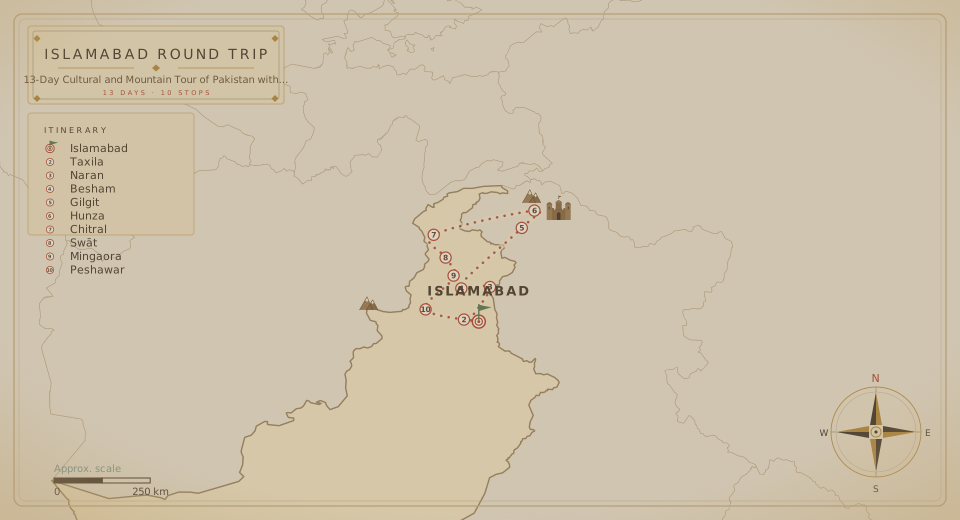
Cities Islamabad, Peshawar, Mingaora, Taxila, Gilgit, Hunza, Naran, Chitral, Besham, Swāt
Languages English

Day by day

The itinerary

1
Day 01

Arrival in Islamabad and Leisure Time

  • Connect with your tour guide, who will pick you up from Islamabad International Airport and transfer you to the hotel.
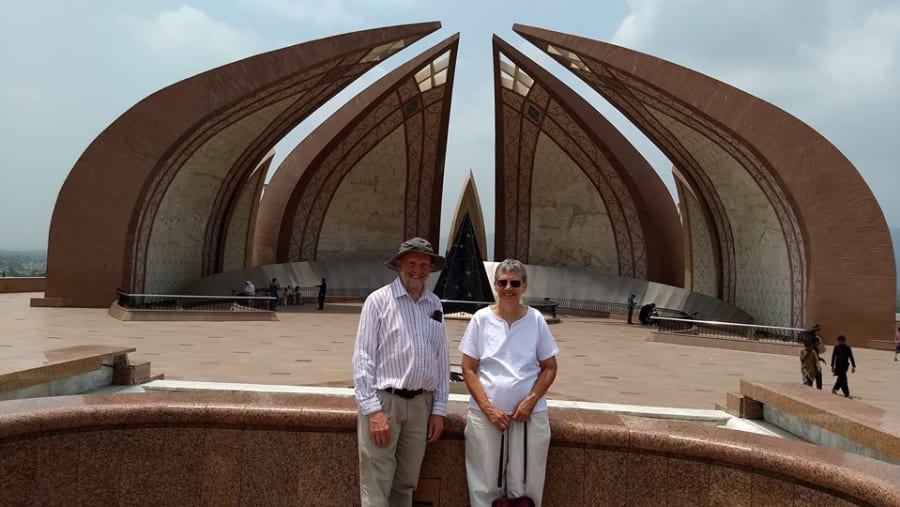
  • Spend the day at leisure in Islamabad, exploring Faisal Mosque, Pakistan Monument, and Rawal Lake. Overnight at Ramada Islamabad.
2
Day 02

Islamabad to Taxila and Onward to Naran or Besham

  • After freshening up, drive to Besham or Naran.

  • En route, visit Taxila, the capital of the Buddhist Gandhara civilization. It is regarded as one of the most important archaeological sites of the subcontinent.

  • See the ruins of the former city of Sirkup, the former monastery of Jaulian built on top of a hill, and the splendid site museum containing artifacts recovered from the excavation sites. Here, you can also see the gold and silver coins of Alexander the Great (326 BC) and local kings.

  • After Taxila, proceed towards the Karakoram Highway, passing through the lush green valleys of Mansehra District and enjoying the beautiful landscapes of the valley. The Karakoram Highway is a joint effort of Pakistan and China. Its completion took 20 years, and 300 Chinese and 600 Pakistanis sacrificed their lives for the completion of this road.

Overnight stay at hotel. (5/6 hours, 200 km)

3
Day 03

Besham or Naran to Gilgit via the Karakoram Highway

  • Go for a morning drive on the KKH to Gilgit, the capital city of the Northern Areas of Pakistan.

  • At Thakot, cross the Chinese bridge to enter the gorge of the Indus River. For centuries, traders and Buddhist missionaries used this branch of the Silk Route. There are many rock carving sites from that time, and Shatial rock carving is one of them.

  • Have lunch in Chilas and then make a stop at Thalichi for the best views of Nanga Parbat (8,125 m), the 9th highest peak in the world and the second-highest after K2 in Pakistan, also known as the Killer Mountain. Rakaposhi (7,788 m) and the Haramosh range can also be viewed from here.

  • Afterwards, arrive at the meeting point of the mountain ranges. The three highest mountain ranges in the world - the Karakoram, Himalayas, and Hindukush - meet where the Indus River is joined by the Gilgit River.

  • Later, continue along the Gilgit River and overnight at the hotel. (9/10 hours, 320 km)

4
Day 04

Gilgit to Hunza via Kargah and Rakaposhi Viewpoint

  • Drive out from Gilgit and re-enter the town by the historic route, crossing a suspension bridge over the river.

  • At Kargah, visit the 7th-century AD rock-carved Buddha. In ancient times, the Kargah Valley used to be the travelling route of Buddhist monks going to Taxila.

  • Stroll through the colourful bazaars of Gilgit. The tour then continues to the beautiful, breathtaking Hunza Valley along a scenic route.

  • On the way, see the old Silk Route once used by Buddhist monks and traders.

  • En route, take a halt at Rakaposhi's (7,788 m) viewpoint.

  • Enter the Hunza Valley and arrive at the capital, Karimabad.

Overnight at hotel. (2/3 hours, 110 km)

5
Day 05

Explore Karimabad and Hunza Valley

  • Spend a free day in Karimabad for short walks to Altit and Baltit Forts and for further exploration in Hunza Valley. The people of Hunza are famous for their long lives.
  • See some beautiful peaks of the Karakoram from Karimabad, including Rakaposhi (7,788 m), Diran (7,266 m), Ultar (7,400 m), Golden Peak (7,027 m), and the Nagar Valley on the left bank of the Hunza River. In Hunza, each family grows enough wheat, maize, apricots, and walnuts for its own use. The people are mostly self-sufficient, making their own clothes, shoes, wooden and stone bowls, and growing their own food. The people are very friendly and cheerful.
  • In the afternoon, walk to Ultar Glacier, follow the irrigation channel through the village, or stroll through the single-lane bazaar for better views of the soaring peaks around you.

Overnight at hotel.

6
Day 06

Karimabad to Passu via Gulmit and Khunjerab Region

  • Today, go for a short drive through the heart of the Karakoram.
  • Make a stop at the village of Gulmit, in the shadow of the virgin Gulmit Tower.
  • Stroll through the village fields, and visit the polo ground and old houses.
  • Later, take a short trek to Gulkin Glacier and Borit Lake. As you end your hike near Borit Lake, the transport will pick you up for a 15 km drive to Passu. Passu is a small, charming village set against the backdrop of the soaring Passu Cones, with Passu and Batura glaciers at short walking distance.
  • Walk through the village to observe village life. Some 70 years ago, Passu used to be the second-largest settlement in Hunza after Karimabad. The glacier upstream on the Hunza River moved down to create a large dam that later broke and destroyed the fertile fields and houses. Now the river occupies the major share of the valley, with the village on its right bank. Walk to Passu Glacier and Passu Lake (45 minutes one way).
  • From the snout of the glacier, witness fascinating views of Shispar (7,611 m) and Passu Peak (7,478 m).
  • Visit the famous suspension bridges of Passu. These 800-foot-long bridges over the Hunza River are still in use by local people.

Overnight at lodge.

7
Day 07

Passu to Phander Valley

  • Drive to Phander with occasional drop-offs from the jeep for exciting walks along the route.
  • Then bid farewell to the Karakoram range and enter the Hindukush range. Wild landscapes accompany the drive, as this route is visited by far fewer people and remains snow-covered during the winters, so only nomads move with their flocks of goats, searching the higher slopes for green pastures.

Guest house overnight. (6/7 hours - 3200 meters)

8
Day 08

Phander across Shandur Pass to Mastuj or Chitral

  • From Phander, the jeep track passes over Shandur Pass (3500 m) to Mastuj. At the top of Shandur, leave the jeeps and walk over the pass to the highest polo ground in the world. Every year, a grand polo festival takes place here, where teams from all over North Pakistan gather to decide the champion of the year. Many enthusiasts attend the festival from every village and camp here for days to watch their team progress towards glory.
  • Then, drive to Laspur village.
  • After Laspur village, a zigzag jeep track descends towards Mastuj.
  • Continue driving to Mastuj for overnight camping. (6/7 hours - 3000 meters)
9
Day 09

Mastuj or Chitral to Kalash Valley

  • Head for a morning drive from Mastuj village along the Chitral River, which flows in the main valley bed. The landscape of the Hindukush range appears much more arid and dry, as this area lies outside the reach of the monsoon and receives very little rain.
  • Stop at a small village for lunch and then continue, enjoying fascinating views of snow-clad peaks reaching 4,500 meters.
  • Arrive in Chitral and, after some rest, drive to Kalash Valley.
  • Visit Bumburet and Birir villages in Kalash Valley to experience the unique landscapes and meet the local population during their daily life.

Overnight at guest house in Birir village. (6/7 hours - 3000 meters)

10
Day 10

Chitral to Swat and Mingora

  • Go for a morning drive to Swat.

  • Proceed towards Lowari Pass (3,200 meters). The ascent is very interesting, with around 96 hairpin turns bringing you to the top of Lowari Pass.

  • Descend to Dir, Chakdara, and Malakand Pass.

  • Arrive in Swat, a land that shines with fruit-laden orchards, flower-filled slopes, meandering rivers, rumbling streams, and is surrounded by the mighty ranges of the Hindu Kush and Karakoram. The valley is 3,250 feet above sea level. Saidu Sharif and Mingora are the towns that form the twin capital of this area.

  • Arrive and transfer to the hotel for an overnight stay in Mingora.

11
Day 11

Swat Exploration and Drive to Peshawar

  • Visit the museum, White Palace, some rock carvings from the Buddhist period, and in Upper Swat, explore Malam Jaba and Kalam.
  • Then, drive to Peshawar.
  • Proceed towards Lowari Tunnel and Pass (3,200 meters). The ascent is very interesting, with around 96 hairpin turns bringing you to the top of Lowari Pass.
  • Descend to Dir, Chakdara, and Malakand Pass, and arrive in Peshawar. Peshawar has always been important in the history of the subcontinent because of its location by the Khyber Pass and the Gandhara civilization. The city is now known more for its unique feeling of being a frontier town than for its monuments.
  • Arrive and transfer to the hotel for an overnight stay. (8/9 hours - 1350 meters)
12
Day 12

Peshawar and Khyber Pass Excursion

  • In the morning, visit the street of storytellers, Kissa Khawani Bazaar; the street of gold, Kasera Bazaar; Karavan Serai; Mahabat Khan Mosque; and the Peshawar Museum, known for its collection of Gandhara artifacts. Also visit Bab-e-Khyber, Jamrud Fort, and, if possible, Khyber Pass. Otherwise, spend more time in Peshawar. It is also possible that you may not be able to visit Khyber Pass but still see Bab-e-Khyber and Jamrud Fort, as they are before entering the FATA.

Overnight stay at hotel.

13
Day 13

Peshawar to Islamabad and Departure

  • Head to Islamabad while travelling on the Grand Trunk Road laid down by the Pathan Emperor of the United Indian Empire, Sher Shah Suri.
  • Stop for a photo at the meeting point of the Indus and Kabul Rivers just beyond Attock Bridge.
  • Enter Faisal Mosque, the landmark of Islamabad.
  • Visit Daman-e-Koh on top of the hill for a panoramic view of Islamabad.
  • Then drive on Constitution Avenue, looking at the President's House, Parliament, Supreme Court, and other state buildings.
  • In the evening, proceed to the airport to board your return flight.
Karakoram Highway, Hunza Valley, Passu Cones, Shandur Pass

Where this trip takes you

Karakoram Highway, Hunza Valley, Passu Cones, Shandur Pass

The route

Where you'll travel

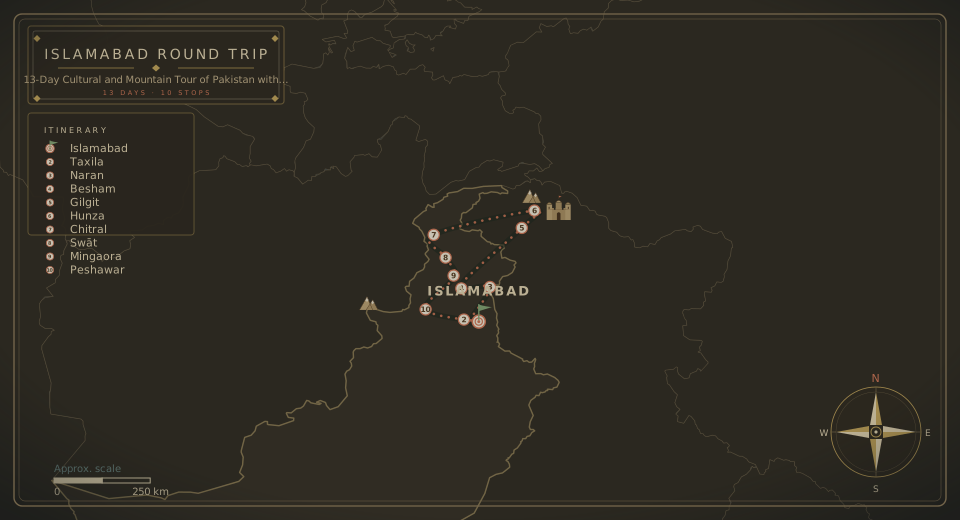
Tour route map
Round trip from New Islamabad Airport Rd 10 cities · 13 Days

The fine print

Trip details

What's Included

  • Accommodation: Twin-sharing basis at standard hotels in towns

  • Meals: Half board breakfast only

  • Transport: TZ Land Cruiser for the entire safari with fuel, toll tax, and an experienced driver

  • Guide: English-speaking mountain guide

What's Not Included

  • Domestic and international airfare and airport taxes
  • Tips and portage at airports and hotels
  • Entrance fees at sites and museums
  • Travel insurance
  • Meals: lunch and dinner, and soft drinks
  • Any expense due to forced measures, cancellation of flights, landslides, natural calamities, acts of God, force majeure, or circumstances beyond the control of Rock Valley Tours, their staff, and suppliers
  • Any expense of a personal nature not mentioned above

What to bring

  • Gear and clothing: While on an organized trek, it is best to pack all items for your trip in one large piece and one carry-on. The large piece must be a duffel bag (weighing not more than 12.5 kg) because duffels are easier for porters to carry. A small day pack is suggested as a carry-on to keep items that you will use while on the trek, bus, or jeep.
  • Luggage: Large duffel bag with lock. It is not recommended to put your stuff in a backpack, as the straps might get damaged while being transferred from bus to jeeps, jeeps to campsites, and during loading and unloading by porters each day. A small padlock that fits through the zipper of your duffel bag is recommended.
  • Day pack: Large enough for camera gear, cap, sunglasses, water bottle, jacket, and other items you may like to use while on the trek.
  • Extra carry-on: For storing city clothes in Skardu.
  • Money belt: A small fanny pack, money belt, or around-the-neck passport bag is suggested for safely keeping your passport, travel documents, and money.
  • Sleeping bag: As you shall be sleeping for four nights at Concordia at 4,700 meters or at Snow Lake and Hispar Pass at 5151 meters above sea level, the bag should be rated for 0 degrees F/-18 degrees C. Ratings are all relative, since the amount of insulation needed for a particular person to stay comfortable depends on their rate of metabolism. A down bag will be warmer for its weight and pack smaller, but it does not retain its insulative properties when wet. A waterproof breathable shell or a bivy bag will keep the bag dry. A synthetic bag keeps you warm even when wet and is a less expensive alternative, but will weigh more for a given amount of warmth.
  • Trekking boots: The single most important item on this list. Never take brand-new boots on a trek; make sure they are well broken in before departure. Good trekking boots are hard to get in Pakistan. If you are buying a new pair from abroad, look for medium-weight boots of fabric or a fabric/leather combination. They should provide adequate ankle support. A Vibram or other deep lug sole will protect you from rocks and add support. Always use thick socks when trying shoes so that you get the correct size. Short shoes can jam your toes painfully during steep descents. You could also try to get new

Know before you go

  • Pakistan is a country close to our hearts...and for good reason. Home to some of the most spectacular mountain scenery in the world, thriving cities, colourful markets, and warm hospitality, a trip to this part of the world is bound to excite even the worldliest travelers.

  • Having run trips here for more than a decade, we understand the political complexities of traveling to this fascinating country, and our paramount consideration has always been the safety of our clients.

  • Despite the negative images painted by the press, we believe that most areas in Pakistan - particularly around Chitral and the mountains of the north - pose little or no danger within the current climate.

  • You will drive up from the capital of Islamabad through stunningly spectacular scenery to the ancient kingdom of Chitral. Here, you will spend two days with the Kalash before heading over the Shandur Pass to one of the most beautiful places on earth, Hunza. You will complete your circuit by returning to Islamabad via the Buddhist university town of Taxila.

Logistics

Meeting & route

Meeting point
Islamabad Gandhara International Airport, Pakistan
Tour start
New Islamabad Airport Rd, Islamabad, Rawalpindi, Islamabad Capital Territory, Pakistan
Tour ends at the same location as the start point.
End of the journey

Your 13 days finish where they began, in New Islamabad Airport Rd.

Watch the tourHQ film Watch the film

Create your own adventure

Can't find the perfect tour? Tailor your dream trip.

  • Tell us your destination, dates and group size.
  • Our travel experts and local guides design a tailored itinerary, just for you.
  • Enjoy your trip with peace of mind, knowing everything is taken care of.
Plan my holiday

Say goodbye to travel stress.

Starting from

USD 1,950 /person
Book This Tour

When

Travellers

Total