
Arrival and City Tour of Islamabad
In the morning, arrive in Islamabad.
Visit Islamabad, the federal capital of Pakistan.
Explore Faisal Mosque, Daman-e-Koh, Constitution Avenue, Lok Virsa Museum and Shakar Parian Park.
Overnight at the hotel.
Pakistan · Mountain Exploration
The journey
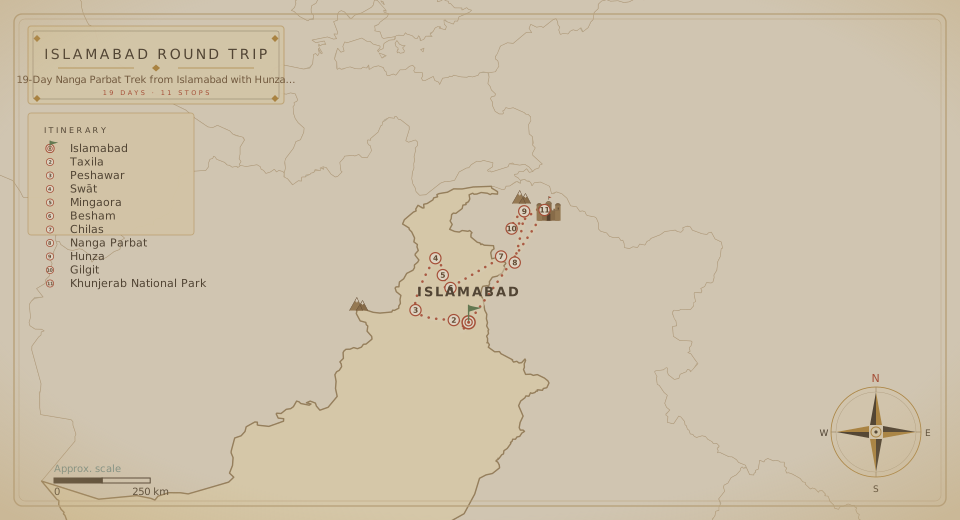
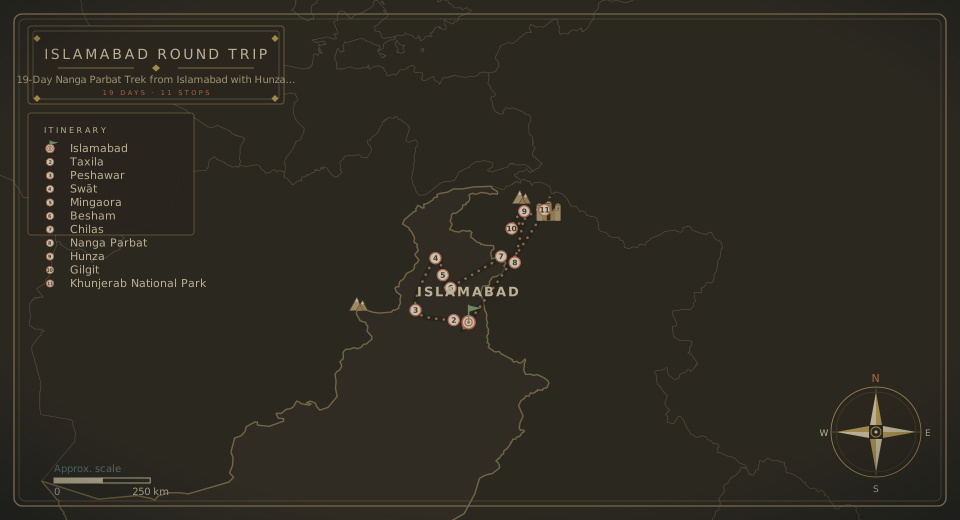
Embark on a challenging 19-day trek to Nanga Parbat from Islamabad, travelling through Peshawar and the fertile land of Swat before crossing Shangla Pass between the Hindukush and Karakoram ranges. Trek around the mighty Nanga Parbat massif, covering its three faces as you pass through Mazeno Pass, Loiba Meadows and Kachal, with sweeping views of the Himalayas, Karakoram and Hindukush. After the trek, continue to Hunza Valley to explore its villages, forts, glaciers and high mountain scenery before driving back to Islamabad.
Embark on a challenging 19-day trek to Nanga Parbat from Islamabad, travelling through Peshawar and the fertile land of Swat before crossing Shangla Pass between the Hindukush and Karakoram ranges.
From the itinerary
At a glance
Day by day
In the morning, arrive in Islamabad.
Visit Islamabad, the federal capital of Pakistan.
Explore Faisal Mosque, Daman-e-Koh, Constitution Avenue, Lok Virsa Museum and Shakar Parian Park.
Overnight at the hotel.
Drive to Peshawar in the morning along the Grand Trunk Road, laid down by Sher Shah Suri, the Pathan Emperor of the United Indian Empire.
En route, visit Taxila, the former capital of the Gandhara civilisation.
See the archaeological remains of a monastery at Julian, the ancient city of Sirkup, and the site museum.
Continue driving towards Peshawar.
While crossing the Indus River at Attock, there may be a stop for photographs at the meeting point of the Indus and Kabul rivers just beyond Attock Bridge.
Arrive and transfer to the hotel. Peshawar has always held an important place in the history of the subcontinent because of its location near the Khyber Pass and the Gandhara civilisation. Today, the city is known as much for its distinctive frontier-town atmosphere as for its monuments.
Visit the street of storytellers at Kissa Khawani Bazaar, the gold market of Kasera Bazaar, Karavan Serai, Mahabat Khan Mosque, and the Peshawar Museum, known for its collection of Gandhara artefacts.
Dinner and overnight stay at the hotel in Peshawar. (170 km, 3-4 hours).
Cross the historic Malakand Pass, the gateway between Peshawar and Swat valleys, and enter Swat Valley.
En route, visit the Buddhist archaeological site of Takht-e-Bhai and other places before reaching the valley.
Swat shines with fruit-laden orchards, flower-filled slopes, meandering rivers and rumbling streams, all surrounded by the mighty ranges of the Hindu Kush and Karakoram. The valley lies 2,250 feet above sea level, and Saidu Sharif and Mingora together form its twin capital.
Visit the Swat Museum and the Butkara excavation site, dating from the 1st to the 7th century AD.
Transfer to the hotel for an overnight stay in Mingora.
As this is a long drive, start early from Swat.
Continue for about an hour on the road leading towards upper Swat Valley, then turn north from the small and beautiful town of Khuaza Khaila.
Drive on a single mountain road and cross Shangla Pass between the Hindukush and Karakoram mountain ranges.
After crossing Shangla Pass, enter the Karakoram and arrive at Besham, an important city on the Karakoram Highway.
Have lunch in Besham and continue along the Karakoram Highway, a joint effort of the Pakistan Army and Chinese engineers. It took 850 lives and 20 years to complete and is reputed as the eighth wonder of the world.
Drive through the Indus gorge and arrive at Chilas on the bank of the Indus.
Transfer to the hotel for dinner and an overnight stay. (9-10 hours drive).
Drive early in the morning to Jaglot on the Karakoram Highway, then board 4x4 jeeps.
Continue to Trashing village, the trek head. En route, make a short stay at Astore, 56 km from Jaglot. Astore is an important place, as many treks begin here, along with the jeep road towards Deosai and Kashmir.
Trashing, the start of Rupal Valley, lies 30 km from Astore. Most of the population here is Kashmiri- and Shina-speaking. On arrival in Trashing, the camping staff will welcome you.
Overnight camping at Trashing. (6-7 hours drive, 2900 m).
The first half-hour of the trek is steep, climbing up to the lateral moraine of Trashing Glacier. It then takes another half-hour to cross the glacier. On the far side lies the lower Rupal Valley, with two large summer settlements and broad wheat fields.
From the lower Rupal Valley, the trek becomes green and gradually ascends.
After about three hours of walking from here, arrive at Bazin, just below the solid ice wall of Nanga Parbat's east face.
Overnight camping in Bazin. (4-5 hours trek, 3600 m).
At the start of today's trek, walk on the Bazin Glacier for about two hours.
After crossing the glacier, the trail passes through juniper and willow trees. The local people of the area are friendly and helpful.
The trek continues up to the Rupal River. After about an hour's walk, reach a place called Herligkoffer Base Camp. He was a famous climber who led many expeditions to Nanga Parbat, including the 1953 expedition during which Herman Buhl made the first ascent.
After a short stay here, walk on for about another hour to reach Second Base Camp, another summer settlement.
The campsite at Shaigiri is not very far from here. After about an hour's walk, arrive at Shaigiri. Porters normally ask for a goat here, which they slaughter before arranging a campfire with local songs and dances.
Enjoy the beautiful views of the south face. (5-6 hours, 3700 m).
Day free to explore the area or take an optional climb to Rupal Peak (5580 m).
Follow the lateral moraine of the Rupal Glacier.
Turn back for views of Nanga Parbat, Rupal Peak and Laila Peak. The campsite is at 4200 m, with a few juniper trees and a small water stream. (4-5 hours)
Start the trek on a comparatively steep route, ascending to the Mazeno Glacier, which comes straight down from Mazeno Pass. At this altitude, the campsite is no longer green, but water is available.
The high base camp is at 4724 meters. (5-6 hours)
Start early in the morning before sunrise.
The climb up to the pass is not very difficult, but the other side is steep and requires rope, an ice axe, a sit harness and crampons. The steep section is about 250 m in length.
After crossing the pass, the Loiba Glacier begins, and camp here at Upper Loiba at an altitude of 4300 m. (7-8 hours).
Trek down from Upper Loiba to Lower Loiba, known as Loiba Meadows.
It is a comfortable walk through lush green meadows and trees.
The campsite consists of many shepherds' houses at 4000 m. (3-4 hours)
Today, enjoy beautiful views of Nanga Parbat as the straightforward trek passes through pine and birch trees, crosses the Airil River, and enters the Kachal summer settlement at the base of Kachal Pass (4400 m).
Camp at 3000 m. (4-5 hours).
From Kachal, four trekking routes meet: one goes to Kachal Pass, the second to Zangot, the third back to Loiba, and the fourth to Diamer Base Camp.
Take the Diamer Base Camp trail. A small water channel flows alongside the hike, and the walk gradually ascends, with a short stop en route at Kutgali.
Arrive at Diamer Face Base Camp. The world's most famous mountaineer, Reinhold Messner, climbed Nanga Parbat from this side in 1979, and he lost his brother on their way back. It is reputed to be the most difficult route on Nanga Parbat. Spend a short time here for exploration and photographs.
Walk back by the same route and camp at Zangot, 4200 m. (6-7 hr)
Take a warm and somewhat steep trek down to the Diamer River to arrive at Dimroi.
From Dimroi, board 4x4 jeeps and continue towards Gilgit, the capital of the Northern Areas of Pakistan.
Arrive in Hunza, transfer to the hotel, and enjoy a hot shower. (7-8 hours trek, 4 hours drive).
Drive out from Gilgit and re-enter the town through the historic route, crossing a suspension bridge over the river.
Drive to Kargah to visit the rock-carved Buddha from the 7th century AD.
In ancient times, Kargah Valley was part of the travelling route used by Buddhist monks on their way to Taxila.
Stroll through the colourful bazaars of Gilgit before continuing along a scenic route to the beautiful, breathtaking Hunza Valley.
On the way, see the old Silk Route once used by Buddhist monks and traders.
Make a short stop at the Rakaposhi (7,788 m) viewpoint.
Enter Hunza Valley and arrive at its capital, Karimabad.
Overnight at the hotel. (2-3 hr, 110 km).
Enjoy a free day in Karimabad for short walks to Altit and Baltit Forts and for further exploration in Hunza Valley. The people of Hunza are famous for their long lives.
From Karimabad, you can also see beautiful peaks of the Karakoram range, including Rakaposhi, Diran, Ultar, Golden Peak and the Nagar Valley on the left bank of the Hunza River. In Hunza, each family grows enough wheat, maize, apricots and walnuts for its own use. The people are mostly self-sufficient, making their own clothes, shoes, wooden and stone bowls, and growing their own food. They are very friendly and cheerful.
In the afternoon, you could walk to the Ultar Glacier. Follow the irrigation channel through the village or stroll through the single-lane bazaar for better views of the soaring peaks around you.
Excursion to Khunjerab Pass (4733 meters) in Upper Hunza.
Take a short drive through the heart of the Karakoram and stop at the village of Gulmit, in the shadow of the virgin Gulmit Tower.
Walk through the village fields to visit the polo ground and old houses. Later, take a short trek to Gulkin Glacier and Borit Lake.
At the end of the trek near Borit Lake, transport will pick you up for a 15 km drive to Passu. Passu is a small, charming village set against the backdrop of the soaring Passu Cones, with Passu and Batura glaciers within short walking distance.
Take a walk through the village to observe local life. Around 70 years ago, Passu was the second-largest settlement in Hunza after Karimabad. The glacier upstream on the Hunza River moved down to create a large dam that later broke, destroying fertile fields and houses. Today, the river occupies much of the valley, with the village on its right bank.
From Passu, enjoy fascinating views of Shispar (7,611 m) and Passu Peak (7,478 m).
Visit the famous suspension bridges of Passu. These 800-foot-long bridges over the Hunza River are still used by local people.
Later, drive to Khunjerab Pass, the border between Pakistan and China and the world's highest metal road border crossing.
Spend some time at the top of Khunjerab and drive back to Karimabad for an overnight stay at the hotel.
Drive along the bank of the Hunza River on the Karakoram Highway, enjoying fascinating views of the Karakoram peaks from a different angle.
There may be a stop in Gilgit town for lunch.
Arrive in Chilas on the bank of the Indus River for an overnight stay at the hotel. (260 km, 6-7 hours)
Drive the full day on the Karakoram Highway back to Islamabad.
Start early in the morning to cover the 12-hour drive.
Make a short stop in Besham for lunch. By evening, arrive in Islamabad.
Transfer to the airport for your international flight back home.
The route
The fine print
Accommodation on a twin-sharing basis at standard category hotels in towns, and 2-person dome tents during the trek
Meals: half board at hotels and full board during the trek
Transport: air-conditioned transport and soft-top 4x4 jeeps to the trek head and trek end
Camping facilities: 2-person dome tents with mattresses, a dining tent with folding table and chairs, a kitchen tent with complete kitchenette and staff, and a toilet tent
Portage of 15 kg during the trek
Tips and portage at airports and hotels
Entrance fees at sites and museums
English-speaking Pakistani mountain guide
Domestic and international airfare, and airport taxes
Any expense due to forced measures, flight cancellation, landslides, natural calamities, acts of God, or force majeure beyond the control of our staff and agents
Any personal expenses not mentioned above
Trek & Tour Nanga Parbat Round Trek with Hunza, Swat & Peshawar
18 days, 10 nights camping around the 9th highest mountain in the world and 07 nights in hotels, including Hunza Valley.
The trip starts from Islamabad, the federal capital of Pakistan.
From Islamabad, we travel on the Grand Trunk Road to Peshawar.
Then we enter the fertile land of Swat, cross Shangla Pass between the Hindukush and Karakoram ranges, and continue into the Karakoram for a 10-day trek around Nanga Parbat.
After finishing the trek, enjoy some days in Hunza Valley and drive back to Islamabad to end your trip.
Nanga Parbat (8126 m) is reputed as the Killer Mountain and the most difficult among the world's 8,000-meter peaks. First climbed by Herman Buhl in 1953, the peak still retains its awe for experienced climbers.
The massif of Nanga Parbat offers three faces, each with its own distinctive features. We will take a round trek of this mighty mountain, covering all three faces. The trek is strenuous and involves the use of crampons and rope work.
Logistics
Your 19 days finish where they began, in Islamabad.
Watch the film
Create your own adventure
Say goodbye to travel stress.
Starting from
When
Travellers
Total
—