
Bhutan, Nepal · Trekking

15-Day Botanical Trek in Paro and Thimphu with Jomolhari Camps

15 Days Round trip from Bhutan Hard pace

The journey

Trip highlights
  • 01 Explore Bhutan's alpine flora across blue pine forests, Himalayan woodlands, and high meadows
  • 02 Follow the course of the Pachhu River from the Paro valley into remote trekking country
  • 03 Visit Taktsang Monastery, one of Buddhism's most venerated pilgrimage sites
  • 04 Enter Jigme Dorji Wildlife Sanctuary, Bhutan's largest protected area
  • 05 Traverse the wildflower meadows and gardens of Thongbu Shong and other high camps

Enjoy this tour with a focus on Bhutan's alpine flora and fauna specialities. Explore several beautiful habitats and botanical spots, from blue pine forests and some of the finest woodlands of the Himalaya to farmlands, while following the course of the Pachhu River throughout the trip. Trekking to the various camps and crossing different sites also offers opportunities to visit local attractions such as Taktsang Monastery and Jigme Dorji Wildlife Sanctuary, along with activities that are exclusive to these places.

Close by, overlooking it, is the ruined Dzong, beyond which the enormous snow-covered southeast face of Chomolhari fills the head of the side valley.

From the itinerary

At a glance

What this trip includes

Duration 15 Days
Tour type Shared
Activity level Hard
Accommodation Included · Standard
Transport Included
Cities Thimphu, Paro, Jomolhari
Languages Dzongkha, English, Hindi

Day by day

The itinerary

1
Day 01

Arrival in Paro and Valley Introduction

  • Fly to Bhutan along the chain of the Great Himalaya and, if the weather is kind, enjoy views of several 8000 m peaks, including Qomolangma, more commonly known in the West as Mount Everest, and Kanchenjunga, as the flight is done on a visual approach without radar.

  • Pass the final few kilometres along a narrow valley between forested ridges, going by Paro Dzong, the fortified administrative centre of the district, before descending into Bhutan's only airport at Paro. After completing the formalities, meet your guide, who will accompany you to your hotel in Paro.

  • Look up to Paro Dzong and appreciate its fortress structure as you follow the valley past the archery ground into the town during the transfer.

  • Walk out into this small town to get a feel for daily life and visit the shops during the transfer.
2
Day 02

Acclimatization Walk to Taktsang Monastery

  • Begin your explorations by setting out by vehicle upstream along the course of the Pachhu, the river that runs through Paro, where you may see many farmlands and farmhouses along the way.

  • Cross the river to your right as you rise through more farmlands and blue pine forest to a spot from where you can look up to Taktsang Monastery, also known as the Tiger's Nest, one of Buddhism's most venerated pilgrimage sites. This will be your destination for the day.

  • Take an acclimatizing steep walk of around 3 hours, with the first section on forest paths to a tea room, then continue through another forest section to a much closer second viewpoint, and finally follow steep stone paths down and up to the monastery itself.

  • Retrace your steps to the vehicle, with a possible stop at a local farmhouse for an inside look at the daily life of a traditional rural family.

  • Return along the valley to your hotel in Paro.

3
Day 03

Chele La Pass and Botanical Exploration

  • Drive steadily up the valley side to the southwest en route to Chele La (3750 m), the highest road pass in the country.

  • Walk through the mixed tree and shrub layer into more open areas. The varied habitats, including rock outcrops, provide an interesting introduction to the flora of Bhutan.

  • Make a slow descent through the forest after your first Bhutan picnic lunch, with time for botanising.

  • Return to Paro.

4
Day 04

Trek from Shana to Thongdu Zampa

  • Follow the Pachhu, the river of the Paro valley, from its course to its source over the next few days.

  • Drive north with spectacular views throughout to Taktsang Goemba.

  • Head to Drukgyel Dzong and then to Gunetsawa on a dirt road for about one hour to begin your trek. Here, all main bags are loaded onto ponies while you carry only cameras, water bottles, wet-weather clothing, umbrellas, and any other personal gear in small daypacks.

  • Leave behind the settlements of Shana after a short trek and enter Jigme Dorji Wildlife Sanctuary, the largest protected area in the country. The list of mammals it harbours is very impressive, but close to your path, the main trade route through the area, you would be lucky to catch sight of them.

  • Witness a good selection of birds and, as with the flora, woodland species on this and the next day.

  • Go along closely with the river and cross by bridge to your camp at Thongdu Zampa.

5
Day 05

Thongdu Zampa to Gezampa

  • Continue from Thongdu Zampa, following the river and crossing back again so that it remains on your right as you gradually rise. The valley narrows, and a bridge takes a path off to link towards where you will be in a week's time.

  • Take a path through thinning woodland with interesting river flats to a camp on a meadow from which you can look up to high pastures with grazing yaks, high rock ridges, and carries.

  • As you approach Gezampa camp (3730 m), you may see the snow dome of Chomolhari (7314 m) beyond this green and brown foreground. You will now be high above the river, and the pastures are full of flowers that you can begin to look at this evening if time allows.

6
Day 06

Gezampa to Jangothang

  • Set out through the broad expanses of Primula sikkimensis and the plants of the nearby meadow. The first kilometre will be time-consuming due to the number of botanical distractions. Your lunch stop will be on a broad flat meadow, with the river below.

  • Watch yaks and the herders' dwellings, as well as the SOE community settlements nearby.

  • Reach a bridge that takes you past a huge boulder adorned with prayer flags, beyond which stands the stone building at the heart of the Jangothang campsite.

Close by, overlooking it, is the ruined Dzong, beyond which the enormous snow-covered southeast face of Chomolhari fills the head of the side valley.

7
Day 07

Rest and Acclimatization at Jangothang

You have two nights at Jangothang to aid acclimatization now that you have reached 4000 m+. This can be taken as a rest day if required, with opportunities for botanising close by. There are other options as well, with an approach towards Chomolhari probably the most appealing.

8
Day 08

Jangothang to Nyile La Shong

Leaving the campsite, you lose your view of Chomolhari as soon as you depart, but in less than 15 minutes the main valley opens out to your left with the Pachhu, which you have followed all the way from your starting point, issuing from the terminal moraine. Beyond this is a huge cirque with Jichu Drake (6989 m), a shapely spire of snow and ice at its head, and you should have wonderful views as you cross the Pachhu for the last time and rise quite steeply up the opposite valley side to the shoulder.

  • Enter a long, gently rising hanging valley, along which your progress will be punctuated by botanising stops and photography spots, with the lure of the screes on your left throughout its length. Passing yak herders' tents, be aware of the beasts themselves.

  • Look across the river to huge side valleys beyond before turning uphill steeply again for the short rise to Nyile La Shong campsite. The trail to camp and welcoming tea is good, but taking a shortcut can be very time-consuming, as the wet pasture in the last half kilometre is full of delectable plants.

Camp is at 4730 m in a huge corrie, over the rim of which the snow top of Tsherim Kang, 6526 m, appears and, with waxing moonlight at this time, clear night skies would give you a wonderful experience.

9
Day 09

Botanising from Corrie to Nyile La

You will be camped in the realms of the Tibetan Snowcock and, in the first hints of light, you shall hopefully be aware of their eerie calls as they feed in the heath above.

  • Begin your search of the corrie after breakfast, at first across yak pasture and then moving into an incredibly rich low heath with many sentinel Reumnobile at its upper edge. These are collected for medicine, but you should be ahead of the collectors.

  • Continue round at various levels. The screes and outcrops will give you continuing botanical interest until you reach Nyile La itself (4890 m), from where you can walk up again amongst the cushions of Androsace tapete. Throughout the day, the camp is almost continuously visible below.

  • Aim to stay high for as long as possible, though the wet pasture in the bowl will also be explored before you return to camp in the late afternoon.

10
Day 10

Nyile La Shong to Bonte La Shong

  • Turn downhill from your high camp to retrace your steps through the hanging valley along which you walked on Day 8. Having already botanised these slopes, you should try to avoid too many diversions here because there is much new ground to explore later.

  • Travel south and contour round with Jichu Drake to your right and your previous campsite at Jangothang far below.

  • Enter the Tso Phu Valley and look along its length at the two lakes at its head. The screes on the slopes to your left as you approach them hold much interest, while the damp meadows by the lakes support a different flora.

  • Ascend at the valley head on the route to the Bonte La and to your campsite at Chazhi Thang, a common habitat of the elusive Snow Leopard, which is another high camp.

11
Day 11

Exploration Around Nachuing La

You will be in exploration mode, as no records show that anyone has botanised this area. At Nyile La Shong, your high camp here gives you close access to high alpines, and you can spend as much time as possible seeking out its treasures.

12
Day 12

Bonte La Shong to Yaksa

  • Take a short steep ascent that brings you to the Bonte La (4890 m), the highest pass crossed by trail on this trek.

  • Spend time botanising at the top and, if it is an auspicious day, you may help the crew put up some prayer flags as well.

  • Descend past the rocky cliffs of Yaksathang, traverse the wildflower meadows at their base, and camp at a picturesque site with a waterfall at the far end of the valley, just below the tree line on the other side of the pass.

13
Day 13

Yaksa to Thongbu Shong via Windhorse Pass

  • Start with a gradual climb above the tree line, past hillsides covered with rhododendron and azalea thickets, before a further rise takes you up over the Tagilung La, also known as the Windhorse Pass (4540 m). In very clear conditions, Kanchenjunga (8586 m), the third-highest mountain on earth, is visible from the peak to the east of the pass, and in exceptional air, Makalu, even farther away in Nepal.

  • Descend to grassy meadows where herds of yak graze during the summer months. The campsite is surrounded by snow-streaked peaks.

14
Day 14

Thongbu Shong to Shana

  • Take a short climb that leads you above the valley to the Memla (4270 m), beyond which you traverse an incredibly beautiful garden of wildflowers. It is intriguing to speculate on what this might contain.

  • Begin the steep descent to Shana, where you started the trek. Your trek ends here, and you will be driven to your hotel in Paro.

15
Day 15

Departure from Paro

  • Drive to Paro airport for your onward departure.

The route

Where you'll travel

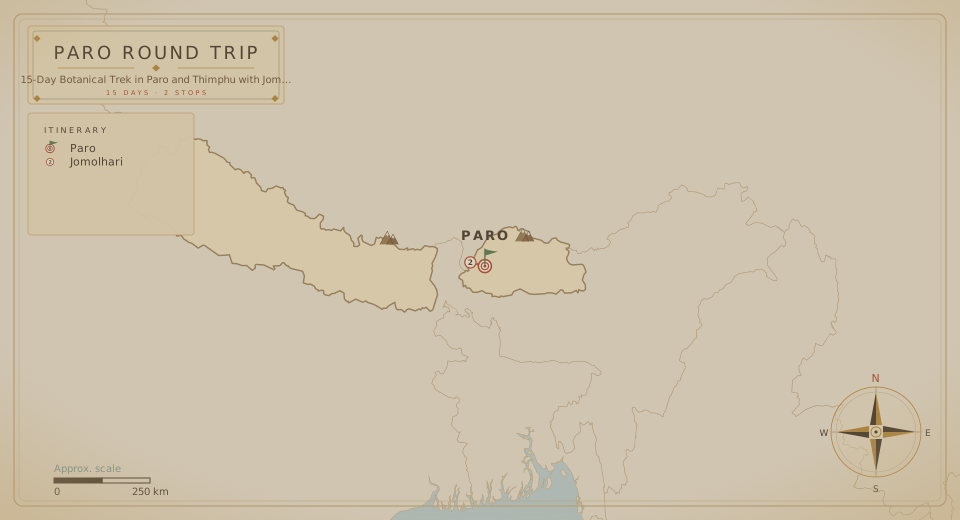
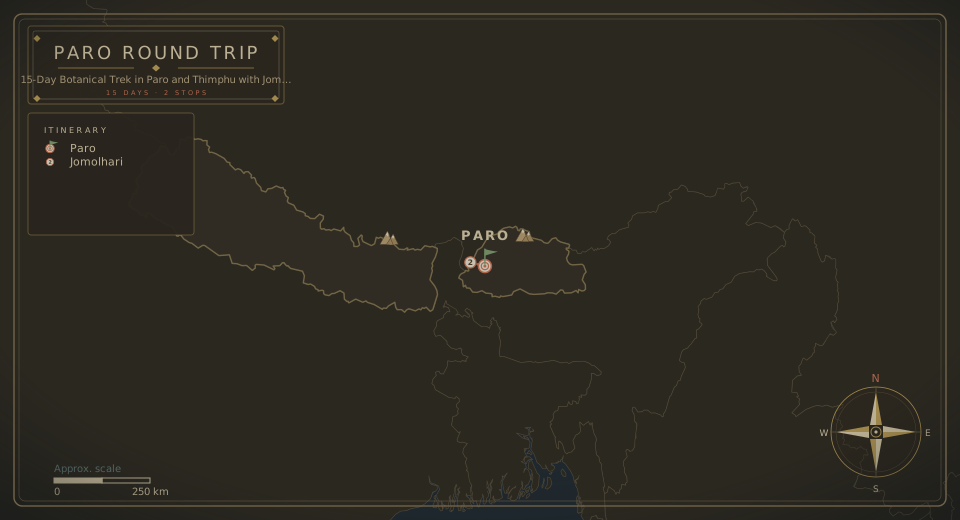
Tour route map
Round trip from Bhutan 3 cities · 15 Days

The fine print

Trip details

What's Included

  • English-speaking Bhutanese tour guide

  • Full-board meals

  • Transportation

  • Bhutanese tour guide

  • Accommodation in 3-star and above hotels

  • Museum entry fees

What's Not Included

  • Farmhouse visit and stay

  • Traditional hot stone bath

  • Cultural show

  • Drinking water

Know before you go

  • Get an opportunity to explore the various non-botanised areas throughout the trek.
  • This tour to Bhutan has been organized to give participants access to some of the exceptional flora of this small mountain kingdom, one of the jewels in the crown of Himalayan countries. The ultimate aim is to see high alpine specialities, but in order to reach them, you will also pass through several other habitats, including some of the finest woodland remaining in the Himalayas.

Logistics

Meeting & route

Meeting point
Bhutan
Tour start
Bhutan
Tour ends at the same location as the start point.
End of the journey

Your 15 days finish where they began, in Bhutan.

Watch the tourHQ film Watch the film

Create your own adventure

Can't find the perfect tour? Tailor your dream trip.

  • Tell us your destination, dates and group size.
  • Our travel experts and local guides design a tailored itinerary, just for you.
  • Enjoy your trip with peace of mind, knowing everything is taken care of.
Plan my holiday

Say goodbye to travel stress.

Starting from

USD 250 /person
Book This Tour

When

Travellers

Total