Uganda · City Tours

1-Day Kampala City Tour with Museums, Markets and Kasubi Tombs

1 Day Round trip from Kira Rd Easy pace

The journey

Trip highlights
  • 01 Explore the Uganda Museum and its precolonial and tribal artifacts
  • 02 Visit the Kasubi Tombs, burial grounds of the Baganda royal family
  • 03 Stroll through Nakasero Market at the foot of Nakasero Hill
  • 04 Walk around Owino Market, the largest open market in Uganda

Spend a day exploring Kampala, one of the city's seven hills and popularly known as the Rome of Uganda. Visit prominent attractions such as the Uganda Museum, Kasubi Tombs, Nakasero Market, Owino Market, and Rubaga Hill, along with churches nestled on the hill. This tour offers a closer look at Kampala's cultural heritage, spiritual landmarks, and lively local markets.

Walk around Owino Market, the largest open market in Uganda.

From the itinerary

At a glance

What this trip includes

Duration 1 Day
Tour type Shared
Activity level Easy
Accommodation Not included
Transport Included
Wheelchair access Not applicable
City Kampala
Languages English

Day by day

The itinerary

1
Day 01

Kampala City Highlights Tour

After breakfast, leave the hotel and explore several places with a Kampala guide/driver.

  • Explore the Uganda Museum, exhibiting ethnological, natural-historical, and traditional life collections of Uganda's cultural heritage.

  • Visit the Kasubi Tombs, an important spiritual and political site.

  • Traverse through Nakasero Market and find fresh food, textiles, shoes, and cheap electronics.

  • Walk around Owino Market, the largest open market in Uganda.

  • Go to Rubaga Hill, rising up to 4,134 feet above sea level.
The route

Where you'll travel

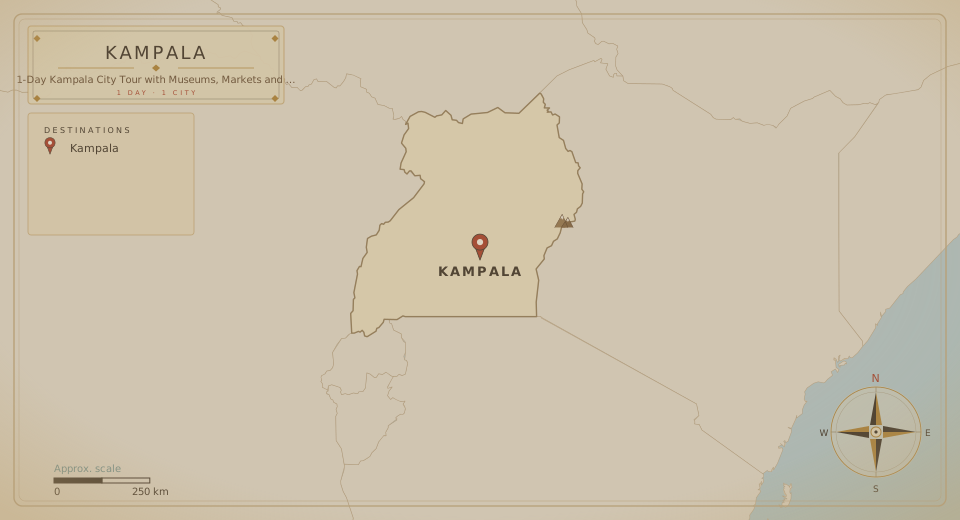
Tour route map
Round trip from Kira Rd 1 city · 1 Day

The fine print

Trip details

What's Included

  • Car hire services with a Kampala driver

  • Entry fees

  • Excursions to the Uganda Museum, Kasubi Tombs, vegetable markets, Owino Market, Rubaga Hill, Namirembe Hill, and the King's Lake

  • English-speaking local tour guide

What's Not Included

  • Fuel

Know before you go

  • Kampala City tour at $27 per person.

  • The Uganda Museum is a display of Uganda's cultural heritage, where one can see ethnological and natural-historical exhibitions. It is a vivid reminder of the country's colourful past. Founded in 1908 in Kampala, the museum has exhibits of traditional culture, archaeology, history, science, and natural history. It regularly presents performances of traditional music. One of its most interesting features is the collection of traditional musical instruments, which anyone is free to play. The National Museum of Uganda is located in Kampala, the capital of the country, and contains rich materials from Uganda, making it a must-see. The Uganda Society's library is housed in one room of the Uganda National Museum. Started in the 1930s by a group of scholars, the collection is comprised of approximately 3,000 volumes, maps, periodicals, and photographs, all pertaining to African history, culture, sociology, travel, and science. In addition to its collection, the library houses the books of the East African Wildlife Society and a number of books from the museum that were given to the society's care some years ago. Although the library was a circulating library for many years, due to the limited availability of the books and their value, the collection is currently available for reference use only.

  • Kasubi Tombs is where the fallen kings of the Buganda Kingdom are buried. The Tombs of Buganda Kings at Kasubi constitute a site embracing the hillside within Kampala District. At its core on the hilltop is the former palace of the Kabakas of Buganda, built in 1882 and converted into the royal burial ground in 1884. Four royal tombs now lie within the Muzibu Azaala Mpanga, the main building, which is circular and surmounted by a dome. It is a major example of an architectural achievement in organic materials, principally wood, thatch, reed, wattle, and daub. The site's main significance lies, however, in its intangible values of belief, spirituality, continuity, and identity.

  • Nakasero Market: At noon on Saturday, January 1895, the Right Reverend Mckay advised the then Kabaka of Buganda to establish the first market in the Lubiri (Palace). In 1905, the market moved to Kabugube, where it was housed in a temporary structure. Here, you can find a huge variety of fresh fruits and vegetables, mostly indigenous to Uganda. Across the street is a flower market, full of spices, legumes, grains, and handmade household items. This market is surrounded by a number of shops, or dukas, where you can find everything for the home. Hardware, sanitary ware, and electrical shops surround the area.

  • Owino Market is one of the largest in this region of Africa. The endless booths that line the chaotic alleys of Owino offer a mind-boggling array of everything from homemade irons to American hand-me-down clothes with the Goodwill price tags still on them, to an amazing array of African foods, and almost anything else under the sun. Everything at Owino starts cheap and gets cheaper with bargaining. If you are interested in a market for souvenirs, check out the craft market on Buganda Road or the slightly larger crafts market behind the national theatre near the Garden City complex. Also on Buganda Road, across the street from the craft market, you can find a number of tailors if you are looking to have clothes sewn. And if you get tired from shopping, the upscale 1000 Cups of Coffee Cafe is a relaxing Mzungu hangout.

  • Rubaga Hill was taken up by the Roman Catholics and was the site of the first Roman Catholic church here. It was also the location of the main palace of Kabaka Muteesa I, who ruled Buganda between 1856 and 1884. The palace was struck by lightning and rebuilt on neighbouring Mengo Hill. The first Roman Catholic missionaries to arrive in Buganda were Frenchmen Father Pierre Lourdel Monpel and Brother Amans, who settled near the hill in 1879. As the Catholic Church took root in the country, the missionaries were allocated land on Lubaga Hill. The construction of St. Mary's Cathedral on Lubaga Hill took place between 1914 and 1925, with the assistance of monetary contributions from Roman Catholic congregations abroad. Later, the missionaries also built a hospital and a nursing school on the hill. Today, Lubaga remains the seat of the headquarters of the Catholic Church in Uganda. It is the seat of the Roman Catholic Archdiocese of Kampala. The remains of the first African Catholic bishop in Uganda, Bishop Joseph Nakabaale Kiwanuka, are also here.

Logistics

Meeting & route

Meeting point
Kira Rd, Kampala, Uganda
Tour start
Kira Rd, Kampala, Uganda
Tour ends at the same location as the start point.
End of the journey

Your 1 day finishes where it began, in Kira Rd.

Watch the tourHQ film Watch the film

Create your own adventure

Can't find the perfect tour? Tailor your dream trip.

  • Tell us your destination, dates and group size.
  • Our travel experts and local guides design a tailored itinerary, just for you.
  • Enjoy your trip with peace of mind, knowing everything is taken care of.
Plan my holiday

Say goodbye to travel stress.

Starting from

USD 100 /person
Book This Tour

When

Travellers

Total