


For many travelers, seeing the Northern Lights is one of the main reasons for visiting Finnish Lapland.
One of the questions I am asked most often is: “Which month gives me the best chance?”
The honest answer is that there is no single perfect month. Northern Lights depend on solar activity, darkness, cloud cover and a little luck. Each part of the aurora season also offers a different kind of experience.
In Ylläs, Finnish Lapland, the nights are dark enough to see the Northern Lights from approximately late August until early April. Your choice therefore depends not only on your chances of seeing them, but also on what else you would like to experience during your stay.
How often can you see the Northern Lights in Ylläs?
The Finnish Meteorological Institute estimates that Northern Lights are visible on roughly half of all dark and cloudless nights in destinations such as Ylläs, Levi and Saariselkä.
That sounds very promising, but two words are especially important: dark and cloudless.
Strong aurora activity cannot be seen through thick clouds, and the sky must be dark enough for the colours to become visible. This is why the Northern Lights may be active above Ylläs even when we cannot see them from the ground.
It is also why staying for several nights gives you a much better chance than visiting for only one evening.
Late August and September: dark nights return
In Ylläs, the first Northern Lights can usually be seen again in late August, once true darkness begins returning after the bright summer. This is one of my favourite times of year. The lakes are still open, so the Northern Lights can be reflected in the water. The ground is normally free of snow, making it easier to walk to viewpoints and spend longer outside without facing deep winter temperatures.
September also brings the colourful ruska season. The forests turn yellow, orange and red, while the nights become longer and darker.
Aurora activity tends to be slightly stronger around the autumn and spring equinoxes. This is connected to the way the solar wind interacts with the Earth’s magnetic field. It does not guarantee a display on the exact date of the equinox, but September is generally a very interesting month for Northern Lights.
For photographers, autumn offers something especially beautiful: auroras above open water, sometimes mixed with the final colours of sunset.
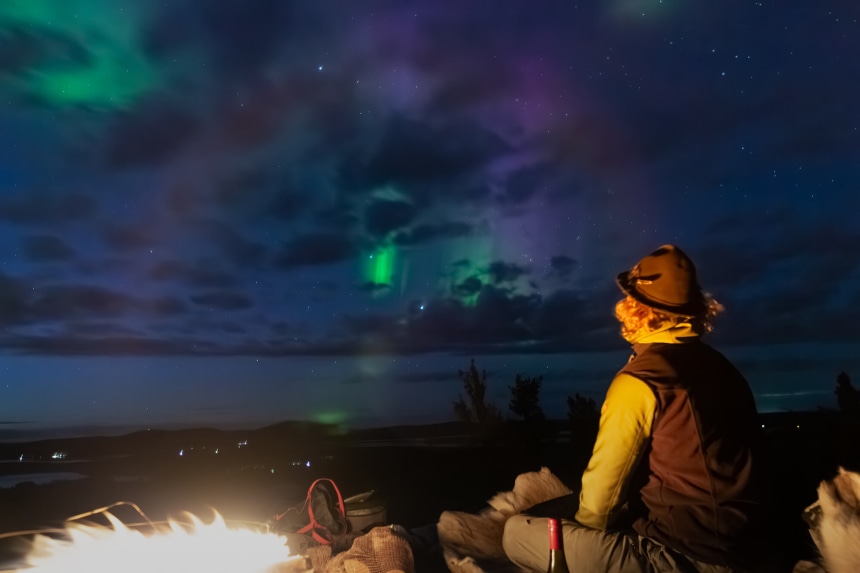
October and November: quiet nights before winter
By October, the nights in Ylläs are considerably longer. The first snow may arrive, although permanent snow cover is never guaranteed early in the month.
October can be an excellent time for travelers who prefer quiet surroundings. There are fewer visitors than during the main winter season, and the darkness offers plenty of time for aurora watching.
November is more unpredictable. It may already look completely wintry, or the weather may move between snow, rain and ice. Cloudy conditions can sometimes persist for several days.
Nevertheless, clear November nights can be wonderful. The landscape is dark and peaceful, and fresh snow makes even a faint Northern Lights display easier to notice.
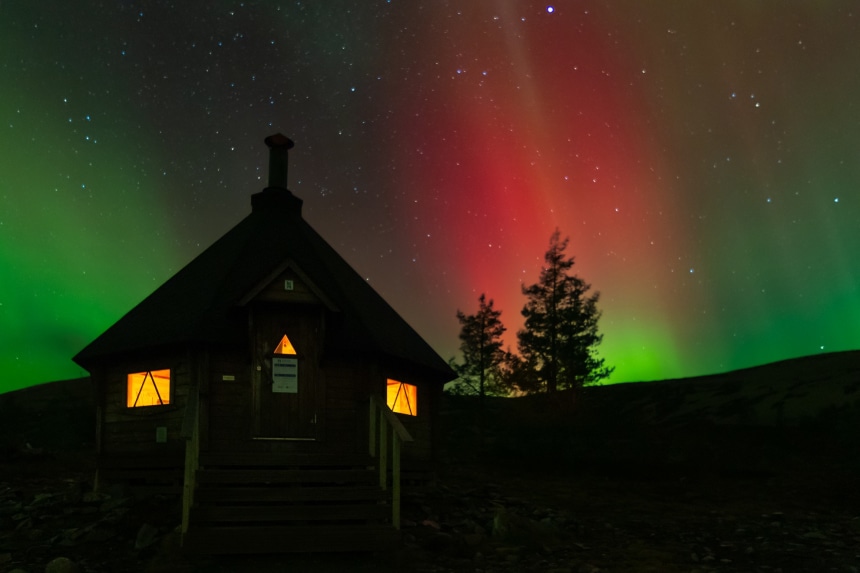
December and January: Northern Lights in the Polar Night
December and January offer the longest hours of darkness. Around midwinter, the sun remains below the horizon for part of the season, although Ylläs is never completely dark throughout the day. A soft blue and pink twilight appears around midday.
These months create the classic winter scenery many travelers imagine: snow-covered trees, frozen lakes and deep Arctic darkness.
However, longer darkness does not automatically mean stronger auroras. The Northern Lights are caused by activity from the sun, not by cold weather or snow. Darkness simply gives us more hours in which we may be able to see them.
December and January can also be very cold. If you plan to wait outside, proper winter clothing and warm footwear are essential. A sheltered fire or warm drink can transform aurora watching from an endurance test into an enjoyable evening.
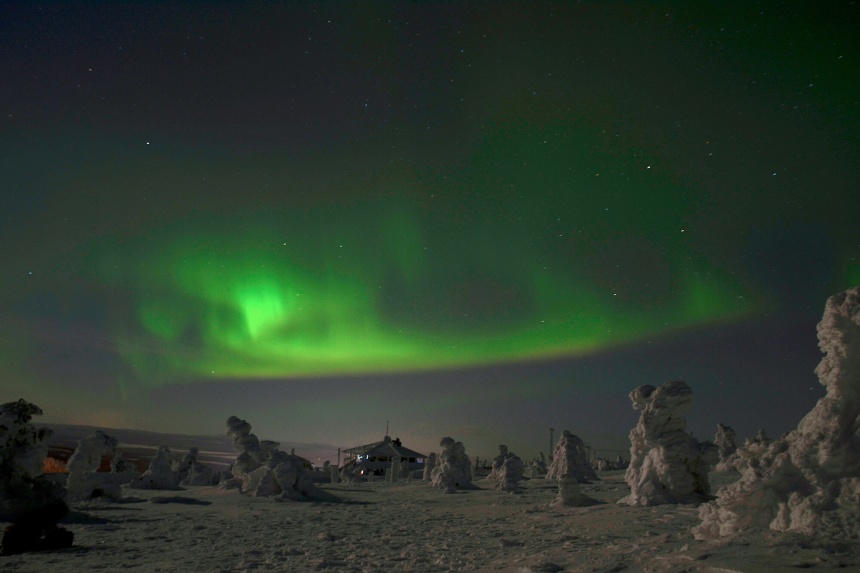
February and March: excellent conditions and more daylight
February and March offer a particularly attractive combination: snowy winter landscapes, more daylight for daytime activities and dark evenings for Northern Lights.
The Finnish Meteorological Institute considers March and early April especially favourable when both aurora activity and typical weather conditions are taken into account. February and March are also listed among Finland’s best months for observing the Northern Lights. The days are noticeably longer, yet the nights remain properly dark. Temperatures can still be very low, but the sun begins bringing warmth and energy back to the landscape.
March is ideal if you want to combine aurora watching with snowshoeing, cross-country skiing or other outdoor activities during the day.
Early April: the final nights of the season
Northern Lights can still be visible in early April, but the window becomes shorter as the nights rapidly grow lighter.
There may still be plenty of snow in Ylläs, and the days are often bright and pleasant. In the evening, however, you may need to stay awake later before the sky becomes dark enough.
By the second half of April, the increasing daylight makes auroras progressively more difficult to see. Solar activity continues throughout the year, but the bright Arctic nights hide it from view.
During summer, the Northern Lights may still be happening above us—we simply cannot see them.
What time do the Northern Lights appear?
Northern Lights do not follow a fixed schedule.
In Finland, they are statistically most common around late evening and midnight, often between approximately 9 p.m. and 1 a.m. However, I have seen them much earlier in the evening and later during the night.
A display can last only a few minutes or continue for several hours. Sometimes the sky begins with a pale, almost colourless arc that gradually becomes brighter. On other nights, the aurora suddenly appears and moves rapidly across the entire sky.
This unpredictability is part of what makes every display different.
Do you need a strong Aurora forecast in Ylläs?
Not necessarily.
Ylläs lies far enough north that the Northern Lights can be visible even when global aurora forecasts show relatively modest activity. Many apps focus heavily on the Kp index, but this alone does not tell you exactly what will happen above Ylläs.
The local cloud forecast is often just as important. A weaker aurora beneath clear skies is better than a major solar storm hidden behind clouds.
Forecasts are useful, but they are most reliable shortly before the event. Conditions can change, and no guide or app can guarantee that the Northern Lights will appear.
How to improve your chances
There are several things you can do:
Stay for at least three or four nights if possible.
Check both cloud cover and aurora activity.
Look outside regularly instead of relying entirely on notifications.
Move away from strong artificial lights.
Give your eyes time to adjust to the darkness.
Dress warmly enough to remain outside comfortably.
Keep your plans flexible when the forecast looks promising.
Join a local guide if you are unfamiliar with the area or winter conditions.
You do not always need to travel far. On a strong night, the Northern Lights can be visible from the villages. On other evenings, finding a darker location with an open view of the sky makes a considerable difference.
What is the best month?
If your only priority is finding favourable Northern Lights conditions, I would consider September, February or March.
Choose September for autumn colours, open water and milder temperatures. Choose February or March for snowy landscapes, winter activities and a better balance between daylight and dark evenings.
December and January offer the deepest winter atmosphere, while October and November can provide quieter experiences.
Ultimately, the best time is the one that suits the whole journey you want to experience. The Northern Lights should never be treated as a performance that begins at a scheduled time. They are a natural phenomenon and part of their magic lies in not knowing exactly when they will appear.
Come for the Arctic nature, the snow or autumn colours, the silence and the local experiences. Then, if the sky begins to move above you, it becomes an unforgettable gift.