


The Place Where the Earth Holds Its Breath: Upper Dolpo
There is a particular silence in Upper Dolpo that does not feel empty. It feels attended to, as if the land has been listening for a very long time and has learned not to interrupt.
You notice it first on the trail beyond Phoksundo Lake, when the last of the birch and juniper thins out and the valley opens into a scale that makes the body feel provisional. The ridgelines run in every shade of rust, ochre, and bone. The sky is a blue so dark and thin it seems less like air than like something you are looking through. And somewhere below, a stream keeps saying the same few words over and over in a language you almost understand.
The Lake That Teaches You to Slow Down
Most people meet Dolpo at Phoksundo, a lake of impossible turquoise cupped inside Shey Phoksundo National Park. It is the kind of color that makes photographs feel like a lie, because no image carries how it changes with the light, going jade, then sapphire, then something like a held breath.
Above the village of Ringmo, the Bon and Buddhist prayer flags snap constantly in the wind, and old men turn prayer wheels with a patience that makes your own hurry feel faintly embarrassing. The lake is sacred here, and it doesn't feel like a tourist attraction. It feels like a presence you have wandered into without being introduced.
Many trekkers turn back here, satisfied. But Phoksundo is the threshold. The real Dolpo begins when you keep walking, when the comforts thin, the passes climb past 5,000 meters, and you are asked to become smaller.
Walking Into the Other Side of the Himalaya
Upper Dolpo lies in the rain shadow of the great peaks, which is why it looks nothing like the green, terraced Nepal of postcards. It is a high, dry, austere world, closer in spirit to the Tibetan plateau than to the lowlands below. The people who live here, the Dolpo-pa, have long practiced a Tibetan Buddhism entwined with the older Bon tradition, and their lives are shaped by the same unforgiving arithmetic that has governed this place for centuries: altitude, season, grain, salt, yak.
For generations, caravans carried salt from the Tibetan plateau across the passes and traded it for barley in the lower valleys. The rhythm of it is almost musical: the bells at the yaks' necks, the whistles of the herders, the long lines moving across slopes so vast that the animals look like drifting seeds. The 1999 film Caravan (Himalaya), shot in this region, captured something of that world, a place where a father's authority, a son's grief, and a mountain pass could all be part of the same story.
You do not have to see the film to feel it, though. Walk for a few days, and the story finds you.
The Weight of the Passes
The passes here are not obstacles so much as arguments. Kagmara La, Numa La, Baga La: each one asks the same question, how much do you want to arrive?
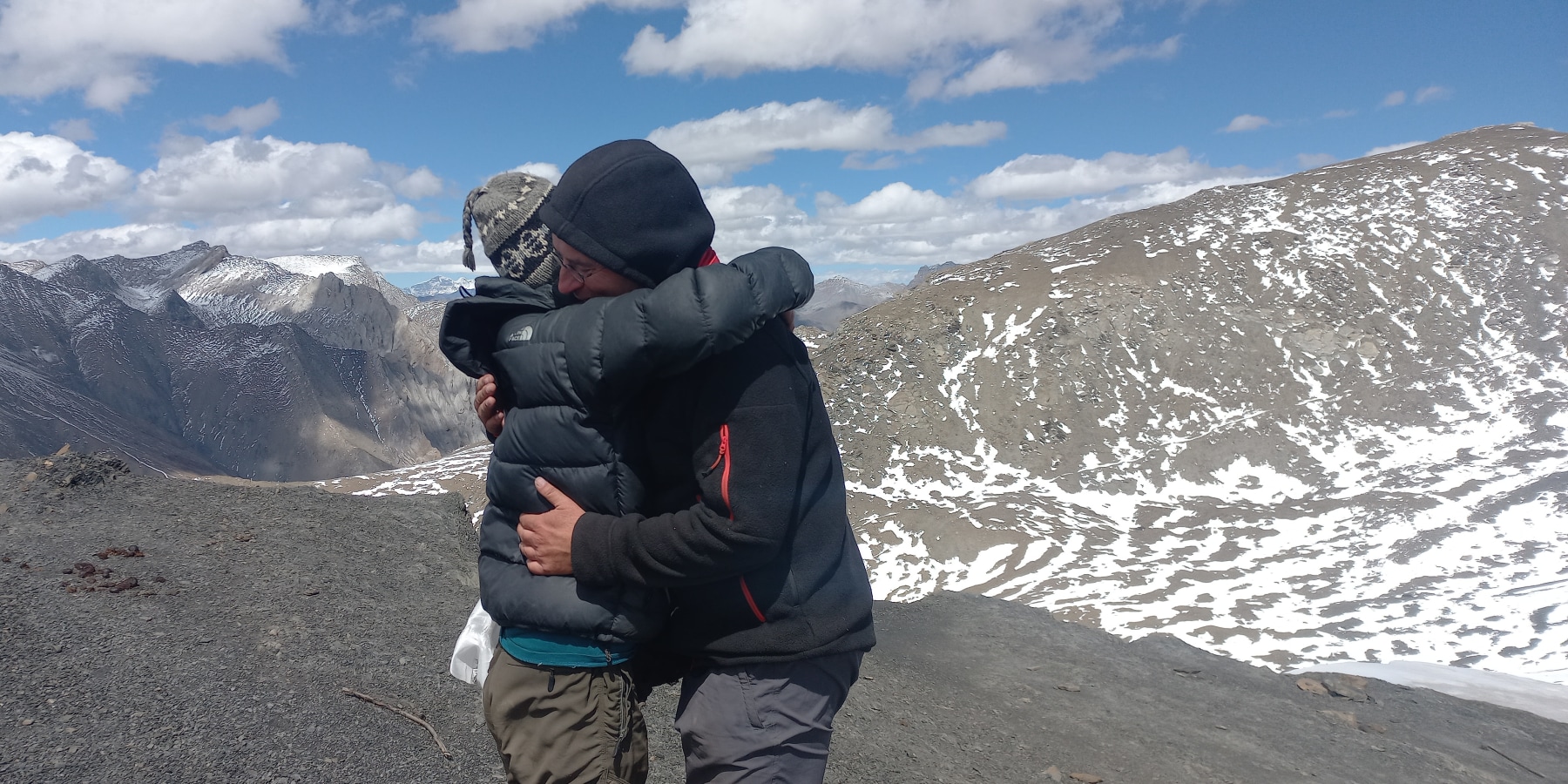
There is a moment on every high pass, usually around the third hour of climbing, when your lungs are working like a bellows and your legs have stopped taking suggestions, that something in you gives up negotiating. You stop wanting the view, or the summit, or the photograph. You only place one foot, then the other. And in that narrowing, an odd tenderness arrives. You notice the small blue of a gentian against the scree. You notice your own breath as something borrowed and precious. You notice that you are alive in a place that does not need you to be.
At the top, the prayer flags are shredded into threads by the wind, and their faded colors flutter over the drop on the other side. Whoever tied them was here, was tired, was hoping. There is no message in the flags. There is only the reminder that people have been coming to the edge of things and asking for mercy for a very long time.
Shey, the Crystal Mountain
If Dolpo has a heart, it may be Shey Gompa, the Crystal Monastery, standing near the foot of the sacred Crystal Mountain. Pilgrims have walked the kora, the circumambulation around the mountain, for centuries, and the route is felt as much as followed.
This is also the place many people know through Peter Matthiessen's The Snow Leopard, the 1978 classic of grief and seeking that follows his journey here in 1973 with the field biologist George Schaller. Matthiessen went, in part, to look for the elusive snow leopard, but what the book really tracks is a man carrying a great loss up into the thin air, hoping the mountains might help him hold it. He never quite sees the cat. And yet the book ends, in its way, in a kind of grace, the suggestion that not seeing can be its own form of arrival.
That is the strange gift of Dolpo. It rarely gives you what you came for. It gives you what you didn't know you were carrying.
The Villages That Hold On
Below the passes, the villages are worlds of mud-brick and stone: Saldang, Dho Tarap, and others where whitewashed chortens stand at the edges like quiet sentinels and long mani walls, carved with prayers, keep the paths company. The barley fields, precarious at this altitude, glow a fierce yellow-green in season. Children run at you with the unguarded curiosity of people who see few strangers. Someone offers butter tea, salty and rich and strangely comforting, and you drink it because refusing would break something more important than your taste.
But the elders here speak, gently, of change. Roads are pushing closer, especially from the north. Young people leave for Kathmandu, for India, for anywhere with a school or a salary. The caravans are fewer. Seasonal income from collecting yarsagumba, the prized caterpillar fungus, has reshaped economies and, sometimes, families. It's not that anyone is nostalgic in a simple way. People want electricity, medicine, opportunity, and they should have them. But you sense, in the way an old woman watches the trail, that she knows something irreplaceable is thinning, and that it is thinning faster than anyone can hold.
To visit Dolpo is to witness a world that is still whole and already changing at the same time. That is a heavy thing to carry, and a good one.
What the Silence Asks
Upper Dolpo requires a special, costly permit and a willingness to be uncomfortable. The trek is long, the altitude serious, the logistics demanding. These barriers are frustrating. They are also, perhaps, a kind of mercy. They filter for people willing to arrive slowly, on foot, with their egos worn down by the miles.
And if you go, if you truly go, something happens that is hard to explain to people who haven't been. You start to feel small in a way that is relieving rather than diminishing. The problems you carried up from the lowlands, the emails, the résumé, the ache of who you're supposed to be, loosen their grip. The mountains do not care about any of it, and there is an unexpected freedom in being so thoroughly uncared for by something so beautiful.
On your last evening, you might sit outside a stone hut as the light goes gold, then rose, then a cold violet. A herder's whistle drifts across the valley. Somewhere a bell clinks. The peaks hold the last of the sun a moment longer than seems fair, and then let it go.
You will not have solved anything. But you will understand, in your body if not your words, why people have always walked to the edges of the world to listen.
And when you finally descend, back into air thick with oxygen and noise, you will carry it: not a photograph, not a story, but a silence that stays inside you, like a lake at the top of the world, turquoise and unbothered, still holding the sky.