

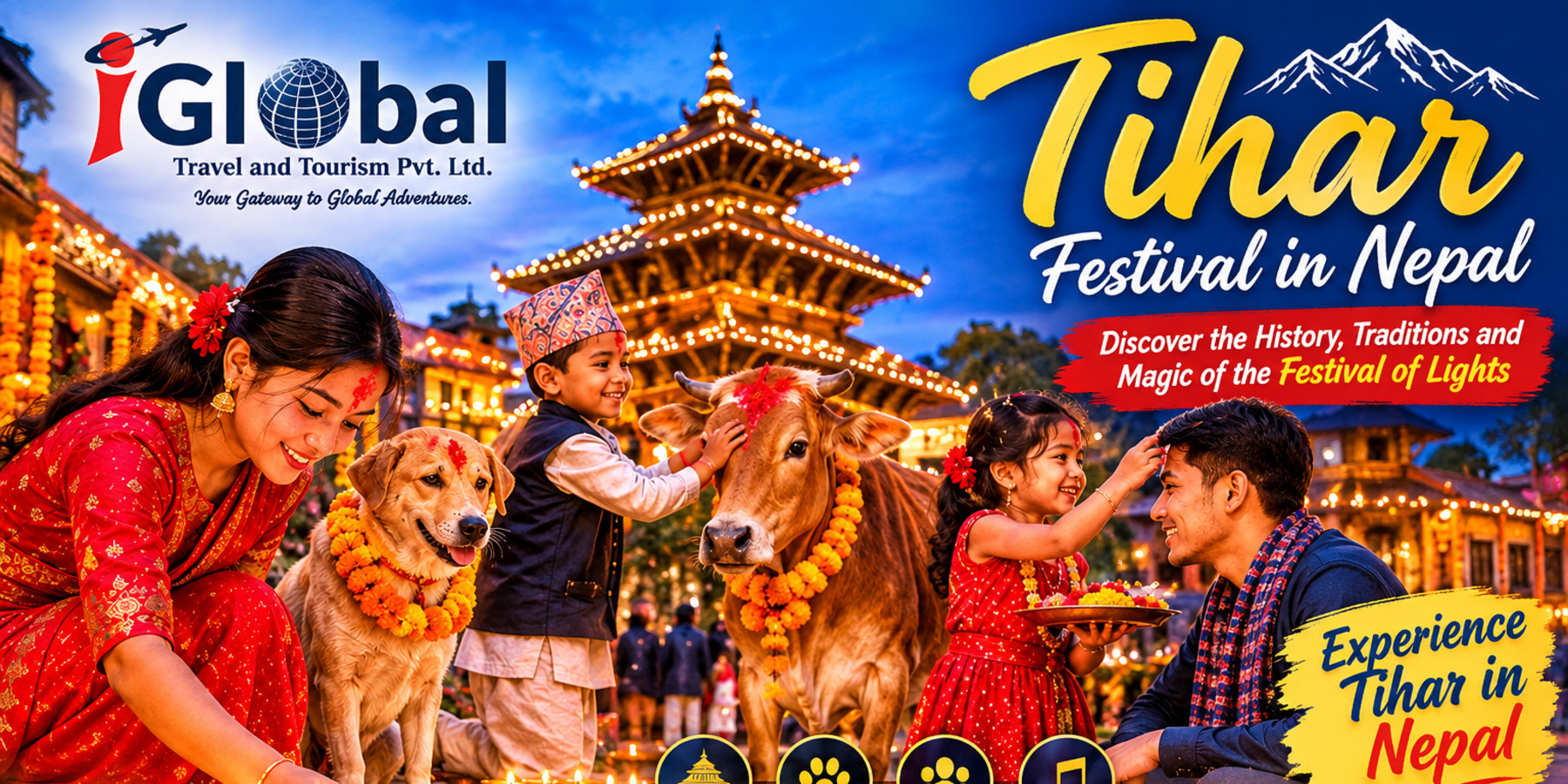

Tihar Festival in Nepal: Discover the History, Traditions and Magic of the Festival of Lights
Imagine walking through the historic streets of Kathmandu as thousands of glowing oil lamps illuminate homes and temples, colourful marigold garlands decorate doorways, and traditional Deusi and Bhailo songs fill the evening air. Families gather, neighbourhoods come alive, and the entire country welcomes one of its most cherished celebrations. This is Tihar, Nepal’s spectacular Festival of Lights.
But Tihar is much more than a celebration of lights, flowers and family gatherings. Behind its colourful atmosphere lies a fascinating world of ancient beliefs, religious stories, agricultural traditions and cultural heritage. It is a festival that honours animals, welcomes prosperity, celebrates family relationships and expresses gratitude for the natural world.
Known in religious tradition as Yama Panchak, Tihar is celebrated over five days during the Hindu lunar month of Kartik. Although it shares similarities with Diwali celebrations in other parts of South Asia, Nepal’s Tihar has distinctive customs that make it a remarkable cultural experience.
Uncover the History and Legends Behind Tihar
The exact historical origin of Tihar remains uncertain. Rather than emerging from one documented event, the festival appears to have developed through a combination of religious beliefs, agricultural customs and community traditions over many generations.
Nepal’s traditional agricultural society depended greatly on animals and nature. Cows provided milk, oxen helped cultivate fields, and dogs protected homes and livestock. Birds also held symbolic importance in traditional beliefs. The practice of honouring different animals during Tihar reflects the close relationship between people, their livelihoods and the natural environment.
One of the best-known religious stories associated with Tihar is the legend of Yama, the Hindu god of death, and his sister Yamuna. According to tradition, Yamuna welcomed her brother with flowers, colourful tika, offerings and prayers. Their reunion became associated with the celebration of sibling relationships and the blessings of long life. This story is closely connected with Bhai Tika, the festival’s final day.
Another traditional legend tells of a king who was warned that a serpent would cause his death. Through the use of lamps, devotion and the intervention of his queen, the king was believed to have escaped his fate. This story is often associated with the tradition of lighting lamps during Tihar.
These legends are important parts of Nepal’s religious and cultural heritage, although they are traditional narratives rather than independently verified historical events.
Experience the Five Beautiful Days of Tihar
Each of Tihar’s five days carries its own meaning, rituals and celebrations.
The first day, Kaag Tihar, is dedicated to crows. In traditional Hindu belief, crows are associated with Yama and are regarded as messengers. Families place food offerings outside their homes as a gesture of respect and to seek protection from misfortune.
The second day, Kukur Tihar, celebrates dogs. They are decorated with beautiful marigold garlands and colourful tika, and offered special food. Dogs are honoured for their loyalty, companionship and role as guardians. This heartwarming tradition has attracted international attention and has become one of Nepal’s most recognisable festival customs.
The third day, Gai Tihar and Lakshmi Puja, is among the most important celebrations. Cows are honoured for their contribution to traditional household and agricultural life. In the evening, families worship Goddess Lakshmi, associated with wealth, fortune and prosperity. Homes and businesses are cleaned and decorated, entrances are illuminated with oil lamps, and colourful designs welcome the goddess. The sight of thousands of lights shining across neighbourhoods creates an unforgettable festive atmosphere.
The fourth day has different observances across Nepal. Many communities celebrate Goru Tihar, honouring oxen for their contribution to farming. Other Hindu households perform Govardhan Puja, remembering the story of Lord Krishna lifting Mount Govardhan. In the Kathmandu Valley, the Newar community celebrates Mha Puja, a distinctive ceremony honouring the self and the value of human life.
The fifth day, Bhai Tika, celebrates the special bond between brothers and sisters. Sisters apply colourful tika to their brothers’ foreheads, offer flowers, fruits and sweets, and pray for their health and long lives. Brothers reciprocate with gifts and blessings. It is one of the most meaningful family celebrations in Nepal.
Discover Swanti and the Unique Newar Heritage of Kathmandu Valley
For travellers exploring Kathmandu, Patan and Bhaktapur, Tihar offers an opportunity to discover the distinctive cultural traditions of the Newar community.
Among the Newars, the festival is known as Swanti or Swonti. It shares the wider spirit of Tihar while preserving unique rituals and cultural practices connected with Nepal Sambat, the traditional Newar calendar.
One of the most remarkable ceremonies is Mha Puja, which honours the individual through beautifully prepared mandalas and ritual offerings. Family members sit before their individual mandalas while prayers and blessings are offered for health, prosperity, longevity and well-being.
Mha Puja also marks the New Year in the Nepal Sambat tradition. Nepal Sambat is traditionally dated to 879 CE, with its new year beginning in 880 CE under the corresponding calendar reckoning. Its establishment is associated with Shankhadhar Sakhwa, who is remembered in Newar tradition for using his wealth to free the people of Kathmandu from their debts.
The traditional account of Shankhadhar Sakhwa remains an important part of Newar cultural memory and identity.
Feel the Festive Spirit of Deusi and Bhailo
No Tihar celebration is complete without the joyful sounds of Deusi and Bhailo.
During the festival, groups of people visit homes, sing traditional songs, dance and offer blessings to families. In return, householders share sweets, food or money. Traditionally, Bhailo was associated with women and girls, while Deusi was associated with men and boys. Today, people of all ages and genders participate in both.
Accompanied by traditional instruments such as the madal, these performances bring neighbours and communities together. They preserve oral traditions, create joyful memories and allow younger generations to connect with Nepal’s cultural heritage.
For visitors, witnessing Deusi and Bhailo is a wonderful way to experience the warmth and hospitality of Nepali communities.
Understand the Deeper Connection Between People, Animals and Nature
One of the most remarkable aspects of Tihar is its recognition of animals. Crows, dogs, cows and oxen each receive special attention during the festival, reflecting the traditional understanding that human life and prosperity are closely connected with other living beings.
In rural Nepal, animals have long supported agriculture, transportation, food production and household protection. Honouring them is therefore both a religious expression and a way of showing gratitude for their contribution.
The festival also carries a message of kindness and compassion. Kukur Tihar, in particular, reminds people to appreciate the loyalty and companionship of dogs. Its deeper message extends beyond the festival itself: animals deserve care, respect and protection throughout the year.
Why Experience Tihar in Nepal?
Tihar is one of the best times to discover Nepal’s living culture beyond its famous mountains and trekking trails. The festival offers visitors a closer look at family traditions, religious ceremonies, local music and the extraordinary diversity of Nepali society.
From the illuminated temples and historic courtyards of Kathmandu Valley to the colourful neighbourhood celebrations of Patan and Bhaktapur, visitors can experience a country where cultural traditions remain an important part of everyday life.
Travellers visiting during Tihar may witness Lakshmi Puja decorations, traditional oil lamps, local celebrations and Deusi-Bhailo performances. They can also explore historic temples, traditional settlements and the cultural landmarks that make the Kathmandu Valley so special.
Visitors should remember that Tihar is primarily a family and religious celebration. Respecting local customs, asking permission before photographing ceremonies and observing traditions considerately will help create a meaningful experience.
Discover Nepal’s Cultural Heart with iGlobal Travel & Tourism
Tihar is more than Nepal’s Festival of Lights. It is a living expression of the country’s history, spirituality, cultural diversity and deep connection with family, animals and nature.
Its glowing lamps symbolise hope, its rituals express gratitude, and its celebrations bring communities together. Whether you are fascinated by ancient traditions, interested in religious heritage or simply looking for an authentic cultural experience, Tihar offers a beautiful reason to discover Nepal.
Planning to visit Nepal during Tihar? Let iGlobal Travel & Tourism Pvt. Ltd. help you experience the festival beyond the usual tourist attractions.
Explore the historic streets of Kathmandu, discover the cultural treasures of Patan and Bhaktapur, experience local traditions and create unforgettable memories with our knowledgeable local team.
Book your Nepal cultural experience through TourHQ and discover the real spirit of Nepal with iGlobal Travel & Tourism Pvt. Ltd.
Website: www.iglobal.com.np
Email: info@iglobal.com.np
WhatsApp: +977 9704804845
Discover Nepal. Experience Its Culture. Travel with iGlobal.