


There is a place in the Great Rift Valley where the earth once roared with fire, only to settle into a silence so profound that the loudest sound you will hear is the cry of a fish eagle echoing off volcanic walls.
This is Lake Sonachi—the Crater Lake of Naivasha.
Tucked within a private game sanctuary west of the main lake, Sonachi sits at the bottom of an extinct volcano. Unlike the vast freshwater expanse of Lake Naivasha, which formed through tectonic faulting, this is a true crater lake, born directly from ancient eruptions within the Kongoni volcanic complex.
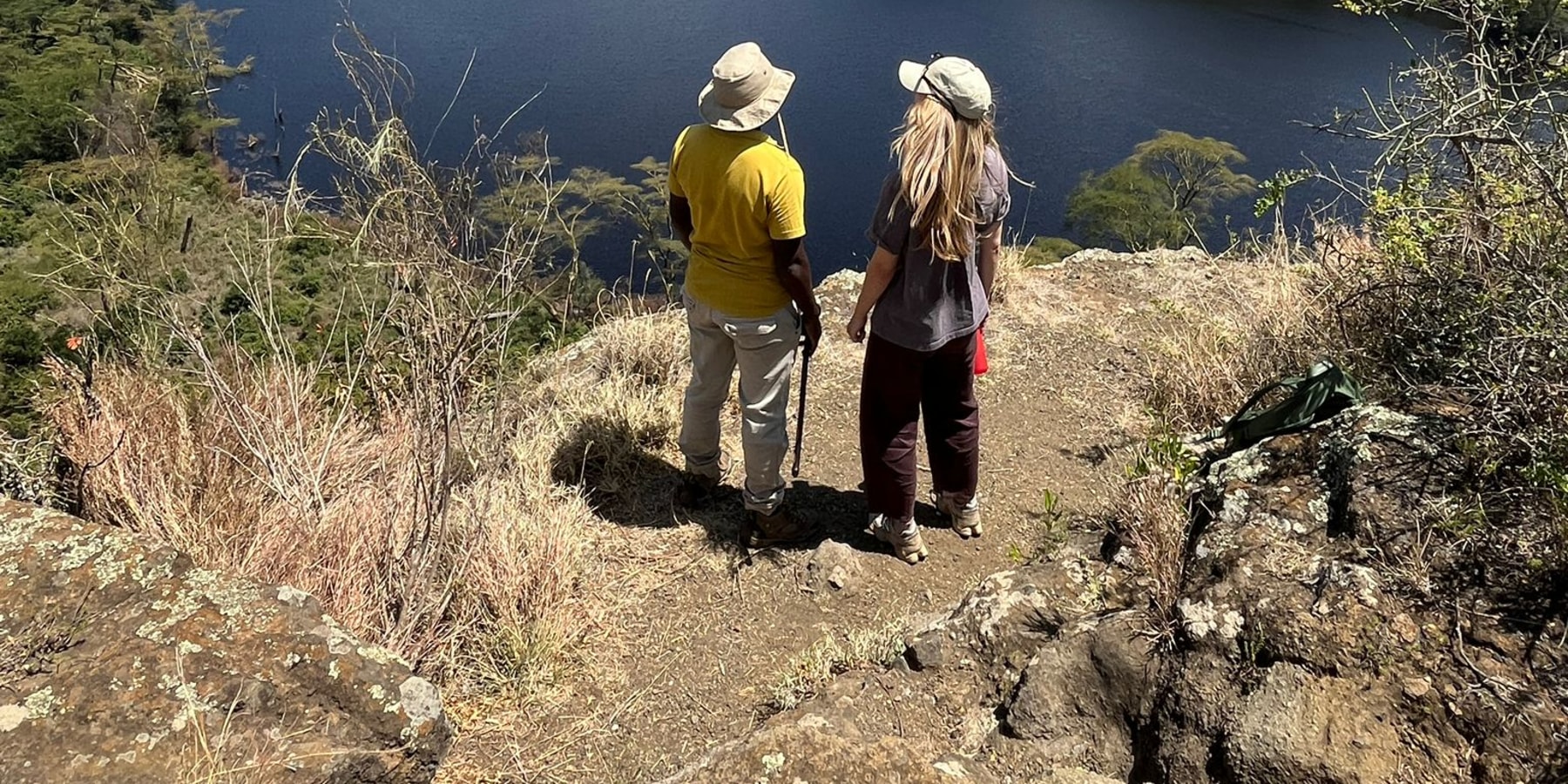
When you stand on the rim and look down for the first time, you will catch your breath. The lake below is not blue, not green, but something in between—a striking jade colour that seems to belong more to a painter's palette than to nature.
The question everyone asks: Why is it that colour?
Lake Sonachi has no rivers flowing in and no streams flowing out. It is a closed basin, fed only by rain and groundwater seepage through porous volcanic rock. Water leaves only by evaporation, and as it evaporates, it leaves behind every mineral it carried.
Over centuries, this process has concentrated salts until the water became alkaline—a soda lake. Within these chemical-rich waters, specific blue-green algae thrive in astonishing numbers, painting the entire lake with their pigments. The jade colour you see is the colour of life itself.
This same chemistry explains why the lake feels so different from its famous neighbour. Lake Naivasha remains freshwater. Sonachi, by contrast, holds onto everything, slowly transforming over millennia into something entirely its own.
The lake itself may be too alkaline for fish or hippos, but the world around it teems with life.
As you walk the trails along the crater rim, keep your eyes on the acacia trees. If you are lucky, you will spot them: the black-and-white colobus monkeys. These are among the most beautiful primates in Africa, their long white mantles flowing behind them like capes as they leap from branch to branch.
Down on the crater floor, a different kind of magic awaits. The Maasai giraffe roam here, their mosaic coats dappled by sunlight filtering through acacia thorns. To watch them from above, silhouetted against the jade water, is to see something that feels prehistoric.
Zebra and waterbuck graze alongside them. More than 150 bird species have been recorded here—kingfishers flashing blue, herons standing motionless at the water's edge, fish eagles surveying their kingdom.
The true magic of Lake Sonachi is that you do not just look at this place—you enter it.
Walking the crater rim, the path rising and falling with the ancient contours of the volcano, you understand that this is a complete world in miniature: born of fire, coloured by chemistry, inhabited by creatures that have made peace with its steep walls and alkaline waters.
From this height, you can see how the crater contains the lake completely, how the world beyond—the vastness of the Rift Valley, the glimmer of Lake Naivasha, the perfect cone of Mount Longonot on the horizon—all seems to exist in relation to this one small, perfect bowl of water.
The volcano is quiet now. The fire has cooled. But in its place, something equally miraculous has grown.
I invite you to discover this hidden gem on your next visit to Kenya. Let me guide you to the crater rim, where the colobus leap and the giraffe roam against a backdrop of jade.
Luke Biko
Professional Tour Guide, Kenya