


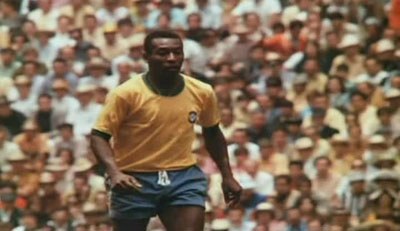
Pelé 1970 in World Cup for Brazil in Mexico.
History
Humble beginnings
The history of international football in Brazil begins in 1914, with the foundation of the Brazilian Football Confederation (CBF). That same year, the team – consisting exclusively of São Paulo and Rio de Janeiro players – took part in its first official match against Exeter City. Interestingly, the game’s final score remains a mystery. Some sources claim that Brazil won 2-0, whereas others insist that the game ended in a 3-3 draw.
Brazil won its first major trophy in 1919, defeating Uruguay in the finals of the South American Championship (later known as Copa América). This team was led by talented striker Arthur Friedenreich, who is considered by many to be the sport’s first great mixed race player. The team repeated this success in 1922 with a controversial 3-0 victory over Paraguay. Both of these championships were played on Brazil’s home turf.
The big slump
Following the 1922 triumph, Brazil went through 27 years without trophies. This period included the first three editions of the World Cup in 1930, 1934, and 1938. The 1930 tournament saw Brazil lose its first World Cup game against Yugoslavia, but they partly made up for it with a convincing 4-0 performance against Bolivia. In 1934, they lost their first match to Spain, which saw them eliminated from the competition.
Brazil was the only South American club to participate at the 1938 World Cup, as their neighbors were unhappy that the tournament was given to Europe for the second time in a row. This turned out to be their best performance yet, as they defeated Poland and Czechoslovakia on their way to a close 1-2 loss to Italy in the semi-finals. Their trophyless streak came to an end in 1949, as they won another South American Championship on home soil.
The Maracanazo
One year later, Brazil got its first chance to host the World Cup. After advancing from their original group, they trounced Sweden (7-1) and Spain (6-1) in the second stage, which meant that they only needed a draw against Uruguay in the final round to win the tournament. Though the country’s newspaper O Mundo already declared Brazil world champions, Uruguay came from behind to steal the game 1-2. This led to a period of national mourning.
This defeat (later known as Maracanazo) kickstarted a revamp of the national team, with the squad colors being changed from all-white to the now-traditional yellow, blue, and green. At the 1954 World Cup, the new-look Brazil made it to the quarter-finals, where they lost 2-4 to tournament favorites Hungary. This match is infamous for violent conduct on and off the pitch by both teams, with three players being sent off and many others getting injured.
Pelé’s arrival
In 1957, the history of Brazilian and world football was forever changed with the arrival of the 16-year-old Pelé. Even at this early age, his reputation was strong enough for him to be included in the 1958 World Cup squad. Unlike in some previous tournaments, the team was expected to follow some strict rules. They were given a list of 40 things they weren’t allowed to do, which included wearing hats and smoking while wearing uniforms.
In their first two matches, Brazil defeated Austria 3-0 and drew 0-0 with England. For their final group match against the Soviet Union, manager Vicente Feola made three changes, subbing in Zito, Garrincha, and Pelé. The first three minutes of the game were later described as “the greatest three minutes in the history of football.” Brazil won the match 2-0 in dominant fashion, with Vava notching a brace in the 3rd and 77th minute