

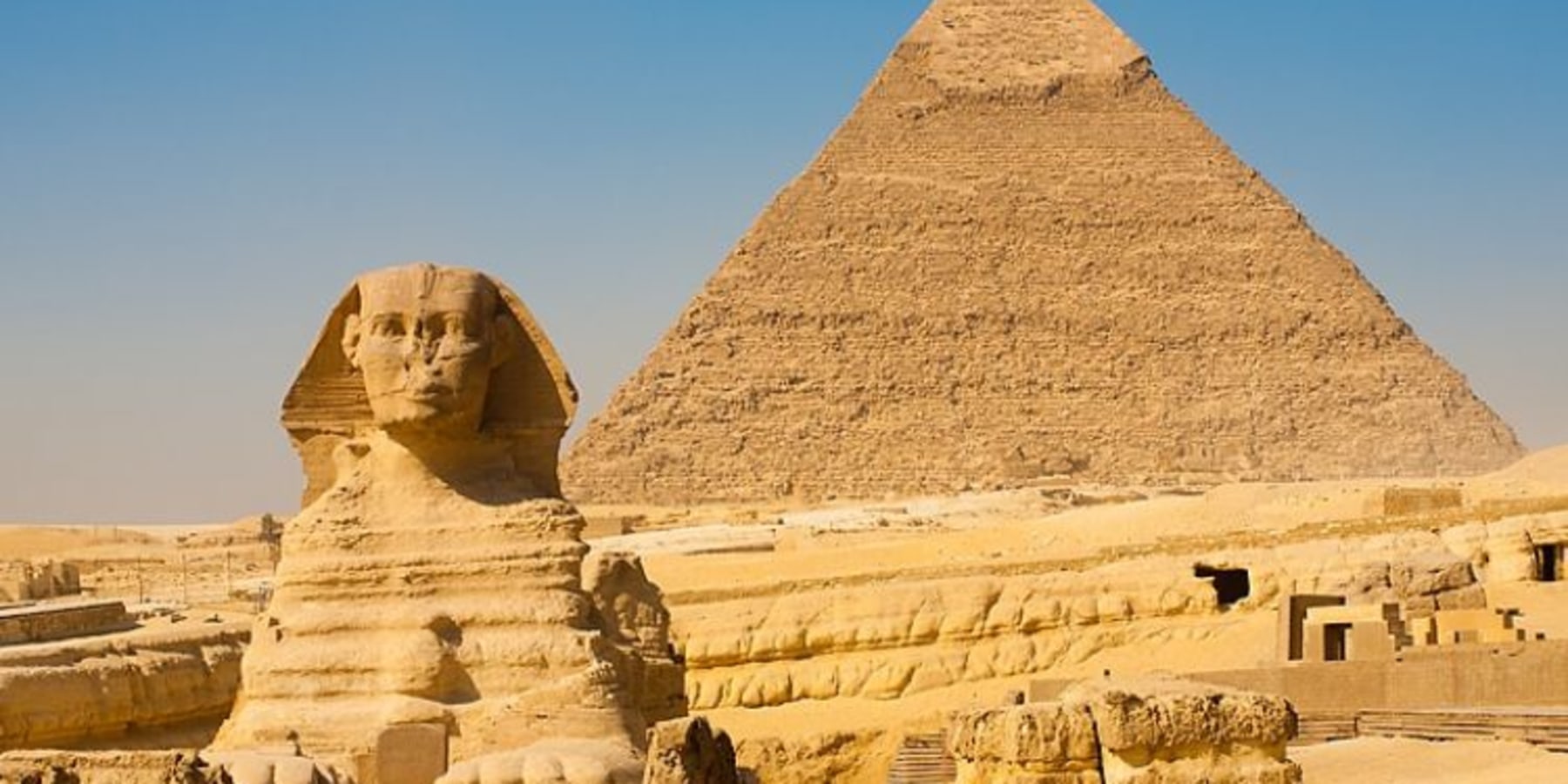

The Great Sphinx of Giza, commonly referred to as the Sphinx of Giza, is a limestone statue of a reclining sphinx, a mythical creature with a man's head and the body of a lion. Facing to the east, it stands on the Giza Plateau on the west bank of the Nile in Giza, Egypt. The face of the Sphinx appears to represent the pharaoh Khafre, the builder of the second pyramid on the Giza plateau.
Cut out of one solid block from the bedrock, the original shape of the Sphinx has been restored with layers of limestone blocks. Its nose is broken. It measures 73 m (240 ft) long from paw to tail, 20 m (66 ft) high from the base to the top of the head, and 19 m (62 ft) wide at its rear haunches. It is the oldest known monumental sculpture in Egypt and one of the most recognizable statues in the world. The archaeological evidence suggests that ancient Egyptians of the Old Kingdom created it during the reign of Khafre (2558–2532 BC). It was built as a guardian for the second pyramid. According to ancient Egyptian mythology, the pyramid is the gateway to the afterlife, and the best guardian is a combination of power and wisdom. That is why shaped the statue's body is a lion's body, and the head is the king's head.
The archaeological evidence suggests that the Great Sphinx was created around 2500 BC for the pharaoh Khafre, the builder of the Second Pyramid at Giza. The stones cut from around the Sphinx's body were used to construct a temple in front of it. However, neither the enclosure nor the temple was ever completed, and the relative scarcity of Old Kingdom cultural material suggests that a Sphinx cult was not established at the time.
To construct the temple, the northern perimeter wall of the Khafre Valley Temple had to be deconstructed. Hence, the Khafre funerary complex preceded the creation of the Sphinx and its temple. Furthermore, the angle and location of the south wall of the enclosure suggest the causeway connecting Khafre's Pyramid and Valley Temple already existed before the Sphinx was planned. The lower base level of the Sphinx temple also indicates that it doesn't pre-date the Valley Temple.
Sometime around the First Intermediate Period, the Giza Necropolis was abandoned, and drifting sand eventually buried the Sphinx up to its shoulders. The first documented attempt at an excavation dates to 1400 BC, when the young Thutmose IV (1401–1391 or 1397–1388 BC) gathered a team and, after much effort, managed to dig out the front paws. Between which, he erected a shrine that housed the Dream Stele, an inscribed granite slab (possibly a repurposed door lintel from one of Khafre's temples). When the stele was discovered, its lines of text were already damaged and incomplete.