

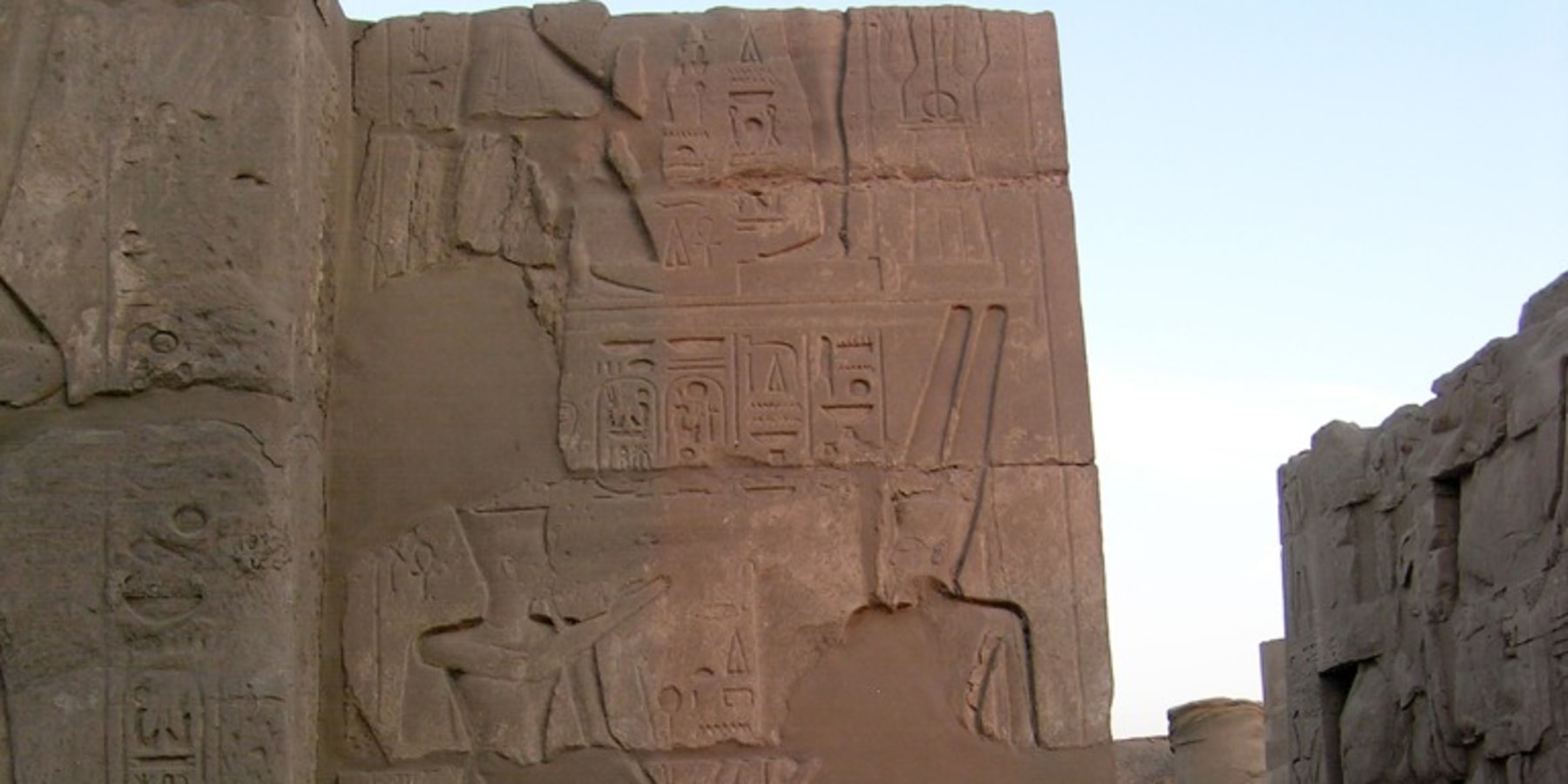

Introduction:
The Construction on the Khonsu Temple took place over several centuries with its origins traced back to King Ramesses III's reign. His son, King Ramesses IV brought the project to completion adding his own inscriptions.[1]
Later, King Ramesses XI and High Priest Herihor who eventually became king finalized the hypostyle hall and the courtyard of the temple.[2]
The tradition of additions and restorations persisted in later periods with Pinedjem I constructed the pylon and inscribing temple entrances. Nectanebo II was involved in restoring some of the temple gates, reaching into the Ptolemaic period.[3] They emphasized the importance of both additions and restorations within the sanctuary area particularly by Kings Ptolemy VIII, IX, and XII, who undertook various modifications in Khonsu sanctuary area.[4]
King Ptolemy VIII, who reigned over Egypt for 53 years[5], notably contributed to this area by adding a lintel to the southwestern entrance of the ambulatory encircling the Amun-Re Shrine. Additionally, he restored the gate leading to the chapel(V) known as the chapel of the sacred bark of Khonsu, as he documented in the foundation text of the gate.
This inscription indicates that both he and his wife, Queen Cleopatra III were responsible for the restoration efforts which were recorded on the bases of the eastern and western jambes on the northern side of the gate. However, it appears that he neglected the southern side which currently features inscriptions and scenes attributed to King Ptolemy XII.[6]The inscriptions do not clarify whether Ptolemy XII continued the restoration initiated by Ptolemy VIII or if he was the first to consider restoring that particular side of the gate.fig:1.
| Fig:1 Khonsu temple plan (Arrow points to the gate) CFEETK |
1- The Gate's architectural structure
The sandstone gate in question serves as the access to chapel (V) which is a rectangular chamber supported by four columns designed in a sixteen-sided style. It was built by King Ramses III to house the sacred bark of Amun and was subsequently used for the sacred bark of Khonsu.
The chapel's axis is aligned from south to north along the temple's main axis[7], with the base of the sacred bark of Amun made of quartzite located between the columns on the northern side.[8]
The gate was adorned with scenes that were engraved within a symbolic frame symbolizing the universe, which represents the sacred area that surrounds the king. This was illustrated by the hieroglyphic sign pt from above and the sign tA (earth) from below, while the sides displayed the sign wAs as lateral supports creating a frame for the sacred area around the king. These symbols were used to express the material world surrounding the king through symbolic representations of the cosmic elements that enveloped him.[9]
The northern side of the Gate:
Positioned in the northern wall of the ambulatory that surrounds the sacred bark of Amun, the gateway features an entrance on its northern side with a lintel divided into three distinct registers.
This lintel is supported by two jambs on the eastern and western sides, which are connected to the northeastern and northwestern walls of the ambulatory.pl:1.
| Pl.1: The entrance to the chapel of Khonsu’s sacred bark on the northern side Photo by Author |
The uppermost register displays sunk relief inscriptions of King Ramesses IV the first to inscribe the gateway[10], pl: 2.
Followed by a register illustrating an astronomical scene in raised relief celebrating the fifteenth day of the lunar month during King Ptolemy VIII's reign.pl:3.
| Pl.2: Nekhbet spreading her wings over the names of Ramesses IV. Lintel, First Register, the Gate to the chapel (V) Photo by Author |
|
|
| Pl.3: Procession of the Moon Goddess accompanied by Ptolemy VIII and Cleopatra III North side of Gate to the chapel (V), Lintel, Second Register Photo by Author |
The third register is segmented into four scenes where the god Amun and his triad are prominently displayed in raised relief in the center while the flanking scenes are inscribed in raised relief featuring two depictions of Khonsu.pl:4.
| Pl.4: The third register of the lintel entrance of the Gate to the chapel (V) Photo by Author |
The entrance stands at a height of 3,574 square meters without the lintel, and reaches 5,983 meters in total height when the lintel is included. This lintel is supported by two jambs, which are linked to the northeastern and northwestern walls of the ambulatory.
The southern side of the Gate:
The southern side of the gateway underwent restoration and was inscribed in raised relief by King Ptolemy XII. It is structured with a lintel and two jambs but it has sustained damage and many scenes are missing.pl:5.
| Pl. Southern face of the gate The Gate to the chapel to the chapel (V) Photo by Author |
The lintel is divided into two registers. The first register illustrates an astronomical scene featuring a procession of lunar gods to commemorate the second half of the lunar month, while the second register contains four scenes arranged in symmetry. This lintel is supported by two jambs which are linked to the southeastern and southwestern walls of the chapel (V). The two jambs each jamb is adorned with three scenes.pl:6.
| Pl.6: lintel of southern face of the gate Gate to the chapel (V) Photo by Author |
2- An overview of the scenes:
2-1 An overview of the scenes located on the northern side of the gate:
2-1.1 The lintel:
2-1.1. a First register:
Description: The upper register of the lintel features a depiction of the goddess Nekhbet, portrayed as a female vulture with outstretched wings grasping Sn in her talons. Above the names of King Ramesses IV two feathers are visible with the coronation name and the birth name anx situated between them. Flanking the sides are the concluding palm fronds šn crowned by Hfnw, while additional palm fronds encircle the names of King Ramesses IV including both the birth name and the coronation name positioned above nbw.[11]
2-1.1. b second register:
Description: The second register of the lintel features a depiction of a group of deities honoring the moon disk with their hands raised in reverence[12] as part of the procession of the moon gods or the Great Ennead of Thebes. In this illustration, eight gods are shown on the right and six on the left, possibly alongside King Ptolemy VIII and Queen Cleopatra III although the scene is incomplete resulting in an equal count of eight on both sides of the moon disk.
The deities are arranged from west to east: Osiris appears in human form adorned with the Osirian crown; Isis is depicted in human form wearing a vulture-like skullcap topped with the Hathoric crown representing the Isis symbol; Thoth is shown in human form with an ibis head and a moon disk featuring a crescent; Nebet-Het is illustrated in human form with a vulture-like skullcap and a cow's horn crown positioned between them; Horus is represented in human form with a falcon head and the double crown; Hathor appears in human form with the Hathoric crown; Sobek is depicted in human form with a crocodile head and the crown of Maat (Henu-Angedty); Thanet is shown in human form with a vulture-shaped skullcap and a crown resembling two cow horns with the sun disk above, which signifies idt symbol.
On the left side of the lunar disk, the deities are arranged from east to west: Montu, depicted as a human with a falcon head and a feathered crown featuring the sun disk at its center; Atum, shown in human form wearing a double crown; Shu, represented as a human with Maat's feather atop his head; Tefnut, also in human form, adorned with a vulture-shaped skullcap and the sun disk encircled by a sacred cobra; Geb, in human form, wearing the northern crown topped with Atef crown embellished with two cobras; Nut, depicted as a human with NW on her head; and possibly King Ptolemy VIII alongside his wife, Queen Cleopatra III, with the king wearing a double crown featuring a cobra on his forehead, raising both hands in homage to the lunar disk while dressed in a short royal kilt. A bull's tail is visible from behind him, and in front are two empty (damaged) cartouches.
It is highly probable that these belong to King Ptolemy VIII, who restored and inscribed the entrance, as noted in the foundation text on the lower register of the two jambs. Behind him is his wife, Queen Cleopatra III who is shown wearing a long-woven robe and raising both hands in salute to the moon disc, with two empty (damaged) cartouches in front of her. [13]Fig:2, pl:7.
| Fig:2. Procession of the Moon Goddess accompanied by Ptolemy VIII and Cleopatra III LD. iv. 66 [a] North side of the gate, Lintel, second register |
|
|
| Pl.7: Procession of the Moon Goddess accompanied by Ptolemy VIII and Cleopatra III North side of the gate, Lintel, second register Photo by Author |
Wsir st DHwty Nbt-Hwt Hr Hwt –Hr sbk snnt
Osiris, Isis, Thoth, Nephthys, Horus, Hathor, Sobek, Thannent
Iwn Haa[14] ir m iAbt. f iaH Ssp t (…) m rnp (…) n.k pt Ra
(… … … … … … … … … … …) xnsw pA Xrd m rn.f xnsw Sw m wAst Hr ib bnnt
The moon in his left eye to begin (……) rejuvenation and youth (…) for you like Ra in the sky, (…………) Khonsu the child called Khonsu Shu in Thebes in the middle of Bennet.[15]
Text above the gods on the left side:
MnT Itm Sw tfnt Gb nwt.
Montu, Atum, Shu, Tefnut, Geb, Nut
rnp[16] tp apr[17] m kmt m smdt s (… … … …)
(… … … m wAst) nfr (Htp Hr nb Awt ib m ipt swt).
He became a renewed youth at first to increase in Egypt on the fifteenth day of the month (the moon... .... .... ) (… ….... Khonsu in Thebes) Neferhotep, Lord of the Happiness of the Heart in Karnak).
2-1.1. c third register:
The third register features four scenes, with two being engraved in reverse, which are identified as double representation scenes.
Right side, first scene:
Description: The scene represents King Ptolemy VIII offering wine to the god Khonsu. The king is shown wearing the red crown, with a ribbon behind his head reaching his shoulders, and offering two wine vessels with both hands. His right hand is shown in front of his left. The king is shown wearing a short, wide kilt ending in a bull’s tail at the back, with his left leg in front of his right. In front of him is the god Khonsu sitting on a throne in the form of Hwt sign on a raised base holding WAs sign in his left hand and Ankh sign in his right a large part of which is now lost. Khonsu is shown with a human body and the head of a falcon wearing a wig and above him is the moon disc resting on a crescent moon decorated with a cobra.[18]Fig:3, pl:8.
| Fig.3: Ptolemy VIII offering wine to Khonsu | Pl.8: Ptolemy VIII offering wine to Khonsu |
| Gate of chapel (v), lintel, third register, first scene Photo by Author |
Text above the god Khonsu (from right to left):
1-Dd mdw in xnsw (…) (bnnt)
2- (… …) wAst (… …)
1- Words spoken by (Khonsu .... ....) in the Temple of Khonsu
2- (... ...) Thebes (... ...)
3- Hnk irp n it.f ir (i)n.f di anx
3- He offers wine to his father I offer it to you to be given life[19]
From behind the king:
anx wAs nb HA.f mi Ra Dt
All life and power are around him like Ra forever.
Second scene:
Description: The scene represents King Ptolemy VIII offering Maat with his right hand extended towards the god Amun.
The king is shown wearing the double crown and the royal chin, a ribbon hangs from behind his head reaching his shoulders, and a short wide kilt behind which appears the tail of a bull.
The king is wearing the wide necklace raising his shattered left hand in salute. He appears with his right leg forward. In front of him is the god Amun-Re in his traditional from, sitting on his throne in the form of Hwt sign on a raised base, holding wAs staff in his left hand, while only the upper half of his right hand remains, which has been lost.
Behind him appears the god (Khonsu the child), standing as a young man with a side lock of hair. Above his head is the moon disk resting on a crescent moon, and he is holding wAs sign in his left hand which is extended forward only part of which remains while in his right hand he holds anx, nḫḫ, and HKA signs.[20]Fig:4. Pl:9.
| Fig.4: Ptolemy VIII presenting nb mAat before Amun and Khonsu the child | Pl.9: Ptolemy VIII presenting nb mAat before Amun and Khonsu the child |
| Gate to chapel (v), lintel, third register, second scene Photo by Author |
Text above the god Amun-Ra (from right to left):
1-Dd mdw in imn Ra nb nswt tAwy xnt ipt swt[21]
2- nTr (…) ra nb pt
3- (… …) nb xAswt Xr Tbtwy.k
1- Words spoken by Amun-Ra, Lord of the Thrones of the Two Lands, prominent at Karnak.
2- The god (….) Ra, Lord of Heaven.
3- (….) All foreign lands are under his sandal.
Text above Khonsu the child:
4-Dd mdw in xnsw pA Xrd aA wr tpy n Imn[22]
5-Ra wHm.f mswt/msxaw[23]
4- Words spoken by Khonsu, the great child, the firstborn of Amun.
5- Ra after his repeated births.[24]
The text before the king:
6- di n(i)n.k mAat n it.f ir (i)n. f di anx
6 - He gives justice to his father, to give him life.
nsw bity (iwa n nTrw prw stp n PtH ir mAat Ra sxm anx (n) Imn) sA ra (Ptwlmis anx Dt mry PtH)
King of the North and the South, heir to the two apparent gods, chosen by Ptah, executor of the justice of Ra, living image of Amun, son of Ra, Ptolemy VIII, may he live eternally, beloved of Ptah.[25]
Third scene
Description: The scene represents King Ptolemy VIII standing on the left side in the opposite direction of the previous two scenes. In front of him is the god Amun and the goddess Mut on the right side. The king appears offering Maat with his left hand (broken) extended towards the god Amun. He is wearing the double crown with a ribbon hanging behind it reaching the shoulders and the royal chin, and a short, wide kilt with a bull's tail hanging behind it. The king is wearing the wide necklace (wsx). He appears raising his right hand in salute and offering his left leg, which has been smashed, while part of the foot on his right leg is missing. In front of him appears the god Amun-Re in his traditional form, sitting on his throne on a raised base in the form of Hwt sign, holding wAs staff in his right hand while holding the ankh sign in his left hand. The lower part of the god Amun-Re's legs is missing, leaving only the feet. Behind him stands the goddess Mut wearing a long-woven robe with her feet and part of her lower legs missing. She appears wearing a female skullcap. The eagle, above which is the double crown, raising her right hand in salute while holding the ankh sign in her left hand.[26] Fig:5, Pl:10.
| Fig.5: Ptolemy VIII presenting nb mAat before Amun and Mut | Pl.10: Ptolemy VIII presenting nb mAat before Amun and Mut |
| Gate to chapel (v), lintel, third register, second scene Photo by Author |
Text above Amun-Ra (from left to right):
1- (Dd mdw in imn ra) nsw nTrw sxm Sps[27]
2- (… …)
3- (…. …. … … )
1- (Words spoken by Amun-Ra) King of the Gods, the Noble Powerful
2- (... ...)
3- (.... ... ... ... )
Text above the goddess Mut (from left to right):
4-Dd mdw in mwt wrt iSrw
5- mr Hmt nb nTrw
4- Words spoken by the great mut, the Lady of Asher
5- The beloved wife of the Lord of the Gods
Fourth scene:
[1]W.j.de jong, "Chonsoe en zijn Temple in Karnak" In) De IBIS 4, 1982(115.
[2] OIP 100, 1979, xiv
[3] OIP 103, 1981, xix
[4]Jean-Claude. Degardin," Procession de barques dans le temple de Khonsou.") RdE35,1984(191-195 ; François. Laroche-Traunecker,"Les restauration et transformations d’époque gréco-romaine du temple de Khonsou à Karnak" )OLA 85, 1998(,905.
[5]Lenzo, Giuseppina. "A Xoite Stela of Ptolemy VIII Euergetes II with Cleopatra II and Cleopatra III (BM.EA 612. JEA 101, no. 1,2015) 217-237.
[6] Dieter Kurth in LÄ. IV, 1197, 58, Ptolemaios.
[7]PM II2, 237-238.
[8]Mohammed Hammad,"Bericht ueber die Restaurierung des Barkensockels Ramses III im Chonstempel in Karnak",(ASAE54, 1956) 47-49.
[9]Pascel. Vernus, Le concept de la monarchie dans l'Egypte ancienne. In E. Le Roy Ladurie (Ed.), Les Monarchies) Paris : Presses universitaires de France, 1985), 31.
[10] Champ, Not. descr. ii, 240.
[11] Hager Ahmed Mohamed Hassan" Sanctuary of Khonsu Temple: Analytical linguistic study of scenes and texts", (PhD thesis, unpublished, Faculty of Archeology, Qena university,2021),155-156.
[12] PM II2, 239 (74-a); LD. IV, 66(b).
[13]Hassan" Sanctuary of Khonsu Temple", 156-158.
[14] Wilson, PL, p.52.
[15] Hassan" Sanctuary of Khonsu Temple",159.
[16] Wilson, PL, p.584.
[17] Wilson, PL, p.151.
[18] PM II2, 239(74-b1); Hassan" Sanctuary of Khonsu Temple",160.
[19] Hassan" Sanctuary of Khonsu Temple",161.
[20] PM II2, 239(74-b2); L. D. IV. 66 [a] cf. Text, iii, p. 68; Hassan" Sanctuary of Khonsu Temple",161; Hager Ahmed Mohamed. "Unpublished Scenes of Khonsu the child in the bark chapel of Karnak precinct." The First International Conference on Africa's Futures and Challenges. University of the Luxor, 2020,5-8.
[21]Wb I, p.66.
[22]Pierre Clère, "La Porte d’Évergète à Karnak, MIFAO 84." (Le Caire 1961), PI. 25 ; Urk. VIII, 29.
[23]Urk. VIII, 137c; Esna II, No. 25, 14-15; Opet I, 160; Medinat Habu, PM II2, p. 239, (74a) III.
[24] Hager Ahmed Mohamed. "Unpublished Scenes of Khonsu the child in the bark chapel of Karnak precinct." The First International Conference on Africa's Futures and Challenges. University of the Luxor, 2020,5-8.
[25]José das Candeias Sales, "Le roi ptolémaïque et les divinités égyptiennes selon la titulature royale."(Aegyptus et Pannonia III. Acta Symposii anno 2004,2006) 191-206.
[26] PM II2, 239(74-b3).
[27] LGG VI, p.542-45.