

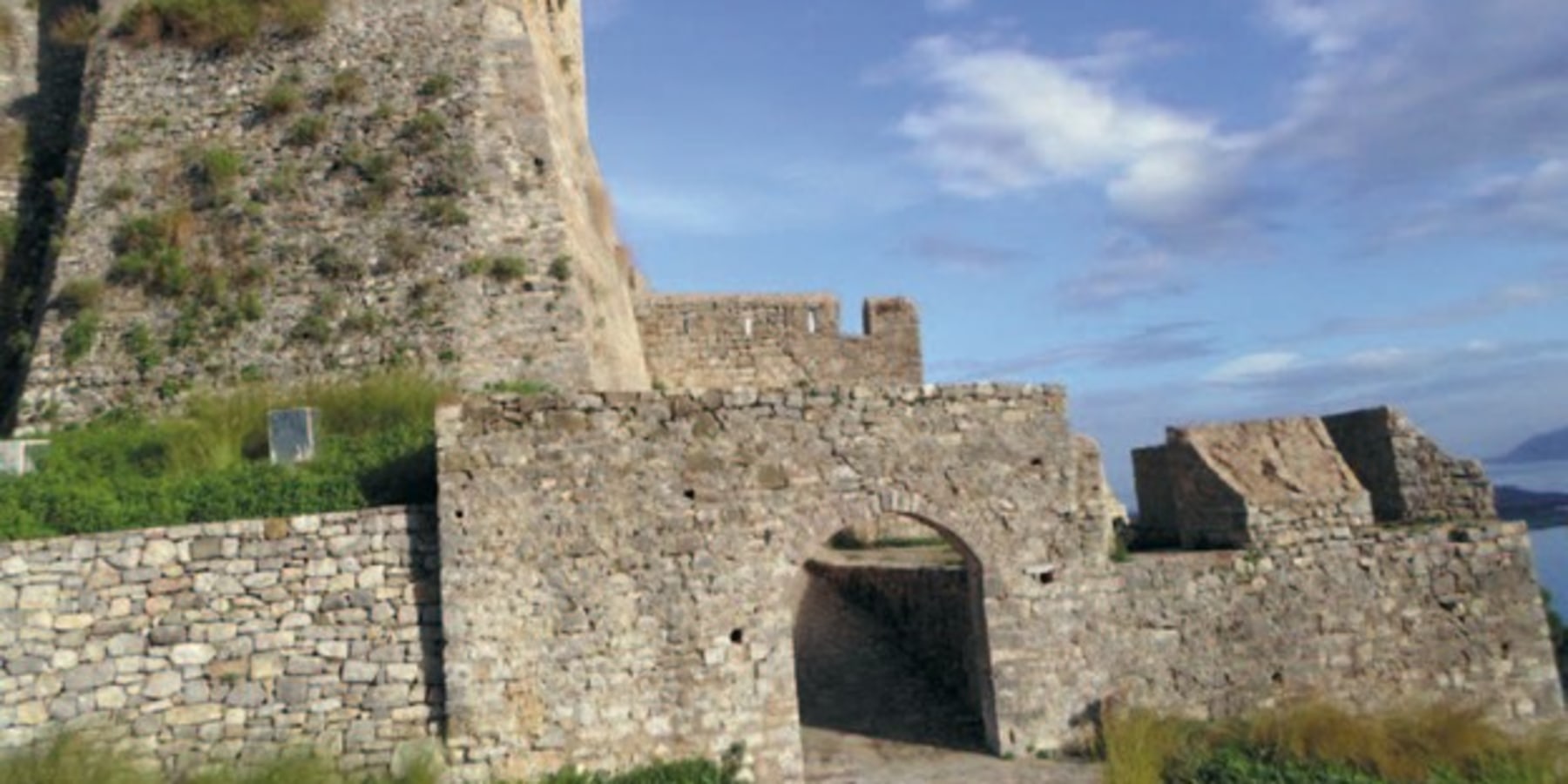

The archaeological site of Nafpaktos was enhanced thanks to the large scale restoration and repair works which took place in the framework of the Programme ‘Castrorum Circumnavigatio’, directed by the Archaeological Receipts Fund, between 2006 and 2008. The site includes the three upper zones, namely the core of the fortification.
The main western entrance consists of three successive gates. It lies beneath a high rectangular tower which has been reinforced with a scarpa (sloping lower wall). The first (exterior) gate penetrates a relatively short wall, embedded in a bastion, the parapet of which bears numerous openings for the use of large fire weapons. The second gate is protected with battlements and a corridor which housed a guard and fire weapons. Finally, in the third gate a part of a murder-hole (used for hurling missiles to the enemy)is preserved. When crossing the three gates, the visitor enters to the third zone of the castle, defined by walls with rectangular battlements. A small gate is opened at approximately the center of the internal wall between the third and the fourth zone, and gives access between the core of the castle and the Upper Town. The third zone houses the buildings of the modern archaeological guard and the refreshment area, as well as ruined storage buildings and water cisterns.
A pebbled pathway leads from the third zone through a single gate towards the second zone, where important religious and administrative buildings of Byzantine Nafpaktos were situated. The single-aisled church of ProphetElias, built in the 19th century just after the liberation of Nafpaktos, stands out at a position with abundant Byzantine and Ottoman vestiges. Remains of a three-aisled Byzantine basilica church with a narthex were found around the 19th-century church during excavations in 2008. The church measures 28 x 16 m and has been identified with the Metropolis of the town, dedicated to the Virgin of Nafpaktos (Theotokos Nafpaktiotissa). According to literary sources, this church was repaired and embellished by the Metropolitan of Nafpaktos Ioannis Apokafkos (1199-1233). The visible parts of the Byzantine basilica are the stylobate of the marble screen,a marble revetment with interlacing circles in the north aisle, as well as fragments of further marble revetments depicting animals and plants,embedded in a later floor. A number of lavishly decorated relief architectural members which have been found scattered or in second use in the core of the castle and the Upper Town may have been detached from this Byzantine church. The west wall of its narthex, as well as burials opened outside the narthex, were excavated during reparation works of an Ottoman retaining wall by the project ‘Restoration and structural reinforcement of the castle of Nafpaktos and enhancement of the archaeological site’.The Byzantine church was succeeded by two mosques, built in the 16th andthe 17th centuries. The base of a minaret has been preserved embeddedin the façade of the 19th-century Christian church of Prophet Elias, whichin turn replaced the mosques.
North of this church the visitor can see a restored vaulted building, andruins of a Byzantine building with vaulted windows and brick decoration,integrated with the exterior castle wall. Both buildings have been identified, according to scholars, with the Episcopal complex, residence of theMetropolitans of Nafpaktos during the 12th and 13th centuries.
To the southeast of Prophet Elias church there is a reconstructed singleroom which was used for storing weapons and currently accommodates temporary exhibitions.
A pathway and a pebbled ramp leads to the entrance of the uppermost part of the citadel, thecore of the castle, called ‘Its Kale’ (interior citadel)in the Ottoman period. In this highly protected partof the castle there is a complex of four restoredvaulted rooms, behind which there is a small gatewhich the defenders could use to escape, as wellas a large Byzantine cistern.