


Five days. It sounds almost too short to do justice to a country this extraordinary. But with the right plan, five days in Oman is enough to stand at the foot of a 3,000-metre mountain, sleep under a desert sky blazing with stars, swim through a hidden canyon, and wander a 400-year-old fort — all before your flight home.
This itinerary has been crafted by people who actually travel Oman professionally. Not a copy-paste of the same tired route you've seen on every travel blog. This is a lean, intelligent 5-day plan that respects your time, your energy, and your wallet — and leaves you wanting to come back.
Before You Go: The Essentials
Best time to visit Oman for a 5-day trip:October to April. Temperatures are manageable (25–35°C), skies are clear, and the desert is at its most beautiful. Avoid June–August if you can — Muscat hits 45°C and humidity makes outdoor activity uncomfortable.
Getting around:Renting a car gives you maximum freedom, but a private driver-guide is genuinely worth considering for a 5-day trip. It removes navigation stress, adds local knowledge, and costs less than you'd expect. WhatsApp-based booking services (see below) make this easier than ever.
Where to stay:
Muscat: W Muscat, Al Bustan Palace, or Oman Air Hotel for luxury; Sama Boutique Hotel for mid-range
Wahiba Sands: Desert Night Camp or 1000 Nights Camp (book well ahead in peak season)
Nizwa area: Alila Jabal Akhdar (if budget allows) or Golden Tulip Nizwa
Oman visa:Most nationalities get visa on arrival at Muscat Airport (OMR 5–20) or can apply online at evisa.rop.gov.om. GCC residents with valid UAE residence don't need a separate visa.
Day 1: Arrive in Muscat — Let the City Reveal Itself Slowly
Morning — Arrival
Land at Muscat International Airport (MCT). Check in, decompress. Oman works on Oman time — don't rush the first day.
After settling in, head to Muttrah Corniche, the old port waterfront that has barely changed in a century. Walk the 2 km stretch in the golden afternoon light, watching the dhow boats and the fishermen who still bring their catch here each morning. The scent of frankincense drifting from the souq ahead of you is your signal to turn inland.
Afternoon — Muttrah Souq
Muttrah Souq is one of the oldest covered markets in Arabia. This is not a tourist market in the manufactured sense — it's a working souq where Omani traders have operated for generations. Wander without a shopping list. Look for:
Frankincense and bakhoor — Oman produces some of the world's finest; buy directly from traders who know their product
Khanjar daggers — the curved ceremonial blade is Oman's national symbol; authentic pieces are handcrafted silver
Omani halwa — the traditional rose-water and saffron sweet, sold by weight from huge copper cauldrons
Bargaining is expected and good-natured. Start at roughly half the asking price.
Evening — Sultan Qaboos Grand Mosque (exterior)
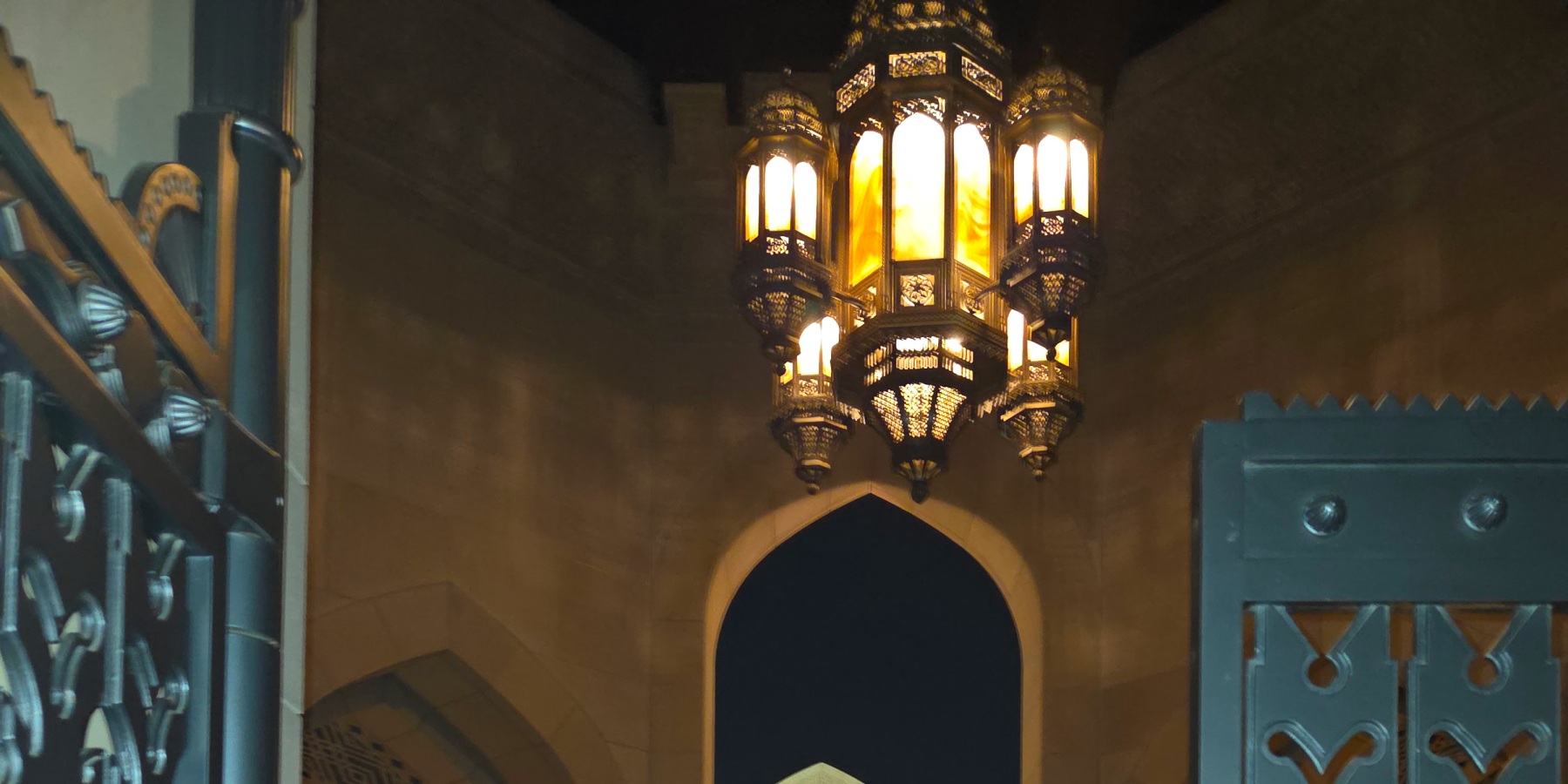
The Grand Mosque closes to non-Muslims in the afternoon, but the approach road and exterior are spectacular in the early evening light. The main dome is 50 metres high. The gardens are immaculate. This is a place that rewards simply sitting and taking in.
Dinner: Try Ubhar Restaurant in Qurum for Omani cuisine done with genuine craft — shuwa (slow-cooked lamb), mashuai (spit-roasted kingfish with lemon rice), and Omani bread baked in a stone oven.
Day 2: Muscat's Depth — Grand Mosque, Old Muscat & Riyam
Morning — Sultan Qaboos Grand Mosque (interior)
Be at the gate by 8 AM (opens 8–11 AM for non-Muslims, Saturday to Thursday). This is one of the most beautiful mosques in the world and one of the few in the Gulf open to non-Muslim visitors. The main prayer hall contains what was, until recently, the world's largest hand-woven carpet — 4,343 square metres, made by 600 weavers over four years.
Remove shoes at the entrance. Women need to cover hair and wear modest clothing (abaya available for hire at the gate if needed).
Allow 90 minutes minimum.
Late Morning — Old Muscat (Al Mirani & Al Jalali Forts)
Drive 15 minutes east to Old Muscat. The twin forts of Al Mirani and Al Jalali have guarded this natural harbour since the Portuguese built them in the 16th century. They're still in use today (not open to visitors inside), but the walk between them along the old city wall, with the Royal Palace on your left and the harbour below, is one of Muscat's finest short walks.
Stop at the National Museum of Oman nearby — opened in 2016, it's genuinely world-class. Gives essential context for everything you'll see over the next four days.
Afternoon — Riyam Park & Qurum Beach
Rest. Swim if you want. Oman's beaches are clean, uncrowded, and largely undiscovered by mass tourism. Qurum Beach is the most accessible.
Evening — Muscat Hills for sunset
Drive up to the Riyam Monument viewpoint as the sun drops behind the Hajar Mountains. The city below turns gold and then pink. Take your time.
Day 3: Nizwa Fort, the Ancient Capital & Jebel Akhdar
Depart Muscat by 7:30 AM. Nizwa is 160 km from Muscat — about 1 hour 45 minutes on the Muscat Expressway through open desert and the dramatic limestone foothills of the Al Hajar range.
Morning — Nizwa Fort
Built in the 1650s by Imam Sultan bin Saif Al Yarubi after defeating the Portuguese, Nizwa Fort is the most visited historical site in Oman — and deservedly so. The main tower is 30 metres tall and 30 metres in diameter, with a maze of defensive chambers, trapdoors, and passages designed to confuse invaders.
Climb to the top for views across the date palm oases and the ancient city below.
Allow 2 hours. Open 8 AM – 6 PM (Fridays 8–11 AM, 1:30–6 PM).
Late Morning — Nizwa Souq
Adjacent to the fort, Nizwa's Friday market is famous. Arrive by 9 AM if you come on a Friday to see the livestock auction — camels, goats, and cattle changing hands in scenes unchanged for centuries. Even on other days, the silver souq is exceptional.
Afternoon — Jebel Akhdar (The Green Mountain)
30 km north of Nizwa, Jebel Akhdar sits at 2,980 metres above sea level. The drive up is extraordinary — switchbacks carved into sheer cliff faces, with views dropping away to the desert 2,500 metres below.
At the top: rose-water distilleries (Oman's roses bloom in April), terrace farms hanging impossibly on cliff edges, and a cool, clear mountain air that feels like another country entirely.
Stay overnight on Jebel Akhdar if budget allows — watching the sunrise from the rim of the Hajar Mountains the following morning is one of those moments travelers remember for decades. The Anantara Al Jabal Al Akhdar Resort is built into the cliff edge; even just dining at the restaurant justifies the drive.
Alternatively, return to Nizwa for the night.
Day 4: Wahiba Sands — The Desert That Changes Everything
Depart by 8 AM. Wahiba Sands (officially the Sharqiya Sands) is 170 km south of Muscat — about 2 hours from Nizwa, or 2.5 hours direct from Muscat.
The approach
The moment the landscape shifts from gravel plain to red sand dunes is one of the most dramatic transitions in any journey. The Wahiba Sands cover 12,500 square kilometres. The dunes reach heights of 100–200 metres.
What to do:
Dune driving: Your 4WD (or private driver) navigates the dunes in the late afternoon when the light is extraordinary and the sand temperature has dropped slightly. If you don't have a 4WD, any reputable desert camp will arrange dune bashing as part of your stay.
Camel riding: Most camps offer guided camel walks at sunset. This is worth doing once — it puts you at the height of the dune crests at exactly the right moment.
Desert camp dinner: Evening meals at camps like Desert Night Camp or Sama Desert Camp are genuine experiences — grilled meat, Omani stews, bread baked in the sand, and stargazing from camp beds laid outside under the sky.
The night sky: Wahiba has almost no light pollution. On a clear night, the Milky Way is visible with the naked eye. Bring a light jacket — desert temperatures drop to 15–20°C after midnight.
Practical notes:
Book your desert camp well in advance in October–March (peak season fills up fast)
If you're driving yourself, a 4WD is essential once you leave the main road
Deflate tyres to 20–22 PSI before entering the sand
Day 5: Wadi Shab — Oman's Hidden Canyon — Then Back to Muscat
The most physically rewarding day of your trip.
Wadi Shab is 120 km from Muscat (via the coastal road) — about 1 hour 20 minutes. Leave Wahiba Sands by 7:30 AM to arrive early and beat the heat.
Wadi Shab: what to expect
Park at the main entrance. A short boat crossing (OMR 0.5 per person) takes you across the river at the wadi entrance. From here, a 4 km walk — easy, mostly flat, following the turquoise water through increasingly dramatic canyon walls — leads to the main swimming pools.
The walk itself is the experience: turquoise water between vertical red-rock walls, wild fig trees, the echo of waterfalls somewhere ahead. Locals bring their families here; it never feels entirely like a tourist attraction.
The cave waterfall: At the far end, the last pool requires you to swim through a narrow rock passage. On the other side is a hidden cavern with a waterfall pouring into a natural pool. This is the destination that every visitor to Wadi Shab is aiming for.
Wear shoes you can walk and swim in. Bring water. Allow 3–4 hours for the full walk, swim, and return.
Afternoon — Coastal drive back to Muscat
The route back along the coastal highway passes through the town of Sur (famous for traditional dhow building), the Bimmah Sinkhole (a natural phenomenon — a turquoise lake in a collapsed limestone cavern, perfect for a final swim), and the Fins beach, widely regarded as one of the most beautiful beaches in Oman.
You'll be back in Muscat by early evening — time for a final dinner at the Corniche or Al Mouj Marina before your departure.
Oman 5-Day Itinerary: Day-by-Day Summary
| Day | Highlights | Distance from Muscat |
|---|---|---|
| Day 1 | Muttrah Corniche, Souq, Grand Mosque exterior | In Muscat |
| Day 2 | Grand Mosque interior, Old Muscat, Riyam | In Muscat |
| Day 3 | Nizwa Fort, Nizwa Souq, Jebel Akhdar | 160 km |
| Day 4 | Wahiba Sands, desert camp, stargazing | 170 km |
| Day 5 | Wadi Shab, Bimmah Sinkhole, coastal drive | 120 km |
Budget Guide: What Does 5 Days in Oman Cost?
| Category | Budget | Mid-Range | Luxury |
|---|---|---|---|
| Accommodation (per night) | OMR 15–25 | OMR 40–80 | OMR 150–400+ |
| Private driver (per day) | — | OMR 40–60 | OMR 80–120 |
| Meals (per day) | OMR 5–10 | OMR 15–25 | OMR 40–80 |
| Attractions | OMR 2–5/site | OMR 2–5/site | OMR 2–5/site |
| 5-day total (per person) | ~OMR 200 | ~OMR 400 | OMR 800–1,500+ |
Frequently Asked Questions
Is 5 days enough for Oman?Five days is enough to see Oman's headline destinations — Muscat, Nizwa, Jebel Akhdar, Wahiba Sands, and Wadi Shab — with proper time at each. It's not enough for Salalah, Sur, or Dhofar. Those require a separate trip or an extended itinerary of 10+ days.
Do I need a 4WD for this 5-day itinerary?For Jebel Akhdar and Wahiba Sands, a 4WD is strongly recommended (Jebel Akhdar technically requires one). Many visitors hire a private driver with a suitable vehicle, which removes both the driving stress and the 4WD requirement.
What should I wear in Oman?Oman is Muslim-majority and modest dress is respected. Outside of hotel pools and beaches, cover shoulders and knees. In Muscat's souqs and at religious sites, conservative clothing is required. Light, breathable fabrics in neutral tones work best in the heat.
Is Oman safe for solo travelers?Yes. Oman consistently ranks among the safest countries in the Middle East and globally. Solo female travel is common and generally incident-free. The Omani people are known for their hospitality — accepting an invitation to tea is part of the experience.
When does Wadi Shab flood?After heavy rainfall (usually December–February), wadis can flood quickly. Check conditions locally before visiting. Your driver or camp will know.
Can I do this itinerary without a car?Most of this itinerary is difficult without private transport. Public buses cover Muscat to Nizwa, but Jebel Akhdar, Wahiba Sands, and Wadi Shab all require private vehicle access. Hiring a driver for key days is the practical solution for most visitors.
Book a Private Driver for Your 5-Day Oman Itinerary
The single best decision you can make for a 5-day Oman trip is hiring a professional private driver for the road sections. It adds local knowledge at every stop, removes all navigation stress, and — shared between 2–4 travelers — costs less than renting and insuring a 4WD yourself.
OmanTaxiPro offers full-day and multi-day private driver hire across Oman, including the Muscat–Nizwa–Wahiba Sands–Wadi Shab circuit.
? WhatsApp: +968 9468 1176
? Email: contact@omantour.in
? Website: https://omantour.in
Send us your travel dates, group size, and preferred itinerary on WhatsApp. We'll send a fixed-price quote within 15 minutes.