

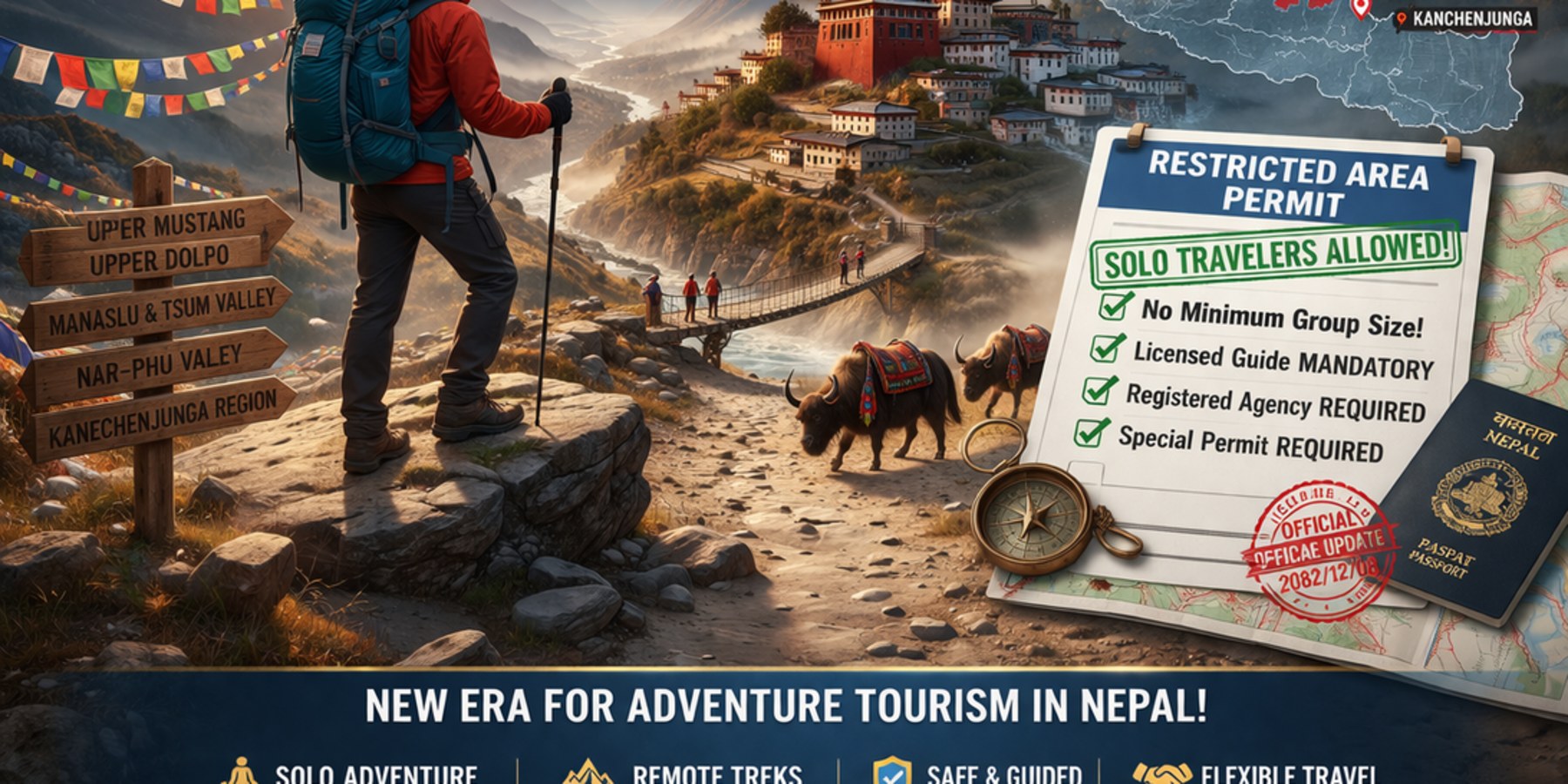

Nepal, a global hub for trekking and adventure tourism, has introduced a major policy reform that is set to reshape travel in its most remote and culturally sensitive regions.
As of 2082/12/08 (March 2026), the Department of Immigration Nepal has officially lifted the minimum group requirement for Restricted Area Permits (RAP), allowing solo foreign travelers to explore previously restricted trekking destinations.
This landmark decision opens new opportunities for independent travelers while maintaining Nepal’s commitment to safety, conservation, and cultural preservation.
What Are Restricted Areas in Nepal?
Restricted areas in Nepal are protected regions that require special permits due to their:
Proximity to international borders
Unique cultural heritage
Environmental sensitivity
Limited infrastructure
Some of the most Famous restricted trekking regions include:
Upper Mustang
Upper Dolpa
Manaslu & Tsum Valley
Nar-Phu Valley
Humla & Simikot
Kanchenjunga Region
These destinations offer raw Himalayan beauty, ancient Tibetan-influenced culture, and off-the-beaten-path adventure experiences.
Major Policy Change: Solo Travel Now Allowed
The most significant update introduced by the Government of Nepal is:
✅ Removal of Minimum Group Requirement
Before 2026:
Minimum 2 trekkers required
Solo travelers were not allowed
Group trekking was mandatory
After 2082/12/08:
✔ Solo travelers can now obtain Restricted Area Permits
✔ No minimum group size required
✔ Flexible and personalized trekking experiences
This reform aims to attract a wider range of travelers, especially solo adventurers, digital nomads, and premium travel seekers.
Important: What Has NOT Changed
Despite this major relaxation, certain rules remain strictly enforced:
1. Licensed Trekking Agency is Mandatory
You cannot apply independently for a Restricted Area Permit.
All permits must be processed through a government-registered trekking agency
Direct applications from individuals are not accepted
2. Licensed Guide is Still Compulsory
Even for solo travelers:
A licensed trekking guide is mandatory
Independent trekking in restricted areas is still not permitted
3. Required Documents
To obtain a Restricted Area Permit, the following documents are needed:
Valid passport & Nepal visa
Travel insurance
Detailed trekking itinerary
Agency guarantee letter
Permit application form
4. Permit Fees (No Major Changes)
Permit fees vary depending on the region. For example:
Upper Mustang: USD 500 (10 days)
Upper Dolpa: USD 500 (10 days)
Manaslu Region: USD 100–150 per week (seasonal)
Feature | Old Rule | New Rule (2026) |
Minimum trekkers | Required (2+) | Not required |
Solo travel | Not allowed | Allowed |
Licensed guide | Mandatory | Mandatory |
Trekking agency | Mandatory | Mandatory |
Independent trekking | Not allowed | Not allowed |
Why Nepal Introduced This Change
This progressive move reflects Nepal’s strategy to adapt to evolving global travel trends:
Rising demand for solo travel experiences
Growth of customized and flexible itineraries
Need to boost tourism in remote regions
Promotion of less crowded trekking destinations
The policy balances tourism growth with safety and sustainability.
What This Means for Travelers
With this update, travelers now have the freedom to:
Plan private trekking adventures
Travel at their own pace
Enjoy personalized experiences with expert guides
Access remote regions without forming groups
However, the presence of a guide ensures safety, navigation support, and cultural understanding.
Step-by-Step Permit Process (Updated)
Choose your trekking destination
Contact a registered trekking agency
Submit required documents
Agency applies for the permit
Pay permit fees
Receive permit approval
Begin trek with licensed guide
Business Opportunity for Travel Agencies
This policy is a game-changer for Nepal’s tourism industry, especially for agencies like Khushi Travels and Consulting Group.
New Opportunities:
Solo trekking packages
Luxury private treks
Female-friendly guided tours
Customized high-end itineraries
Travel with Khushi Travels and Consulting Group
At Khushi Travels and Consulting Group, we specialize in:
✔ Restricted Area Permit processing
✔ Customized trekking itineraries
✔ Experienced licensed guides
✔ Complete travel arrangements across Nepal
Whether you are a solo traveler or a group, we ensure a safe, seamless, and unforgettable Himalayan journey.
Final Thoughts
Nepal’s latest policy change marks a new era in adventure tourism. By allowing solo travelers into restricted areas—while maintaining safety measures—the country strikes a perfect balance between accessibility and responsible tourism.
If you’ve been dreaming of exploring Nepal’s hidden Himalayan gems, now is the perfect time.