

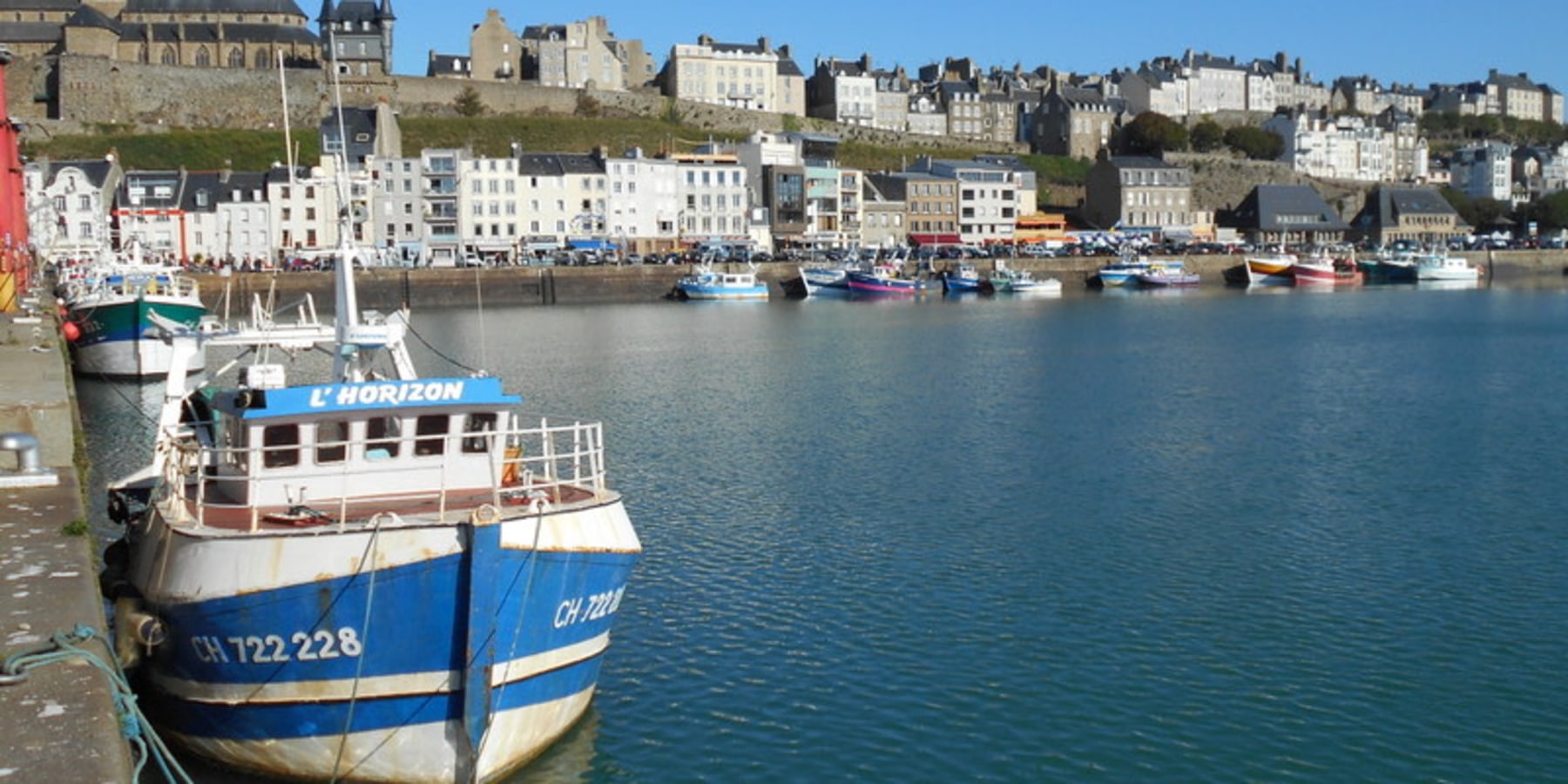

Granville is a Norman seaside resort, located on the west coast of the Manche department. Guardian of the Bay of Mont-Saint-Michel, it protects access to it.
Perched on its rock, the fortified Upper Town with houses built from Chausey granite, encircled by ramparts, dominates its fishing, commercial and pleasure ports, and overlooks the commercial town (shops, hotels, restaurants, campsites, youth hostel, motorhome area, Intercommunal Tourist Office...).
With 4 beaches, the first Nautical Centre in France, a thalassotherapy centre, a casino, a large functional rehabilitation centre, a maritime station and an SNCF station directly connected to Paris, Granville is a very lively town of 13,000 inhabitants, at the centre of a community of municipalities which includes 44,000. A concert and performance hall, a theatre, a media library, a cinema, several museums complete the cultural offering.
A bit of history:
Granville owes its name to its first inhabitants, after the Vikings. Indeed, in 1066, William the Conqueror asked the Grantet family for their help, as a reward for their loyalty during the conquest of England, granting them the lands located on this granite promontory.
In the 15th century, the English conquered Normandy, with the exception of Mont-Saint-Michel. In 1439, the English officer Sir Thomas Scales discovered the rock of Lihou—the original name of Granville—purchased it, and built a fortified enclosure, as well as the foundations of the church. In 1442, the defenders of Mont-Saint-Michel recaptured the stronghold and drove out the English. Charles VII, understanding the strategic importance of Granville, decided to establish a stronghold and in 1445 signed a charter exempting from taxes any inhabitants who settled there. By 1520, boats from Granville and the surrounding area were already fishing for cod on the Grand Banks of Newfoundland. Over the centuries, Granville became an important cod-fishing port. Under Louis XIV, ships were also authorized to arm themselves as privateers. Granville boasted nearly 300 of these privateers and provided 15 admirals to France.
As a garrison town, various barracks were built on the Roc between 1758 and the end of the 19th century.
From the 1850s onwards, the fashion for sea bathing attracted ever-increasing numbers of summer visitors.
Stendhal, Jules Michelet, and Victor Hugo stayed in Granville, appreciating the town's picturesque charm and the bustling port. In 1870, the Paris-Granville railway line was inaugurated.
During the war, the Germans added bunkers to the existing military fortifications, forming part of the "Atlantic Wall". Thanks to the actions of a young resistance fighter, the town was liberated without a fight or destruction on July 30, 1944, by General Patton's American army.
The natural environment:
Besides the superb vantage point offered by the Upper Town, we discover a 360° panorama. First, 17 km offshore, we see the Chausey Islands archipelago, which has formed Granville's maritime district since 1802. Fifty-two islands and islets at high tide, 365 at low tide. Accessible from the ferry terminal, a landmark of natural heritage, this protected area is renowned for its biodiversity: birds, marine life, crustaceans, shellfish, and the intertidal zone. It's worth noting that Granville and Chausey benefit from some of the largest tides in Europe, making it ideal for shellfish gathering.
To the north, along the Cotentin harbor coast, and on a clear day, the island of Jersey. The Channel Islands are connected to Granville by boat throughout the tourist season.
To the south, the bay of Mont-Saint-Michel opens up, including its seaside area of Saint-Pair-sur-Mer, Jullouville and Carolles.
Historical heritage:
Granville boasts numerous must-see attractions: the Upper Town (historic quarter) with its ramparts, narrow streets, the Grand'Porte and its drawbridge, the Saint-Jean gate, the Cap Lihou lighthouse, and the Notre-Dame church where Christian Dior was baptized. Museums include the Museum of Art and History (temporarily closed for renovations), the Halle au Blé (Grain Exchange), the Richard Anacréon Museum of Modern Art, the gardens and the Christian Dior Museum (his childhood home), and Au Cœur du Roc (aquarium and vivarium).
The activities:
Each season's calendar is filled with numerous cultural, sporting, tourist, historical, religious, and economic events. The famous Granville Carnival, listed as UNESCO Intangible Cultural Heritage, takes place every year on the weekend before Mardi Gras. It welcomes 250,000 participants over the five days, with a parade of 47 floats created by local associations, and culminates in a battle with tons of confetti.
So... Fancy coming to discover the Corsair City? Welcome to Granville!