

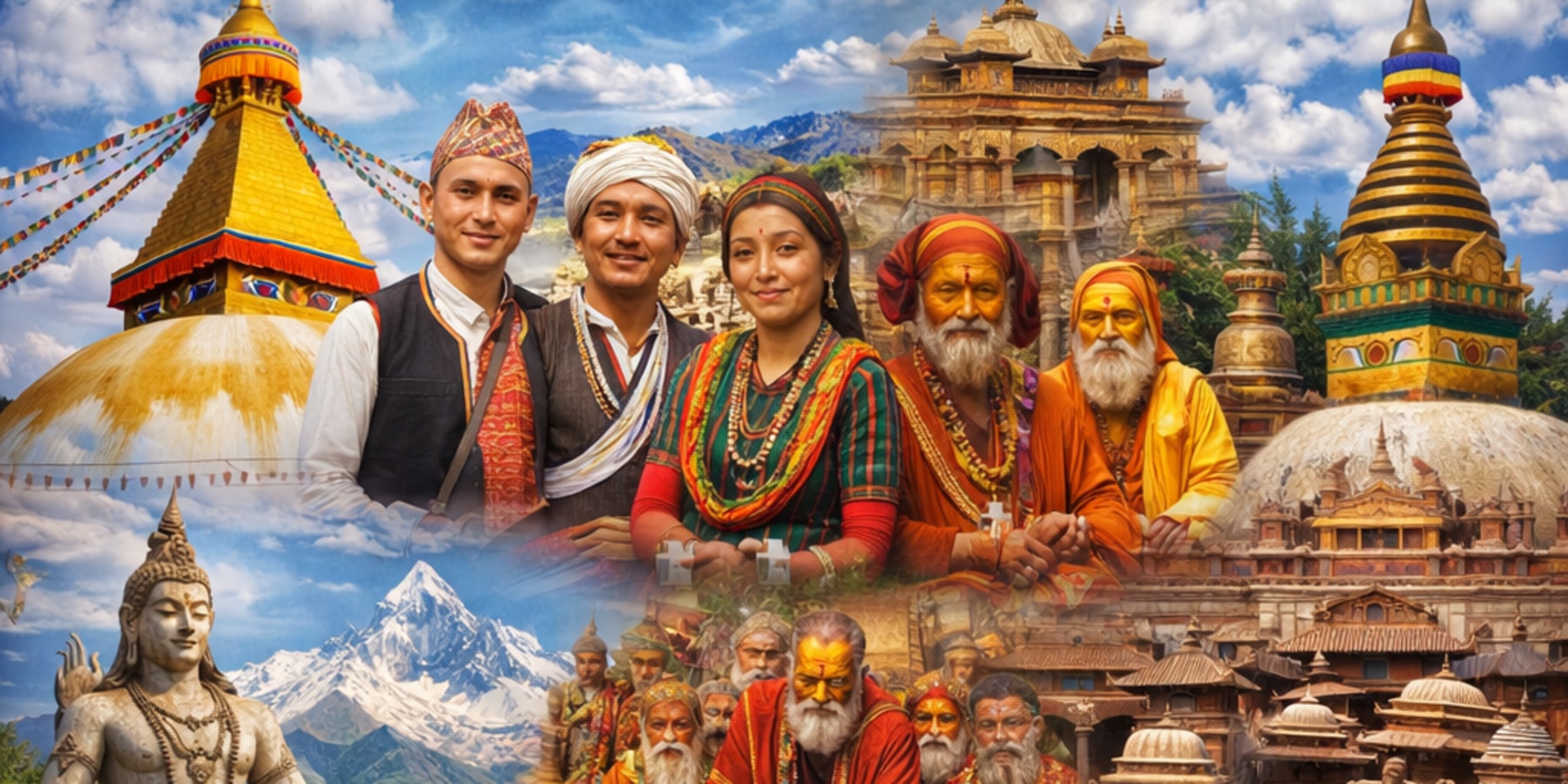

Cultural Treasures of Nepal
A Complete Guide to History, Heritage, Faith, and Living Traditions
Nepal is not only the land of the Himalayas; it is a living museum of civilizations, sacred traditions, and diverse cultures. From ancient kingdoms to vibrant festivals, from sacred temples to spiritual monasteries, Nepal preserves a heritage that is both timeless and alive.
For travelers seeking cultural depth beyond mountains, Nepal offers an extraordinary journey into history, faith, art, architecture, cuisine, and community life.
History & Cultural Foundations of Nepal
Nepal’s history dates back thousands of years, shaped by dynasties, trade routes, and spiritual movements.
Ancient Civilizations
Kirat Period (before 300 CE) – Early indigenous rulers.
Lichhavi Period (400–750 CE) – Golden era of art, temples, and inscriptions.
Malla Period (1200–1768 CE) – Flourishing of architecture, palace squares, and culture.
Shah Dynasty (1768 onwards) – Unification of Nepal under Prithvi Narayan Shah.
The Kathmandu Valley became a center of Hindu-Buddhist civilization, deeply influenced by trade between India and Tibet.
Ethnic Groups & Cultural Diversity
Nepal is home to over 125 ethnic groups and 120+ languages.
Major Ethnic Communities:
Newar – Indigenous people of Kathmandu Valley; masters of art and architecture.
Sherpa – Himalayan community known for mountaineering.
Tamang – Buddhist community in central hills.
Gurung & Magar – Indigenous hill communities.
Tharu – Indigenous people of Terai region.
Rai & Limbu – Kirati groups of eastern Nepal.
Madhesi communities – People of the southern plains with strong cultural ties to North India.
Each community has its own dress, language, festivals, and rituals.
Religions & Spiritual Harmony
Nepal is a multi-religious society where harmony between faiths is visible everywhere.
Hinduism – Majority religion.
Buddhism – Deeply rooted in culture.
Kirat religion – Indigenous belief system.
Islam & Christianity – Minority communities.
Hindu and Buddhist practices often blend, especially in Kathmandu Valley.
Religious Symbols & Sacred Icons
Common spiritual symbols include:
Om (ॐ) – Sacred sound of the universe.
Swastika – Ancient symbol of prosperity (different from Nazi symbol).
Trishul (Trident) – Symbol of Lord Shiva.
Prayer Flags – Represent peace and compassion.
Mandala – Spiritual geometric diagram.
Lotus Flower – Purity and enlightenment.
Holy Sites & Pilgrimage Destinations
Pashupatinath Temple
Sacred Hindu temple dedicated to Lord Shiva. One of the most important pilgrimage sites for Hindus worldwide.
Lumbini
Birthplace of Siddhartha Gautama (Buddha). A UNESCO World Heritage Site and global Buddhist pilgrimage center.
Swayambhunath
Ancient stupa known as the Monkey Temple. Represents harmony between Hinduism and Buddhism.
Muktinath Temple
Sacred to both Hindus and Buddhists; believed to grant salvation.
Myths & Legends
Nepal is filled with legends:
Kathmandu Valley was once a lake drained by Bodhisattva Manjushri.
Living Goddess Kumari represents divine feminine power.
Many temples are linked with epic Ramayana and Mahabharata stories.
Festivals & Celebrations
Nepal celebrates festivals almost every month.
Dashain – Victory of good over evil.
Tihar (Deepawali) – Festival of lights.
Holi – Festival of colors.
Buddha Jayanti – Birth of Buddha.
Indra Jatra – Newar festival with living goddess Kumari.
Chhath – Sun worship festival in Terai.
Festivals are marked by music, dance, rituals, and traditional food.
UNESCO World Heritage Sites of Nepal
Kathmandu Valley (Seven Monument Zones)
Kathmandu Durbar Square
Kathmandu Durbar Square is a historic palace complex located in the heart of Kathmandu, Nepal. It served as the royal residence of the Malla and Shah kings and remains a major cultural and architectural landmark, representing centuries of Nepalese art, religion, and governance.
Patan Durbar Square
Patan Durbar Square is a historic royal palace complex located in the heart of Lalitpur (Patan), Nepal. Once the seat of the Malla kings, it is renowned for its exquisite Newar architecture and dense concentration of temples, courtyards, and shrines. The site is part of the Kathmandu Valley UNESCO World Heritage property and remains a living center of art, culture, and devotion.
Bhaktapur Durbar Square
Bhaktapur Durbar Square is a historic royal plaza in Bhaktapur, Nepal, showcasing the finest medieval Newar architecture of the Malla period. Recognized as a UNESCO World Heritage Site, it remains a vibrant cultural hub where art, religion, and daily life intertwine amid ancient temples and palaces.
Boudhanath
Boudhanath is a monumental Buddhist stupa located in the northeastern outskirts of Kathmandu, Nepal. One of the largest spherical stupas in the world and a UNESCO World Heritage Site since 1979, it serves as a vital spiritual center for Buddhists-particularly those of Tibetan heritage-and as a major landmark in the Kathmandu Valley.
Changu Narayan Temple
Changu Narayan Temple is an ancient Hindu shrine dedicated to Lord Vishnu, located on a hilltop in the Bhaktapur District of Nepal. Recognized as a UNESCO World Heritage Site, it is considered the oldest Hindu temple still in use in the Kathmandu Valley and a masterpiece of early Nepalese art and architecture.
Other UNESCO Sites:
Lumbini
Lumbini is a sacred pilgrimage site in the Rupandehi District of southern Nepal, revered as the birthplace of Gautama Buddha around 563 BCE. Recognized as a UNESCO World Heritage Site, it is one of Buddhism’s holiest locations and a major cultural and archaeological landmark attracting millions of pilgrims and travelers annually.
Chitwan National Park
Chitwan National Park is Nepal’s first national park, established in 1973 and recognized as a UNESCO World Heritage Site in 1984. Located in the subtropical lowlands of south-central Nepal, it protects a diverse range of ecosystems and species, including endangered wildlife such as the one-horned rhinoceros and Bengal tiger.
Sagarmatha National Park
Sagarmatha National Park is a protected Himalayan landscape in northeastern Nepal, encompassing Mount Everest and the Khumbu region’s high-altitude ecosystems. Established in 1976, it safeguards unique mountain biodiversity and the cultural heritage of the Sherpa people. The park was inscribed as a UNESCO World Heritage Site in 1979 for its outstanding natural beauty and ecological significance.
Art, Architecture, Sculpture & Painting
Nepal is globally admired for:
Pagoda-style temples
Intricate wood carvings (Newar craftsmanship)
Bronze and metal statues
Stone sculptures from Lichhavi period
Thangka paintings (Buddhist scroll art)
Paubha paintings (Newar sacred art)
Durbar Squares display some of the finest examples of medieval architecture.
Traditional Dress & Ornaments
Daura Suruwal – National dress for men.
Gunyo Cholo – Traditional dress for women.
Dhaka topi – Cultural cap.
Gold jewelry and tilhari necklaces (married Hindu women).
Sherpa and Tibetan silver ornaments.
Nepali Cuisine
Traditional food reflects geography and culture.
Dal Bhat – Lentil soup with rice.
Momo – Dumplings.
Sel Roti – Rice bread.
Gundruk – Fermented leafy greens.
Thakali Thali – Regional set meal.
Yomari – Newar sweet dumpling.
Food varies between mountains, hills, and Terai regions.
Meditation, Monasteries & Faith Healers
Nepal is a spiritual retreat destination.
Buddhist monasteries in Kathmandu & Himalayan regions.
Vipassana meditation centers.
Shamans (Jhankri) practice traditional healing.
Ayurvedic and herbal traditions.
Spiritual tourism is growing rapidly among global travelers.
Unique Cultural Specialties
Living Goddess Kumari tradition.
Traditional masked dances.
Handicrafts: carpets, metal statues, paubha paintings.
Sacred cremation rituals at Bagmati River.
Community-based festivals preserving centuries-old traditions.
Conclusion: Nepal – A Living Cultural Sanctuary
Nepal’s cultural treasures are not preserved behind museum glass—they live and breathe through its streets, temples, festivals, and people. Every corner of the country reflects stories of faith, resilience, artistry, and harmony passed down through generations. From sacred pilgrimage sites to vibrant ethnic traditions, Nepal offers a profound cultural journey unlike anywhere else in the world.
To experience the true essence of Nepal’s heritage, traditions, and spiritual landscapes, connect with Khushi Travels and Consulting Group. We specialize in curated cultural tours, heritage explorations, pilgrimage journeys, and authentic travel experiences across Nepal, helping travelers discover the soul of this remarkable country.