



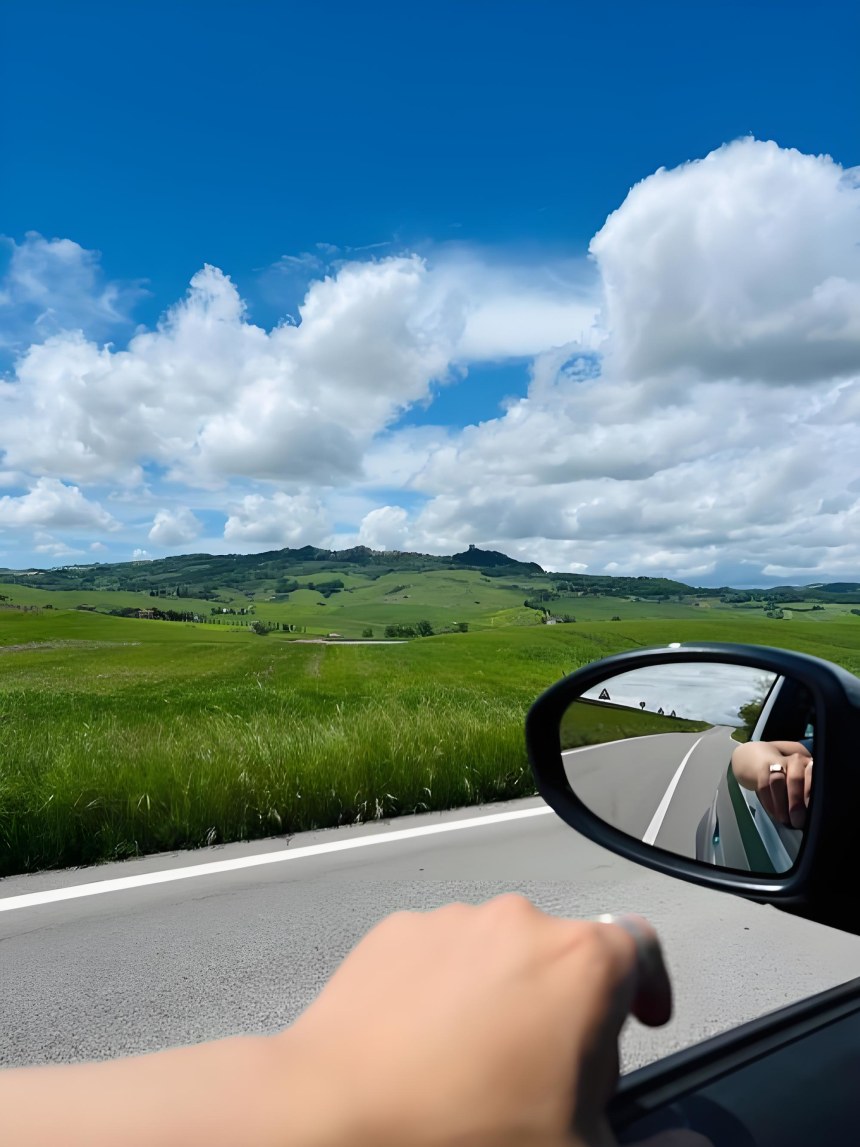
Imagine this: you're driving along the Duku Highway in Xinjiang, with snow-capped mountains on one side and sheer cliffs on the other. Or you pull over by the rice terraces in Yunnan and walk into a small noodle shop that only locals know about. No matter how convenient public transport is, it can never replace the freedom of having your hands on the steering wheel. Driving in China not only lets you explore at your own pace but also takes you to those hidden corners that never appear on any map.
But before you hit the road, there are a few things you need to know. This guide covers everything – from driver's licenses and car rentals to navigation and road conditions – so you can be fully prepared.
- International Driving Permits Are Not Valid in China
This is rule number one, and it's the most important: China does not recognize the International Driving Permit (IDP). No matter what your rental company or embassy tells you, driving in China with a foreign license or an IDP is considered unlicensed driving. You could face fines, penalty points, vehicle impoundment, or even more serious legal consequences.
To drive in China, you must have a Chinese driver's license – either a full official Chinese driver's license or a Temporary Driving Permit.
- Two License Options – Choose Based on Your Stay Duration
1.Emporary Driving Permit (Best for Short-Term Tourists)
If you're a short-term visitor staying in China for no more than 3 months, you can apply for a Temporary Driving Permit valid for 3 months. If you're staying longer than 3 months, the validity can be extended to 1 year.
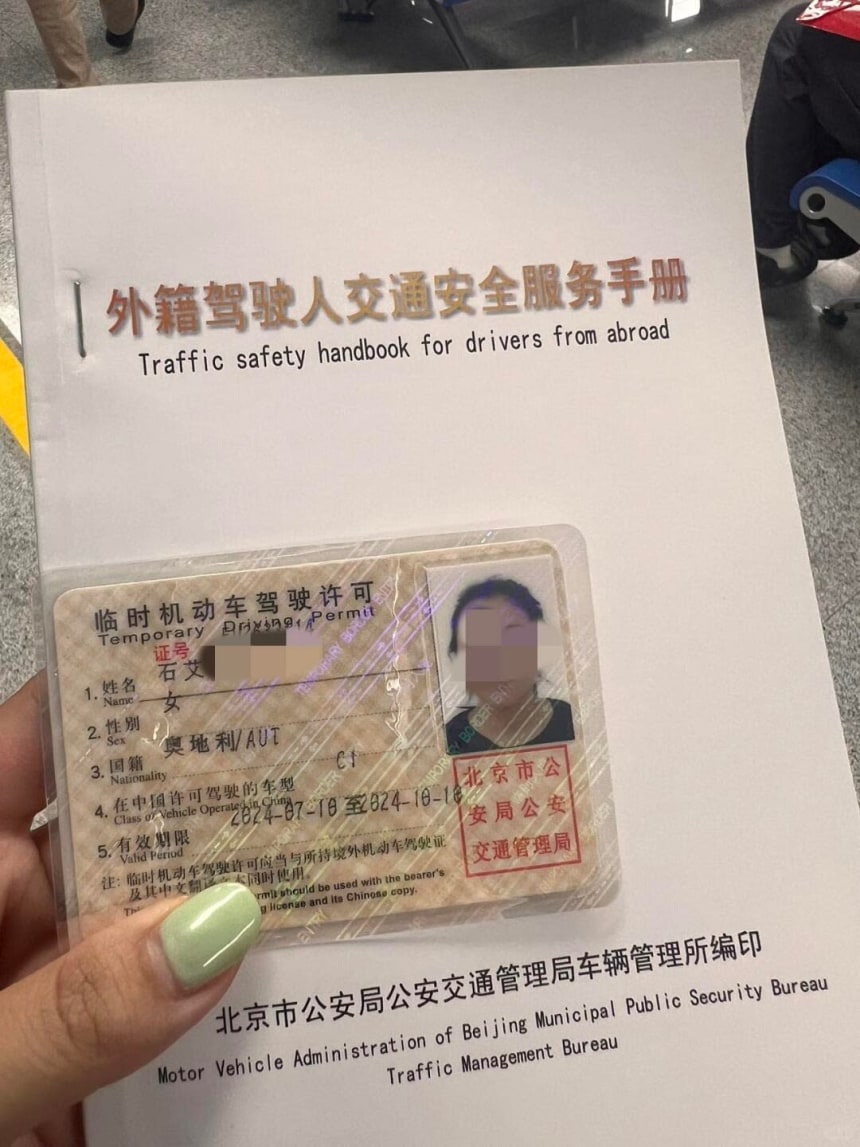
(1)Where to apply:
Temporary Driving Permits can be obtained at local Vehicle Management Offices (车管所). Now, some major international airports have set up service counters within the terminals, offering an "arrival and apply" service. Airports known to offer this include:
• Beijing Daxing Airport
• Shanghai Pudong Airport
• Chengdu Tianfu Airport
• Chongqing Airport
During the 2026 Beijing International Auto Show, over 200 foreign guests directly applied for their Temporary Driving Permits at Beijing Capital Airport Terminal 3, with an average processing time of about 10 minutes per person. The airport police also offered services like document pre-screening and staggered appointments to cut down waiting times.
If your port of entry doesn't have a service counter, or you arrive outside business hours, you can go to the nearest local Vehicle Management Office.
(2)Documents you'll need:
• Valid passport (with valid visa or entry stamp)
• Original foreign driver's license
• Official Chinese translation of your foreign driver's license (must be issued by a qualified translation agency or notarized)
• 2 passport-sized color photos (25mm × 35mm, full-face, bareheaded, on white background)
• Completed Application Form for Temporary Driving Permit
• Pay the 10 RMB administrative fee and watch about 30 minutes of road safety education video
Important: You must carry the Temporary Driving Permit with you at all times while driving, and use it together with your original foreign license and its Chinese translation. The permit can be used for multiple entries within its validity period without reapplication.
2.Full License Conversion (Best for Long-Term Residents)
If you're staying in China for more than 3 months, you can consider converting your foreign license into a full Chinese driver's license. The application must be submitted at the Vehicle Management Office where your residence permit was issued.
(1)Eligibility requirements:
• When you obtained your foreign license, you must have resided in that country or region for at least 90 days within one year
• Your age and physical condition meet Chinese requirements
(2)Documents you'll need:
• Valid passport (with a valid visa or residence permit valid for more than 3 months)
• Accommodation registration certificate issued by the public security bureau
• Original foreign driver's license
• Notarized Chinese translation of your foreign license
• Physical examination certificate from a medical institution
• Photos
Converting to a full license usually requires taking the Subject 1 theory test (about 100 multiple-choice questions covering road signs and traffic rules).
- Renting a Car – Choosing the Right Platform Matters
1.Recommended platforms:
Trip.com (Ctrip) – The most foreigner-friendly option – both app and customer service support English. Some foreign travelers have booked a rental in just a few minutes on the platform.
Zuche (神州租车) – Around 6,500 direct outlets nationwide with over 190,000 vehicles. Together with eHi, it's one of China's largest direct-chain rental brands.
eHi (一嗨租车) – Service network covers over 500 cities with more than 10,000 direct service outlets. Off-season rates for a 1.5L sedan are about 80–150 RMB per day.
Note: Platforms like Didi Car Rental or Alibaba Car Rental usually require a Chinese ID card (二代身份证). Aouto Car Rental (凹凸租车) accepts passports but has limited options. For travelers who don't read Chinese, Trip.com is the safest bet.
2.Hangzhou's "License Swap Car Rental" Service:
From May 1, 2026, Hangzhou launched a license-swap car rental service specifically for incoming tourists. Eligible travelers can submit an online pre-application through Trip.com, then collect their Temporary Driving Permit at Hangzhou Airport upon arrival and pick up their car immediately – making it a seamless "apply online, get it on arrival, and drive away" experience. Rental prices range from 198 to 677 RMB, and in many cases no deposit is required. In Q1 2026, inbound car rental orders in Hangzhou grew by 20% year-on-year.
3.Things to watch out for when renting:
• Read the contract carefully – pay special attention to accident liability and compensation clauses.
• Confirm the traffic violation handling process – ask the rental company if they will handle all violations on your behalf and how they will deduct related fees from your deposit.
• Ask for a formal fapiao (invoice) – it must be a proper invoice, not just a receipt; without one, you may have no recourse in case of disputes.
• Get sufficient insurance – full coverage is recommended, especially third-party liability insurance.
- Navigation – What to Use Since Google Maps Doesn't Work
Google Maps is not accessible in mainland China. You'll need to download these alternative apps before you arrive:
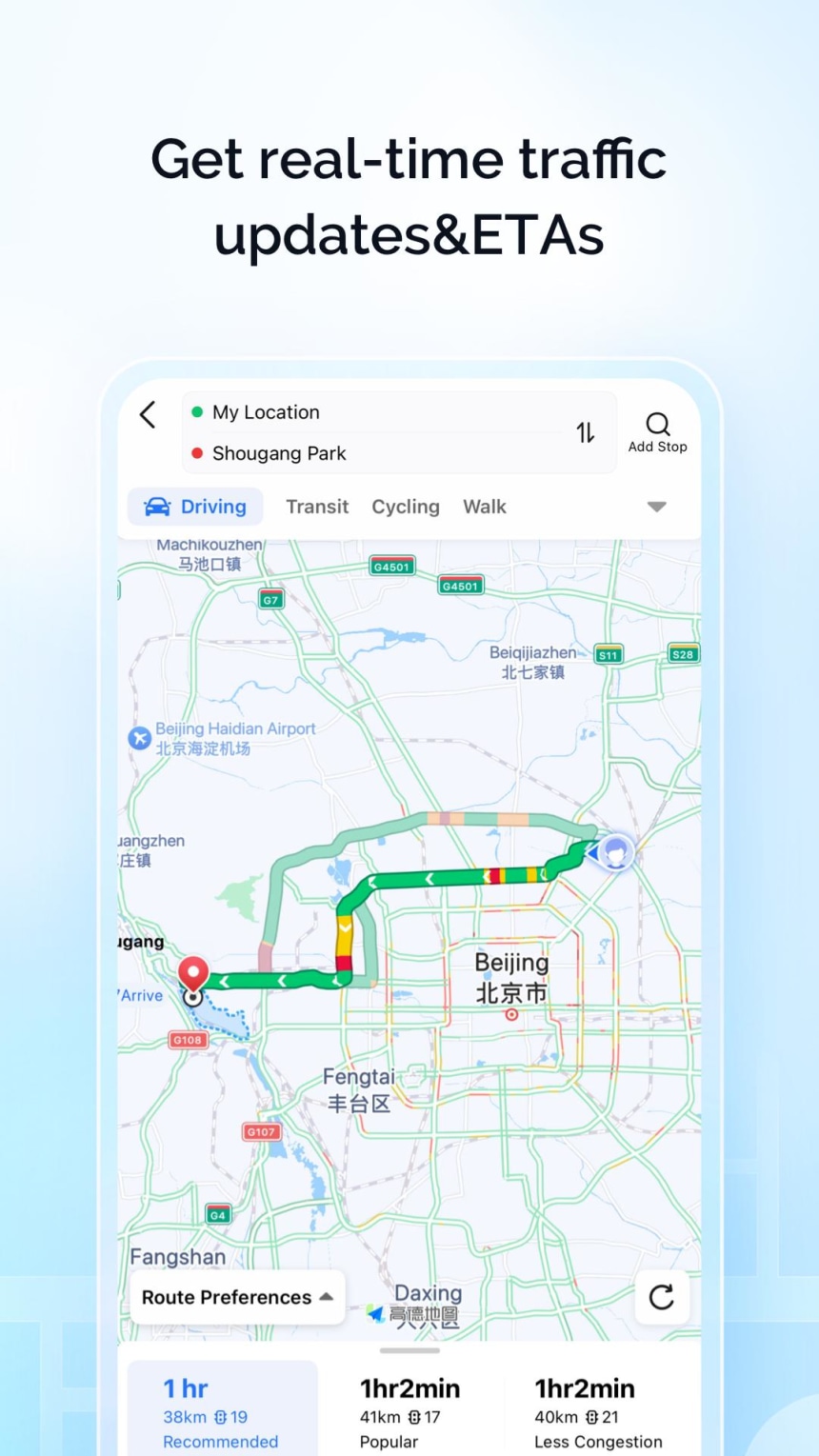
1.Amap (高德地图) – The most recommended navigation tool for self-driving. Offers an English interface, covers almost all urban and rural roads nationwide, and provides real-time traffic updates and road closure info. The downside is occasional ads.

2.Baidu Maps (百度地图) – The second-largest comprehensive map service. However, it has no full English version – the main interface is in Chinese. You can use a translation app to translate screenshots, or search by entering Chinese characters or pinyin.
3.Apple Maps – A great choice for iPhone users. It uses Amap's data in China, no VPN required, and has a full English interface. The downside is slower updates on local roads and points of interest.
4.LingoMap – Designed specifically for non-Chinese speakers, overlaying English and pinyin labels on Amap's data.
Tip: Use Amap as your primary navigation tool and keep Baidu Maps as a backup. Download offline maps for your destinations in advance, in case you lose signal in mountainous or remote areas.
- What's It Like to Drive in China?
1.Driving habits:
China drives on the right-hand side of the road, with the steering wheel on the left – opposite to countries like the UK, Japan, Australia, and Singapore. If you're from a right-hand-traffic country (like the US, Canada, Germany, France), you'll adapt quickly; if you're from a left-hand-traffic country, it's a good idea to practice in a quiet area before hitting busy roads.
2.Road conditions:
• City driving – In big cities (especially Guangzhou, Chengdu, etc.), traffic is heavy. Lane markings are sometimes treated more as "suggestions," and motorcycles and e-bikes weave through from all directions. Pedestrians may cross unpredictably. You need to stay highly alert.
• Rural and long-distance driving – Once you leave the cities, the situation changes dramatically – China's expressways and national highways are world-class, with stunning mountain routes and scenic country roads linking every corner. Even in remote areas, road signs are fairly comprehensive, many with English translations.
3.Key traffic rules:
• Expressway speed limit: 120 km/h; regular roads: 60–80 km/h; urban areas: 40 km/h
• Must yield to pedestrians at zebra crossings – failure to do so is heavily penalized
• Zero tolerance for drink-driving – even one beer could lead to license suspension
• Seat belts required for both front and rear passengers
4.Traffic enforcement:
China takes traffic violations very seriously. Cameras are everywhere – from speeding to illegal lane changes, everything is recorded. Fines are automatically generated and linked to the license plate. Even small towns are packed with cameras, so don't take chances.
- Expressway Tolls and Refueling
1.Toll payment:
Most expressways in China are toll roads. Four-lane expressways cost about 0.40–0.45 RMB/km; six-or-more-lane trunk roads cost about 0.50–0.60 RMB/km.
From May 1, 2026, the national expressway system officially launched "license plate-based non-stop tolling" – drivers can link their plate number and payment method via WeChat or other platforms to enable seamless payment. Traditional methods are still available:
• Cash – Pay at manned toll booths
• ETC – Electronic toll collection – requires a device installed in advance. Foreigners applying for ETC need to provide passport, residence permit, etc., and the linked bank account must be a domestic bank account.
2.Refueling:
Gas stations are everywhere in China, and they are all full-service – attendants will pump the gas for you. Payment options include cash, Alipay, and WeChat Pay. Some stations accept international credit cards, but it's safer to have cash or mobile payment ready.
- Insurance and Accident Handling
1.Rental car insurance:
Always purchase insurance when renting. At a minimum, it should include:
• Vehicle damage insurance
• Third-party liability insurance (at least 1 million RMB recommended)
• Occupant liability insurance
2.What to do in case of an accident:
• Call 122 immediately (traffic accident emergency number)
• Contact the rental company
• Take photos as evidence at the scene
• Do not settle privately – follow official procedures
If you have a dispute with the rental company , you can search for the local tourism bureau or traffic police department's online complaint platform via WeChat. Generally, the relevant authorities handle foreign travelers' complaints promptly and fairly.
- Practical Tips
• Choose the right city to apply – Try to apply for your Temporary Driving Permit in large cities with many foreign visitors. In smaller towns, local officers may be unfamiliar with the procedure and find excuses to turn you away.
• Prepare your translation in advance – Translations must come from qualified agencies or notarized. Authorized agencies include the Shanghai Translators Association (for applications in Shanghai) and Jingyi Zhengtong Translation Center (with desks at both Beijing airports). Some airports also have self-service photo booths.
• Carry all documents with you – Always keep your passport, Temporary Driving Permit, foreign license, and translation in the car – traffic police may stop you at any time.
• Download translation apps – They're very useful for asking directions or explaining documents.
• Avoid peak holiday travel – During Chinese Golden Weeks (Spring Festival, National Day), expressways are toll-free – but they are also extremely congested.
• Watch out for power banks – If you carry a power bank, make sure it has CCC certification , otherwise it may not be allowed on domestic flights.
- Why Is It Worth It?
Driving in China requires some paperwork and a bit of adjustment, but the freedom it brings is priceless. You can stop anytime in a small Yunnan village, drive along the Great Wall, or explore the grasslands of Inner Mongolia at your own rhythm. Public transport is convenient, but it runs on fixed schedules; with a car, the entire journey is yours to shape.
As one traveler from Singapore put it: "With enough driving experience, you'll get used to it as soon as you get behind the wheel."
Got more questions about your trip to China? Drop them below – I'm happy to help!

I'm Yuan, a local tour guide registered on tourHQ, based in Shanghai and covering the Yangtze River Delta region (including Suzhou, Hangzhou, Nanjing, and beyond). I don't just take you to the famous sights – I'll bring you to hidden alleyway eateries, share stories that never make it into guidebooks, and craft a journey that fits your pace and interests.
Ready to explore the real China with a local? Click on my profile now to learn more!
My profile: https://www.tourhq.com/guide/CN38750/yuan-shen
Let me help make your China trip truly unforgettable – see you soon!