

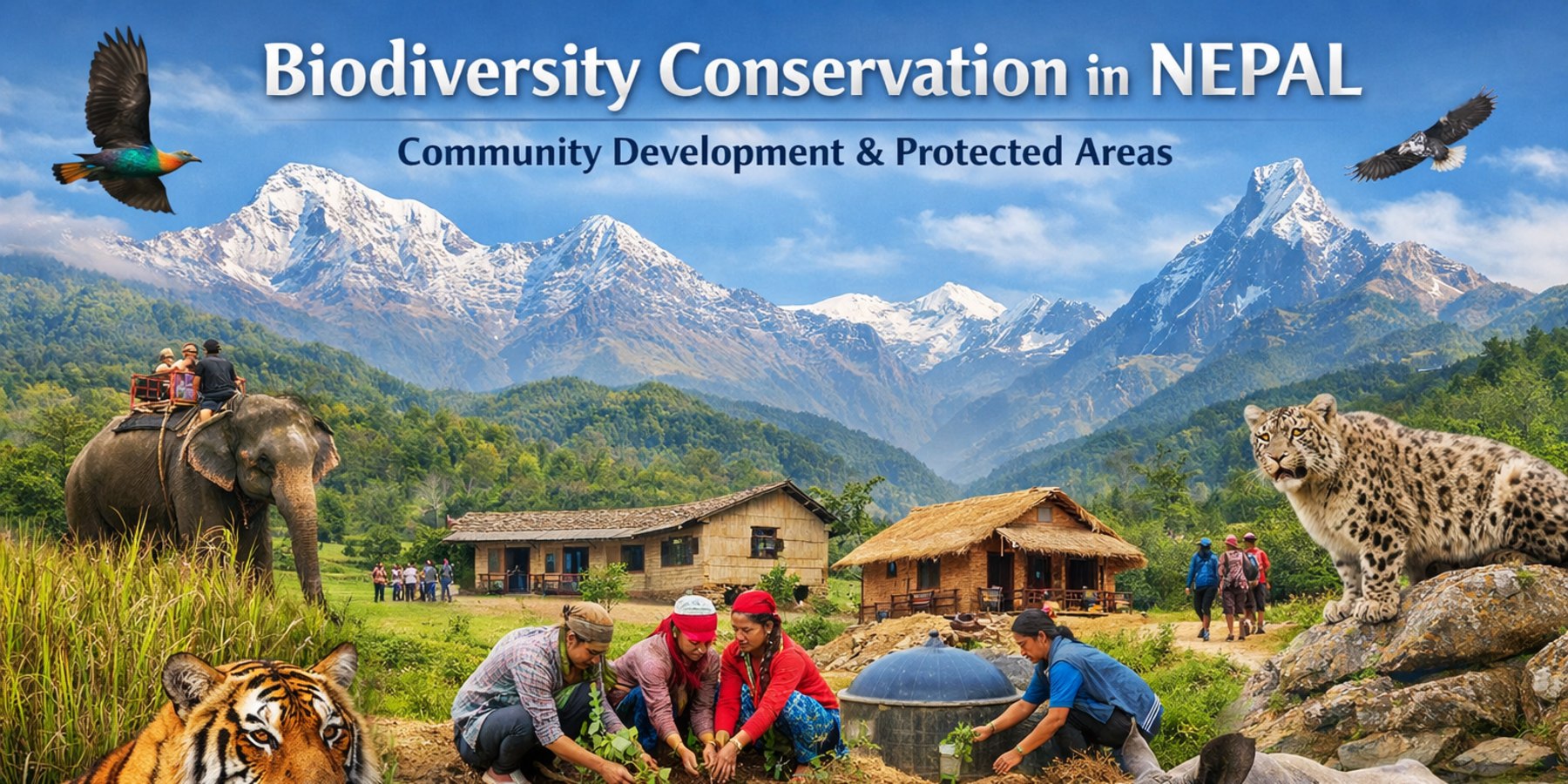

Biodiversity Conservation Through Community Development in Nepal
A Model of People-Centered Conservation
Overview
Nepal is globally recognized as a leader in community-based biodiversity conservation, where local communities actively participate in protecting nature. From tropical lowlands to the high Himalayas, Nepal successfully integrates conservation with sustainable development, making it a global model for eco-friendly tourism and environmental stewardship.
Why Nepal is Unique for Biodiversity
Despite covering only 0.1% of the world’s land, Nepal is home to:
3.2% of global flora
1.1% of global fauna
Rare species such as the Bengal tiger, one-horned rhinoceros, snow leopard, and red panda
This rich biodiversity is protected through an extensive network of national parks, conservation areas, and community-led programs.
Community-Based Conservation Approach
Nepal follows a “people and nature coexistence” model through key programs:
Buffer Zone Management Program (1996):
Shares 30–50% of park revenue with local communities for development and conservation.
Community Forestry Program:
Over 22,000 forest user groups manage forests sustainably, reducing deforestation.
Conservation Area Management:
Promotes community participation in areas like Annapurna Conservation Area.
Integrated Conservation & Development Programs (ICDP):
Combines conservation with livelihood improvement through eco-tourism and renewable energy.
Protected Areas of Nepal
Nepal’s protected areas cover over 23% of the country’s total land.
National Parks
Chitwan National Park (952.63 sq. km, 1973)
Bardia National Park (968 sq. km, 1988)
Langtang National Park (1,710 sq. km, 1976)
Rara National Park (106 sq. km, 1976)
Sagarmatha National Park (1,148 sq. km, 1976)
Shey Phoksundo National Park (3,555 sq. km, 1984)
Khaptad National Park (225 sq. km, 1984)
Makalu Barun National Park (1,500 sq. km, 1992)
Shivapuri Nagarjun National Park (159 sq. km, 2002)
Banke National Park (550 sq. km, 2010)
Shuklaphanta National Park (305 sq. km, 2017)
Parsa National Park (637 sq. km, 2017)
Conservation Areas
Annapurna Conservation Area (7,629 sq. km, 1986)
Manaslu Conservation Area (1,663 sq. km, 1998)
Kanchenjunga Conservation Area (2,035 sq. km, 1997)
Gaurishankar Conservation Area (2,179 sq. km, 2010)
Api Nampa Conservation Area (1,903 sq. km, 2010)
Krishnasaar Conservation Area (16.95 sq. km, 2009)
Other Protected Areas
Koshi Tappu Wildlife Reserve (176 sq. km, 1976)
Dhorpatan Hunting Reserve (1,325 sq. km, 1987)
Park People Programme (PPP)
The Park People Programme, supported by UNDP and the Government of Nepal, strengthens the relationship between protected areas and local communities.
Key Activities
Livelihood Development: Eco-tourism, homestays, handicrafts, and income-generating programs
Alternative Energy: Biogas, solar energy, improved cookstoves
Resource Management: Community forestry, soil conservation, watershed protection
Infrastructure: Schools, drinking water systems, health facilities
Awareness Programs: Environmental education and wildlife conservation campaigns
Human-Wildlife Conflict Management: Compensation systems and protective measures
Key Achievements
Ecological: Increase in forest cover and recovery of endangered species like rhinos and tigers
Social: Improved livelihoods, education, and empowerment of local communities
Economic: Growth of eco-tourism and diversified income sources
Institutional: Strong community governance and user group systems
Conclusion
Nepal stands as a global example where nature conservation and human development go hand in hand. Its community-driven approach ensures long-term sustainability, making it one of the most inspiring destinations for eco-conscious travelers.