


The migration doesn't have one “best month”
There is no single month when the Great Migration is simply “on.”
The herds move in response to rainfall, fresh grass and water, and the exact timing can shift from year to year. What you can plan with reasonable confidence is the general pattern. What you cannot plan with the same certainty is exactly where every herd will be on a particular day.
From around January to March, large numbers of wildebeest are generally concentrated in the southern Serengeti and the wider Ndutu area.
This is the calving period, and it can be extraordinary.
Young wildebeest are everywhere, and the concentration of prey can bring predators close. Lions, cheetahs and hyenas are all part of the picture, which means the experience isn't simply about watching calves being born. It is about seeing an entire predator-prey system become particularly active.
For travelers who care more about wildlife interaction than witnessing a famous event, this can be a particularly rewarding time to visit.
There is one important catch: calving does not follow a fixed calendar.
Rainfall varies. The grass responds. The herds respond to the grass.
So be cautious with anyone who makes the season sound like a timetable.
February may generally be a good month for the calving season, but the Serengeti does not operate on a booking calendar.
Then the herds start moving
As conditions change, the wildebeest begin moving north and west.
By around May and June, the Western Corridor and Grumeti area can offer a very different migration experience.
This is where it is easy to get caught up in the Mara River story and overlook the journey that comes before it.
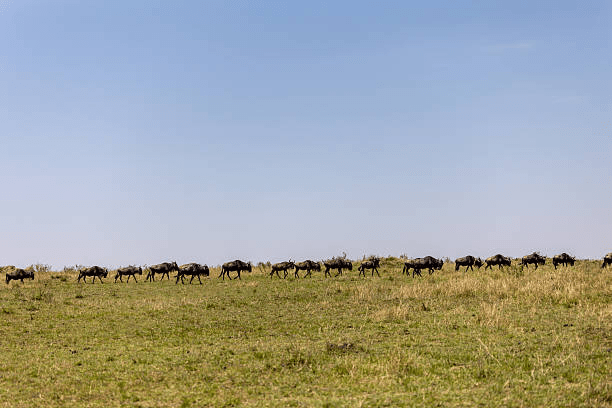
The spectacle here is often the movement itself: enormous numbers of animals spread across the landscape, sometimes forming long columns that seem to disappear into the distance.
It can also feel different from the northern migration season. The focus isn't necessarily on waiting for one dramatic event. You are watching the landscape change as the herds pass through it
And then there is the Mara River
This is arguably the most dramatic scene.
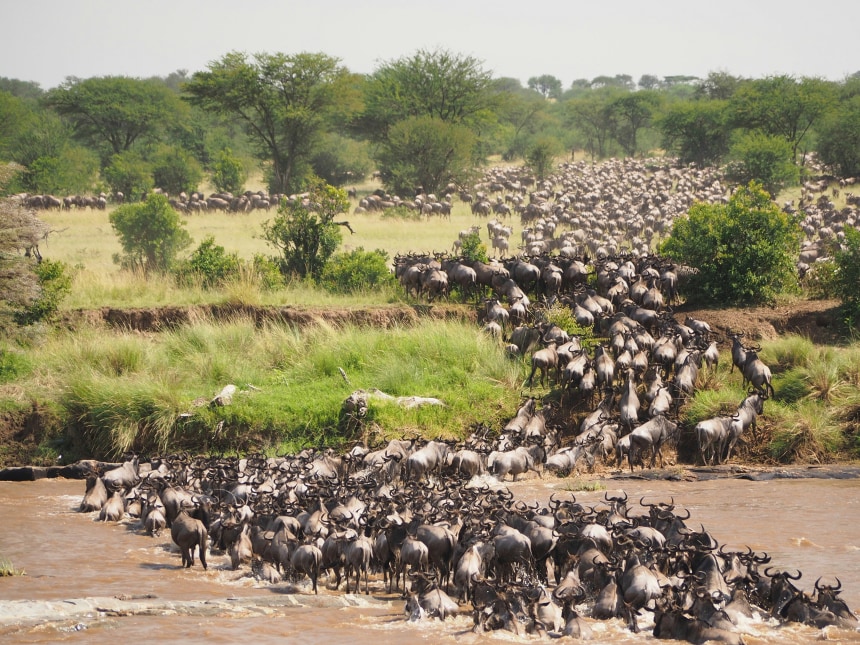
A herd gathers along the riverbank. The animals hesitate. One moves toward the water, then stops. More animals gather behind it.
Then, sometimes without much warning, the hesitation ends.
The herd surges forward.
When a major crossing happens in front of you, it is an extraordinary sight.
But there is something important to understand before building an entire safari around it:
The migration does not perform on schedule.
Wildebeest can reach the river and wait. They can move away and return later. They can cross at one point while you are watching another. And you can spend several days in the northern Serengeti without seeing the dramatic crossing you came hoping for.
That isn't a failure of the safari. It is simply the nature of the event.
The river crossing is unpredictable precisely because the animals are making the decision themselves.
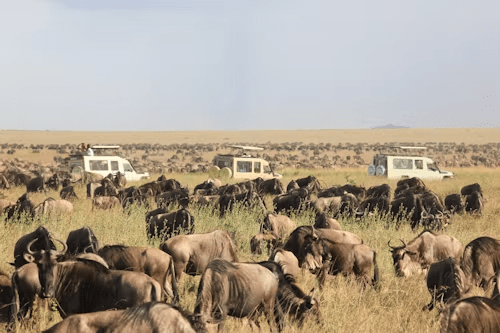
There is another practical consideration during the busiest periods: other safari vehicles may also be trying to reach the same crossing.
That makes the guide's approach important.
Instead of asking only:
“Will we see a river crossing?”
I'd ask:
“What will our guide do if the herd moves to another crossing point?”
That tells you much more about how the safari will actually be handled.
The northern Serengeti is large, and being prepared to reposition rather than sit at one viewpoint can make a meaningful difference.
Why the northern Serengeti can cost more
Part of the price has very little to do with the animals.
It is logistics.
The northern Serengeti is remote, and reaching it overland takes considerably more time than simply driving from Arusha into the southern or central parts of the park.
That is one reason fly-in safaris are popular, particularly for travelers with shorter itineraries.
Accommodation can also become more expensive during the peak migration months, especially in the northern Serengeti. Seasonal demand, remote locations, limited accommodation and the cost of operating in these areas all contribute to the final price.
Then there are the park and conservation-related fees, transfers and other safari costs.
And this is where the difference between a headline safari price and the actual cost of your trip can become noticeable.
Depending on your itinerary, you may also need to account for:
Domestic flights
Accommodation
Park and concession fees
Drinks and personal expenses
Guide and camp tips
Single supplements
Airport and lodge transfers
Optional activities such as a balloon safari
A balloon safari is a good example. It can be a memorable addition to a Serengeti trip, but it is a significant extra cost. If it is something you want, it is better to build it into the budget from the beginning.
The important point is that “migration safari” is not one fixed product with one fixed price.
The month, region, accommodation, transport and number of nights can change the cost considerably.
The better way to choose your dates
Instead of starting with:
“When is the Great Migration?”
Start with:
“What do I want to experience?”
If your priority is newborn animals, predators and large concentrations of wildebeest, look closely at the southern Serengeti and Ndutu period around January to March.
If you are more interested in the movement of the herds itself, the May and June period around the Western Corridor can be worth considering.
If the experience you have always imagined is a Mara River crossing, then the northern Serengeti is the area to build around, with July to September generally being the period associated with the northern migration and river-crossing season.
But there is an important difference between choosing the right season and guaranteeing an event.
You can choose your dates intelligently.
You cannot make a wildebeest cross a river on Tuesday afternoon.
That is why I would be careful about building a short safari around one specific wildlife moment.
If the river crossing is the main reason you are coming, giving yourself several nights in the northern Serengeti gives you more opportunity to follow the movement rather than treating the crossing as something that must happen on a particular day.
Spend more time in the right place, not less time in more places
For a first safari focused on the migration, I would generally rather have enough time in the right part of the Serengeti than spend the trip constantly moving between destinations.
There is a temptation to build an itinerary that includes everything:
Arusha. Tarangire. Ngorongoro. Central Serengeti. Northern Serengeti. Zanzibar.
It can look impressive on paper but every transfer takes time.
If the migration is the main reason for your trip, spending additional nights where the herds are expected to be can sometimes make more sense than adding another destination simply to collect another name on the itinerary.
That is particularly true when your priority is an unpredictable event.
More time does not guarantee a crossing.
It does give your guide more opportunities to respond to what the animals are actually doing.
And that is an important distinction.
What happens if you don't see the crossing?
This is probably the question worth asking before you book.
Because a migration safari shouldn't become a disappointment simply because the most famous photograph didn't happen.
Imagine spending several days in the Serengeti and never seeing a major river crossing.
You could still watch thousands of wildebeest moving across the plains. You could find lions following the herds. You could come across elephants, giraffes, cheetahs and hyenas going about their own lives. You might spend an hour watching a single herd slowly make its way across open grassland.
And then, one morning, your guide notices something in the distance.
A dark line is moving across the horizon.
You drive closer.
The line gets longer.
Then you realize it isn't ending.
More wildebeest keep appearing.
That is the migration too.
It may not be the photograph you had in your head before the trip.
It can still be the moment you remember years later.
The migration is bigger than the crossing
The Mara River is spectacular, but it has become so closely associated with the Great Migration that it can make the rest of the journey seem like a supporting act.
It isn't.
The calving season in the south is a migration experience.
The movement through the Western Corridor is a migration experience.
The herds gathering and moving north is a migration experience.
The river crossing is a migration experience.
They simply offer different things.
So if you are planning a Great Migration safari, don't begin by asking which month is “best.”
Begin with the experience you want.
Then choose the region.
Then choose the dates.
Then decide how much time you can realistically give the safari.
Once those decisions are clear, choosing the right accommodation, route and budget becomes much easier.
And that is ultimately what good safari planning should do: not promise you a perfectly timed wildlife show, but put you in the right place, at the right time, with enough flexibility to make the most of what the Serengeti actually gives you.