

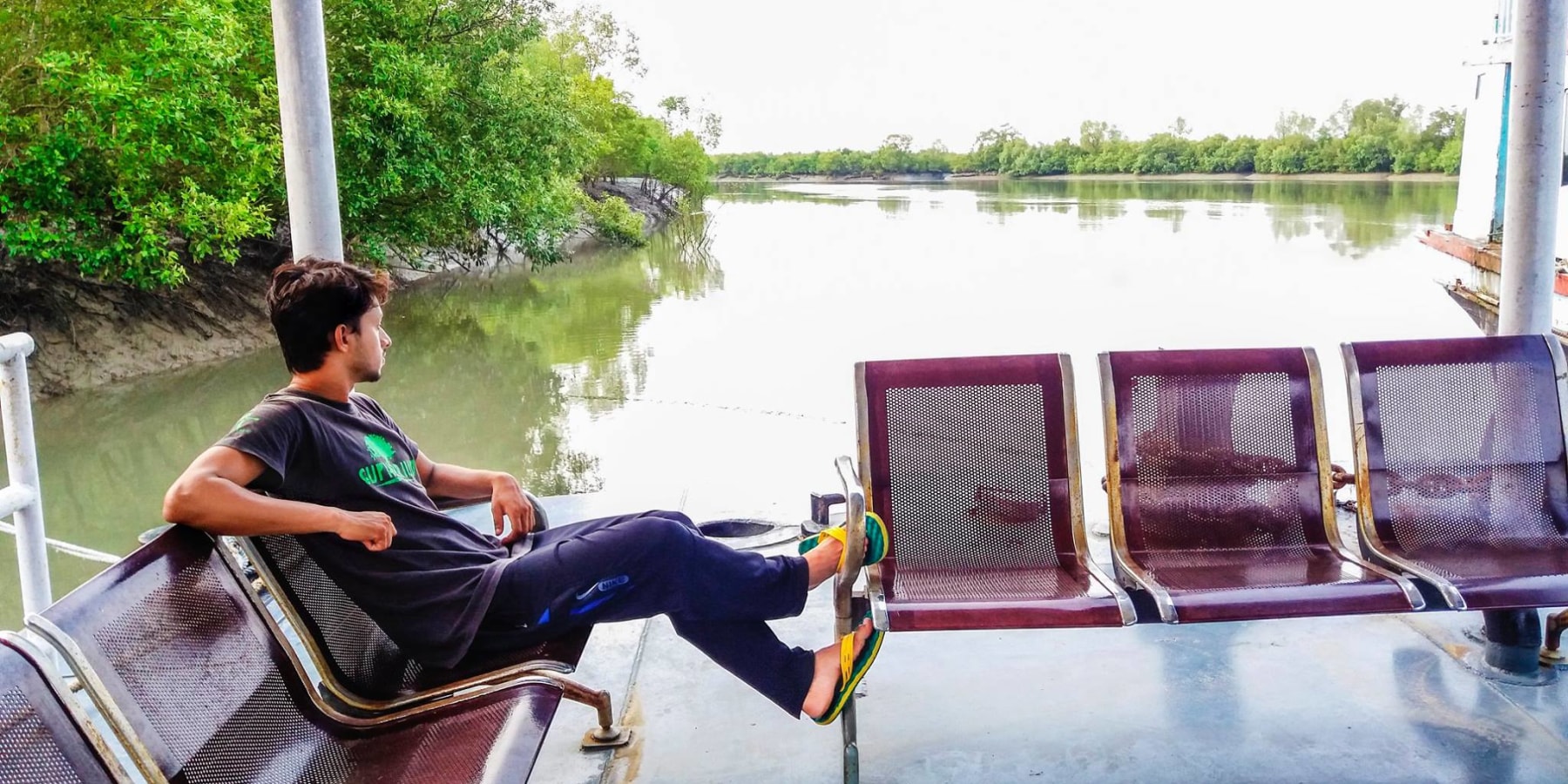

"The Sundarbans in Satkhira?!" I was genuinely surprised when Shahed came up with the proposal.
Our travel team, "TriBAD," founded by three friends—Shahed, Shafin, and myself—about two years ago, has always had a unique taste in travel. All eight of our previous expeditions were to relatively off-the-beaten-path destinations. We are naturally drawn to unconventional and lesser-known spots. As we were planning our 9th adventure, Shahed dropped this unexpected idea.
We first learned about "Akashleena Eco-Park"—a beautiful park nestled right along the edge of the Sundarbans—through Bangladesh's highly popular television magazine show, Ittadi. It hasn't become a mainstream tourist hotspot yet, which made it even more appealing to us.
Driven by curiosity, we finally packed our bags early one morning, caught a bus from Khulna, and set off towards Satkhira.
We had to change buses twice along the way. Around 4:30 or 5:00 PM, we finally got off in a village right at the edge of the forest in the Shyamnagar area. Seeing BGB (Border Guard Bangladesh), RAB, and police camps right near the bus stop brought a sense of security and relief. However, that relief turned into slight anxiety when we couldn't find a place within our budget at the nearby, decent-looking residential hotels.
Moving a bit further ahead, we stumbled upon the Borsha Resort. The four-story resort spans across a vast area, and to our delight, we secured a comfortable double-bedded room for just 1,000 BDT a night. With our accommodation sorted, we felt completely at ease. We dropped our bags, freshened up, and headed out to explore where exactly we had landed!
To be honest, we didn't know much about the local attractions beforehand. But since new places always fascinate us, we stepped out with immense curiosity. And right then, an absolute masterpiece of nature unfolded before our eyes—an undiscovered beauty! Right across a narrow river ran the edge of the world's largest mangrove forest, the Sundarbans.
This part was not a protected wildlife sanctuary. Locals informed us that tigers occasionally cross over from the forest to hunt livestock, and there have even been a few human casualties. We also learned that the heavy presence of security forces wasn't just to curb crime, smuggling, or illegal crossings—keeping the wild tigers at bay was one of their major duties.
I won't lie, a chill of fear ran down our spines. But driven by the pure thrill of adventure, we kept that fear buried deep inside and pushed forward.
By then, dusk was already setting in. Leaving the resort behind, we walked quite far down a rustic village road flanked by rows of trees on both sides. The river-breezes, carrying the rhythm of the waves, felt like a soft touch of silk against our skin. Since it was a completely new place right next to a wild forest, we decided not to stay out too late and headed back to our room for the night.
As the night deepened, a fierce rainstorm broke out, accompanied by howling winds. Inside the resort, we completely lost our inhibitions and started jumping around in pure excitement like little kids. That midnight madness in a remote, jungle-shrouded village is a memory that will stay with me forever.
The next morning, we woke up at the crack of dawn. Our mission? To witness the Sundarbans from the four-story rooftop of our resort. It was an exquisite, breathtaking view. It felt as if the entire world ahead of us was covered under a massive canopy of endless green.
After a quick breakfast, our exploration officially began. Our first stop was Akashleena Eco-Park—the very place that brought us here. The park is uniquely framed by a flowing river on one side and the main road on the other, featuring beautiful, colorful wooden walkways built for visitors. Deciding to return here later in the evening, we stepped out to see what else lay nearby.
Locals told us about a fascinating village not too far away where monkeys and humans peacefully coexist. We hopped onto a motorized local van (engine-van) to get there. Along the way, we passed by massive water enclosures used for commercial crab farming. To reach this monkey kingdom, we even had to cross a river so vast it looked like an open sea.
When we arrived, it was a surreal sight. I couldn't quite tell if it was a village inside a jungle or a jungle inside a village! The monkeys there are treated like friends, almost like the villagers' own children. We even fed some puffed rice (muri) to the baby monkeys.
By the time we returned from the monkey village, it was nearly late afternoon. Since our time was limited, we caught our return bus to Khulna that very evening. It made me realize that every now and then, we truly need to lose ourselves in the vast expanse of nature.
How to get there:
You can take a direct BRTC bus from Dhaka to Munshiganj, Shyamnagar. Alternatively, you can take any other highway bus to Satkhira district, and from there, catch local transport to Munshiganj. Direct BRTC buses are also available from Khulna.
Where to stay:
There are several eco-resorts available in the area. During my trip, I stayed at the Borsha Resort. It is exceptionally clean, beautiful, and can be booked online. You can easily find options and contact details by searching on Google. Pro-tip: Discussing the pricing beforehand might help you get a better rate!
Key Attractions:
Apart from the popular Akashleena Park, this location serves as the gateway to the remote Kolagachia Eco-Tourism Centre (Wildlife Sanctuary) and the pristine Mandarbaria Sea Beach.
My Recommendation:
Keep at least two days in hand to truly immerse yourself in this budget-friendly yet thrilling adventure.
A gentle reminder: Please keep nature clean during your travels!