
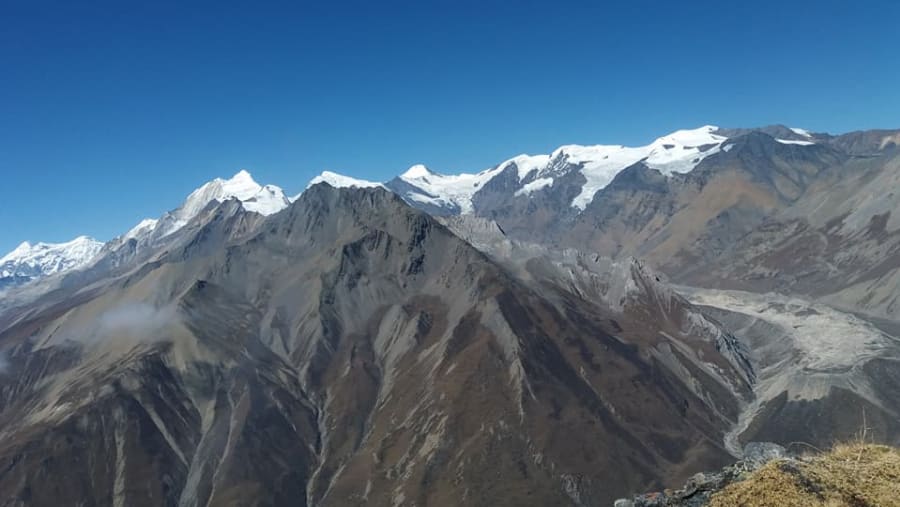
Day 01
Arrival in Kathmandu
Arrive at Kathmandu, connect with your tour guide and transfer to the hotel.


Explore the world with tourHQ
Nepal · Trekking
The journey
Embark on an expedition through the Manaslu region and mystical Tsum Valley, combining a rewarding trek with the exploration of a valley rich in ancient art, culture, and religion. This journey takes you through traditional villages, sacred monasteries, and dramatic Himalayan landscapes beneath the world's eighth-highest peak. Along the way, experience the charm of traditional Buddhist and Tibetan culture and lifestyle in one of Nepal's most revered pilgrimage areas.
Embark on an expedition through the Manaslu region and mystical Tsum Valley, combining a rewarding trek with the exploration of a valley rich in ancient art, culture, and religion.
From the itinerary
At a glance
Day by day
Arrive at Kathmandu, connect with your tour guide and transfer to the hotel.
Indulge in a heritage tour of Kathmandu, seeing places like Swayambhunath, Pashupatinath Temple, Boudhanath Stupa, Patan Durbar Square.
Overnight in Kathmandu Hotel.
Take a westward 70km scenic drive along the Prithvi Highway, through the forested Middle Hills, to Malekhu.
Then drive for 30km on a secondary tarred road that heads north over the Trisuli Nadi towards Dhading Besi and a rutted 35km dirt road northwest to Arughat on the Budhi Gandaki.
Cross the Ankhu Khola and arrive at Arughat
Make a further 3-hour drive up the river's west bank, leading to Soti Khola.
Overnight at lodge in Soti Khola.
Meal: Breakfast, Lunch & Dinner
Today hike up through beautiful Sal forests, then undulating over forested and terraced ridges passing numerous waterfalls.
Pass rice paddies before climbing to the attractive Gurung village of Labubesi (885m/2,800ft).
After crossing a suspension bridge at the spectacular Nauli Khola falls, walk as the valley opens out to reach the village of Machha (Fish) Khola.
Overnight at lodge in Machha Khola.
Meal: Breakfast, Lunch & Dinner
Follow the trail, with minor ups and downs, often dropping to the gravel bar before crossing the Thado Khola and to Khorlabesi, where coffee, buckwheat, and tobacco are grown.
Enter a lush narrow gorge that constricts the river’s progress, beyond which is a landslide with a dicey path, shortly before the triple hot spring spouts in Tatopani.
Climb a ridge before crossing the Budhi Gandaki on a suspension bridge (to avoid a vast cliff face and waterfalls)
Overnight at lodge in Dobhan.
Meal: Breakfast, Lunch & Dinner
Exit over the Dobhan Khola and continue up the east bank of the Budhi Gandaki to the hamlet of Thulo Dhunga, above cataracts.
Cross an old suspension bridge over the Yaru Khola (from Ganesh II and VI), then climb to Thado Bharyang.
Travel to the west bank of the Budhi Gandaki and follow the river gently upwards to the old village of Jagat: entrance and checkpoint to the restricted Manaslu Conservation Area.
Pass a tributary, walk on to Salleri via a cliff-side trail – with views of the Shringi Himal (7,187m/23,580ft) to the north.
Descend to Sirdibas; and the first signs of Buddhist culture.
Follow the suspension bridge as it leads to the east bank, and engage in a tiring climb up to Philim: a prosperous Gurung village and the Chholing Sandu Gompa surrounded by fields of maize and millet.
Overnight at lodge in Philim.
Meal: Breakfast, Lunch & Dinner
Traverse north of Philim, through lush grasses and scrub up the stunning narrowing valley to the village of Chisopani and then the millet fields of Ekle Bhatti.
Gradually descend, beneath a spectacular waterfall, into the gorge below and a junction before “New Bridge”, which leads to the Larkya La.
Walk down through the forest, crossing streams, before tackling a long and steep climb up the south side of the Siyar Khola gorge that drains the Tsum Valley. Flags mark the high point at a turn in the valley with views across the Shringi Himal above colourful grain, potato, and bean fields.
Cross the suspension bridge and finally ascend the gentler narrow trail to Chumling.
Overnight at lodge in Chumling.
Meal: Breakfast, Lunch & Dinner
Cross the suspension bridge into a new forest growing over a recent landslide.
Pass a small water-driven prayer wheel on a ‘Nepali flat’ path through a lush forest inhabited by white-faced langurs.
Continue to Tanju and the small Damphe Gompa.
Go beyond Rainjam farm as the trail drops to cross the Sarphu Khola that drains the Syakpa Glacier off Shringi Himal to the north.
Reach Chahe Kampar. Magnificent slate chortens facing Ganesh Himal herald the linked villages of Chhokang and Paro, collectively known as Chhekampar.
Overnight at lodge in Chhekampar.
Meal: Breakfast, Lunch & Dinner
From Chhekampar, walk past a local school at Kaye before reaching the clustered twin villages of Ngakyu and Leru. The Rachen Nunnery stands across the river. The trail then rises to a low ridge with chortens before Lama Gaon.
Visit the village of Burji and nearby Milarepa’s Cave (Piren Phu – Pigeon Cave) on the slopes of Langju Himal. There are two chapels and two caves.
Head a little east of the cave, as the retreat monastery Chi Phu clings to the slopes higher up the Langju Himal.
Cross to the southeast bank of the Siyar Khola and join the trail from Rachen Gompa to the Nile, shortly before Phurbe.
Before Ngakyu, another bridge crosses to the southeast bank of the river and heads northeast to Rachen, Nile, and Tibet.
Visit the Rachen Nunnery, established in 1905, enclosed within spacious walls that form the outer residential cells for the nuns. The original small monastery (and a large prayer wheel) is in the southwest of the complex and is decorated with murals depicting the history of Buddhism.
Head next to Phurbe and further up the trail, Pangdun: its gompa has a large prayer wheel. Beyond Pangdun, the valley gently curves towards the north. Next is an unusual round stupa before the impressive entrance gate to the large village of Chhule (Chhu Li, shady side). Thirty minutes above this village, to the south, is the 700-year-old two-storeyed Gonhgye Monastery, with superb views.
Beyond the village, take the bridges, cross a tributary (with an impressive waterfall ahead) and then the Siyar Khola back to the west bank.
Make a final short rise up to the Nile.
Overnight at lodge in the Nile.
Meal: Breakfast, Lunch & Dinner
Start a 2-hour walk up to the 77-year-old Mu Gompa.
Make another ¾ hr stiff hike up to the small 856-year-old Dephyu Doma Nunnery (place of the birth of light), which is superbly situated at 4,000m/13,100ft on a small promontory; with Ganesh II as its primary view.
Get astounded as the views of the western Ganesh Himal are visible to the left of an intervening peak. Mu only has the latter view (including Ganesh I) and a view back down the valley.
Return to the Nile for lunch, then trek back to Chhe Kampar.
Overnight at lodge in Chhekampar.
Meal: Breakfast, Lunch & Dinner
Retrace the trail to the small gompa at Gho, then drop south to a wooden bridge over the river and continue to Dumje, a Tibetan herbal medicine clinic and school.
Climb the trail as it then leads up steeply (~3½hr) through magnificent pine, oak and rhododendron forest to a mani wall, after which it traverses along an exposed route before zigzagging up through huge silver pines to the gompa perched on a ridge.
Marvel as you reach- mountain views in all directions are fantastic.
Overnight at gompa in Gumba Lungdang.
Meal: Breakfast, Lunch & Dinner
Descend on the trail back to Dumje, turn left to cross the Langtang Khola and take the south bank trail down the Siyar Khola and shortly the lower of two paths that cross deep, impressive gorges on new bridges to the climb to the high fertile land and ribbon village of Ripchet.
Beyond the village, steep stairs lead down to Gumlung on the river before the trail climbs back through the forest to Lokpa.
Overnight at lodge in Lokpa.
Meal: Breakfast, Lunch & Dinner
Follow the trail down to the junction with the Manaslu trail from Philim.
Cross the Budhi Gandaki (below its confluence with the Siyar Khola) and enter its narrow gorge on an up-and-down trail with river crossings. After a suspension bridge, the trail enters a bamboo forest and rises to the village of Deng.
Overnight at lodge in Bihi Phedi.
Meal: Breakfast, Lunch & Dinner
Overnight at lodge in Namrung.
Meal: Breakfast, Lunch & Dinner
The trail continues through a mix of forest and vast barley fields: guarded by bear watchers. In Lihi, many dwellings are grouped, each under a single shingled roof. There are impressive chortens, plus great views of Himal Chuli to the south, and only the Ganesh Himal is visible to the east.
Note as the trail drops and enters a side-valley to cross the Hinang Khola (where a path leads south to the Himal Chuli BC). Beyond the double-span bridge, it rises sharply to a detailed chorten from where impressive views of Ngadi Chuli rise above the side-valley walls. Beyond are the packed houses of Sho. Good views continue on the climb, past a large prayer wheel on the trail, up to Shrip.
Walk up to Lho, Manaslu, as Manaslu North and Naike Peak are revealed for the first time. A steep pull leads to the ridge and the large village of Lho.
Rise early for sunrise shots of Manaslu.
Overnight in the lodge at Lho.
Meal: Breakfast, Lunch & Dinner
The Budi Gandaki now flows far below in the valley north of the trail, which passes the long mani wall out of Lho before dropping steeply to cross the Damonan Khola tributary.
Follow the gentle stream upwards through a magnificent mixed forest.
Do a short climb to a plateau: and the badly deforested village of Shyala (3,520m/11,549ft). Huge mountains surround it: Himal Chuli (7,893m/25,897ft) and Peak 29 (Ngadi Chuli, 7,873m/25,831ft) to the south; Manaslu (8,156m/26,760ft) and large glaciers ahead; more snow-capped peaks to the west and north.
Follow ahead as the trail leads left to Pungyen Gompa.
Continue down the broad valley, past a school, to a large chorten, beyond which a yellow Kani leads to rows of houses with front courtyards that form the central part of Sama. The Kargyu Chholing Monastery stands above the far end of the village against a forested moraine. Only the upper sections of Manaslu and the Naike ridge are visible from the town.
Overnight at lodge in Sama.
Meal: Breakfast, Lunch & Dinner
Explore the village architecture and customs: only potatoes and barley flourish in the short summers at this altitude. Cloth weaving for chubas (from local goat and sheep wool or Tibetan imported wool) and the manufacture of hooked rugs are essential occupations for trade with Tibet.
Visit The Labrang (Lama's Place) Gompa in the lower village.
Make an easy and rewarding hike beyond the monastery to the Birendra Tal below the Manaslu Glacier. It can be viewed from a hilltop or a stony beach and offers striking views of the mountain.
Follow the trail towards Samdo to a bridge over the stream from the lake and then ascend the demanding trail that rises above the lake and the glacier's snout to the Base Camp.
Walk to the Pungyen Nunnery, which stands on a plateau above the Pungyen Glacier, offering unbeatable views of the Nadi ridges and Manaslu from near the gompa. It also adds an illuminating perspective of the mountain and its satellites to the other views seen along the circuit trail.
Hike a trail along the Numa Khola and Pungyen Glacier can be icy and slippery. Above the complex is a cave gompa with yet better views.
Return to the lodge in Sama for the night.
Meal: Breakfast, Lunch & Dinner
Descend towards the Budhi Gandaki, which has turned north, and pass the lake and Base Camp trail as well as several mani walls as the valley begins to widen. This is an easy trail above the river past juniper and birch forests surrounding Kermo Kharka.
Reach Samdo, the last village before Gho, in the Manang District.
Overnight at lodge in Samdo.
Meals: Breakfast, Lunch & Dinner
Descend past the northern village fields to cross the Budhi Gandaki for the last time at the remains of the Larkya Bazaar site. The river turns north up the Pana Danda Valley.
Follow the westward trail on grassy slopes with scrub juniper, rhododendron and lichen-covered granite above the Syacha Khola Valley. The source of the Syacha Glacier that descends from the Manaslu North ridge comes into sight.
Engage in short walks that lead to better views of the Larke and Naike peaks.
Overnight at Lodge in Dharamsala.
Meal: Breakfast, Lunch & Dinner
Engage in a short climb that leads to an ablation valley followed by a drop to pass the first of four small scattered frozen lakes.
Undertake a gradual ascent to the left, up the glacial moraine, and a final pull leads to the first set of summit flags.
Back to the east; look over the trail to Tibetan border ranges beyond Samdo Peak. The Larke Himal wall blocks more southerly views; the Pawar Himal views north.
Begin your descent from these flags, and the trail drops steeply off the moraine, then traverses loose scree slopes down a set of steep zigzags to the grassy Dangboche Kharka (4,450m/14,600ft) almost directly below.
Enjoy a bird’s eye view of the glacial action that feeds the upper Dudh (milk) Khola. From the Pawar Himal, the Salpudanda Glacier merges with the Ponkar Glacier below the medial Ponkar Lake (trapped between their moraines). It is then joined by the western Kechakyu Glacier to form the Bimthang Glacier that exists in the valley.
Hike down the trail and follow the curve of the lateral moraine of the Salpudanda/Bimthang glacier into the lovely Bimthang Valley. A T-junction indicates a path up over the moraine to Ponkar Lake or down to the scenic settlement of Bimthang (plain of sand). The Kechakyu Himal rises to the north, and Manaslu’s northeast face and connecting ranges stand high above the valley to the east.
Overnight at lodge in Bimthang.
Meal: Breakfast, Lunch & Dinner
Begin a further descent with a walk across the Bimthang Plain, a drop to cross the stony glacier, then up and over the far moraine to enter magnificent pristine rhododendron and pine forest. Views back towards the Larke, Manaslu, Nadi and Chuli Himals are excellent all along this route.
Walk along the trail that descends along the west bank of the Dudh (milk) Khola past Hompuk and attractive Sangura Kharka before descending steeply to the highest cultivated land at Karche.
Overnight at lodge in warmer Gho.
Meal: Breakfast, Lunch & Dinner
After breakfast, trek through farmlands to the old paved village of Tilje, then cross to the east bank of the river before descending rapidly towards the Marsyangdi Valley through a scrub forest.
Cross back to the west bank just before Thonje and cross the Marsyangdi Khola.
Enjoy a hot shower and wander around this Tibetan village.
Overnight at Lodge in Dharapani.
Meal: Breakfast, Lunch & Dinner
After breakfast, take a jeep ride along the dusty and bumpy road to Besi Sahar and the paved road back to Kathmandu.
Overnight in Kathmandu Hotel.
After breakfast, transfer to Tribhuvan International Airport for your return flight.
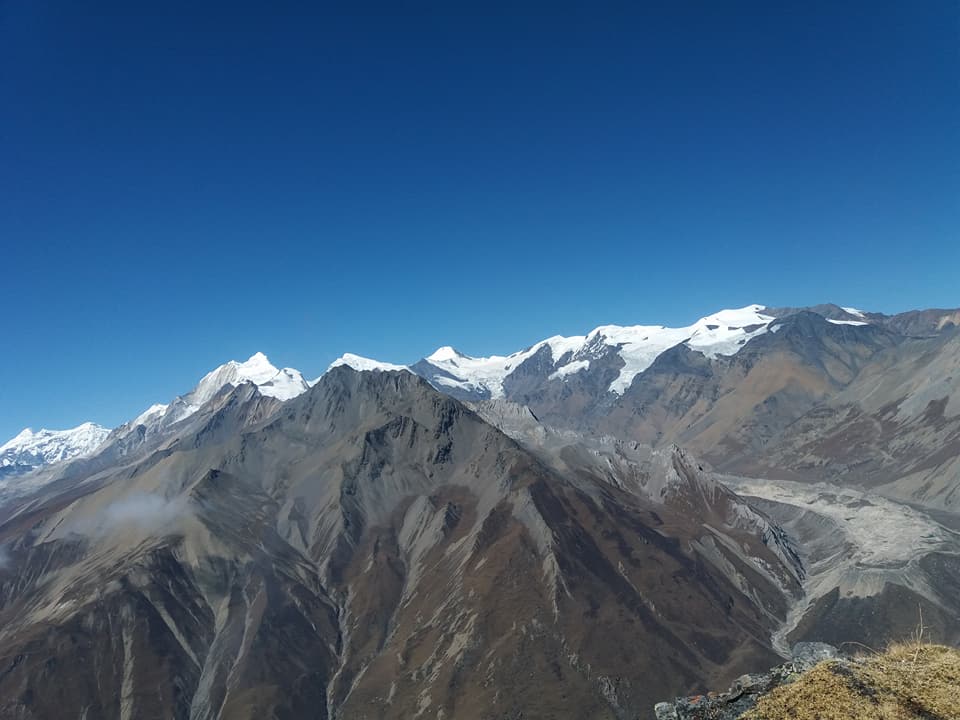
Where this trip takes you
Tsum Valley monasteries, Larkya La alpine pass, Birendra Tal below the Manaslu Glacier, Boudhanath Stupa
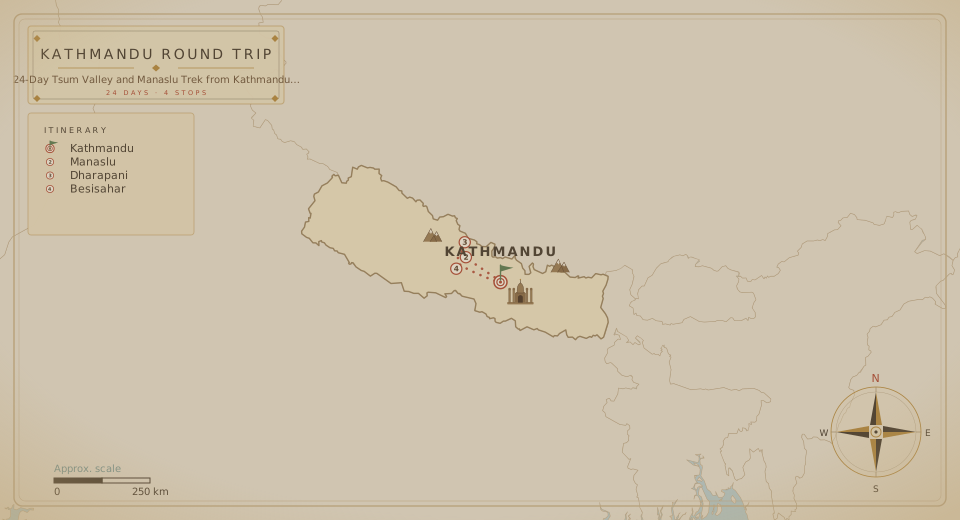
The route
The fine print
Lunch & dinner in Kathmandu
City entrance fees
Hot drinks and bottled drinks
Boiled water
Wi-Fi
Electronic device recharging in the mountains
Travel insurance & evacuation
Tips
Logistics
Your 24 days finish where they began, in Ring Rd.
 Watch the film
Create your own adventure
Say goodbye to travel stress.
Starting from
When
Travellers
Total
—